Article too long to read?
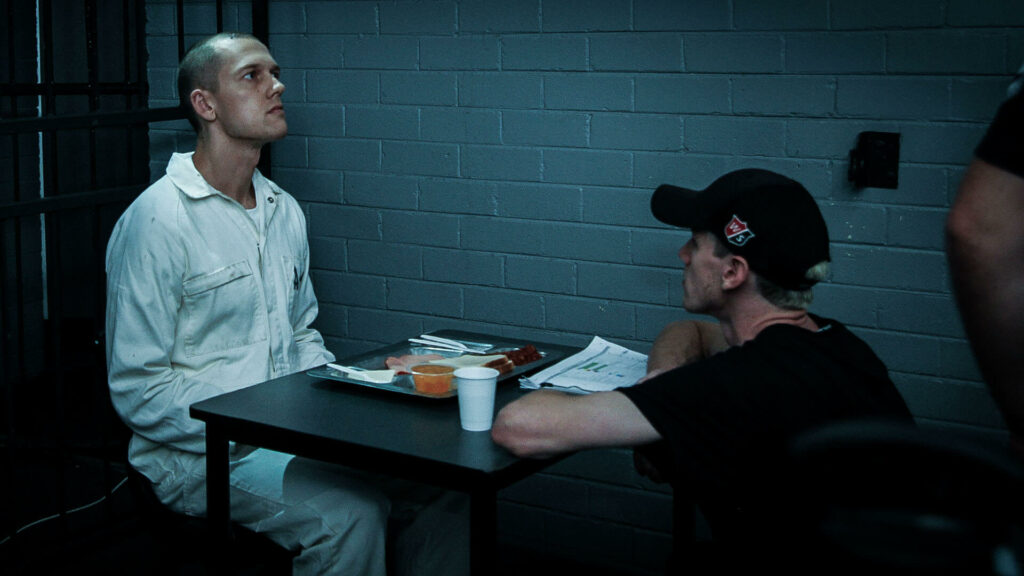
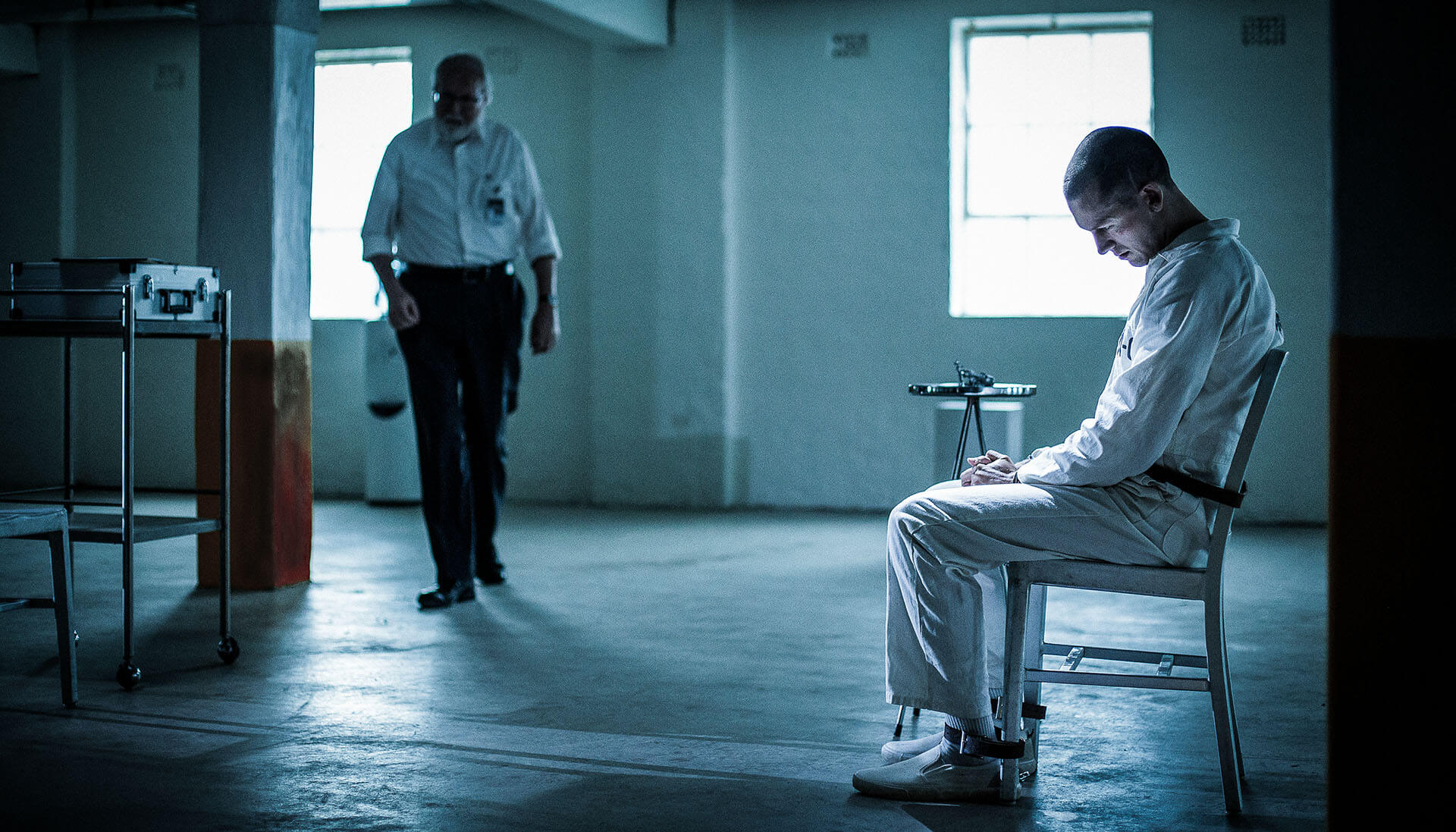
In an era where independent cinema often leans toward comforting narratives and easily digestible catharsis, Sydney-based director James Andrew Murray is determined to make us squirm. Fascinated by the darker, untamed instincts lurking just beneath the veneer of civilized society, Murray treats filmmaking not merely as entertainment, but as a medium for intellectual provocation. His latest project, Animus—a meticulously crafted 24-minute psychological thriller—is the culmination of a six-year, fiercely independent DIY journey. Blending live-action with hand-drawn animation, archival footage, and restrained AI imagery, the film traps audiences in a suffocating duel of ideas between a state-issued psychologist and an unrepentant cannibal. Indie Shorts Mag recently sat down with the fearless auteur to discuss the grueling realities of independent filmmaking, the unsettling historical irony of utilizing artificial intelligence to depict our primal selves, and why resisting “cultural sedation” is more vital now than ever.
Indie Shorts Mag: Coming from a background in music—a medium often driven by immediate spontaneity—how has the meticulous, multi-year process of piecing together a project like Animus shaped your creative voice and your relationship with the final product?
James Andrew Murray: Music was the first language I learned that bypassed speech entirely. It was also my first encounter with the discipline that artistic practice demands. I started playing saxophone at seven years old, and as I gradually discovered how little I knew, I realised that what people romanticise as “talent” is usually just thousands of hours spent alone in a room repeating scales until the instrument stops resisting you. There’s something almost monastic about it. I began to realise that art is less about self-expression than self-erasure. The ego has to die a little before anything truthful can emerge.
But music, especially live music, exists within impermanence. A jazz improvisation vanishes the moment it is played. Even a mistake evaporates into air. There’s mercy in that. Filmmaking offers no such mercy.
Cinema is closer to architecture or surgery. You are constructing something that will outlive your emotional relationship to it. Once a cut is locked, it becomes fossilised. You can’t reinterpret it the next night the way John Coltrane could reinterpret a melody. Your decisions become archaeological evidence of who you were at a particular moment in history. That terrified me initially.
Yet it also became the thing that fascinated me about filmmaking – its illusion of control. A director is often treated as a kind of Hobbesian sovereign—the central authority preventing chaos among competing wills. A band is democratic tribalism; a film set is organised theology. Yet paradoxically, the larger the apparatus becomes, the less control you actually possess. The weather changes. Money evaporates. People break down psychologically. Technology fails. Actors bring unconscious elements you never anticipated. Reality quietly rewrites the film beneath your feet.
The musician practises scales to earn the right to surrender control, while the filmmaker plans obsessively in the hope of retaining it. Both eventually learn that chaos always gets the final say.
Indie Shorts Mag: You’ve been vocal about cinema’s duty to provoke rather than merely reassure, a philosophy that echoes the work of filmmakers like Lars von Trier. Why do you believe creating this kind of “intellectual danger” is so necessary in today’s cultural landscape?
James Andrew Murray: I’m wary of artists who speak about provocation as though it is inherently virtuous. Most provocation today is synthetic; A Netflix approximation of danger. The algorithm has learned that outrage itself is profitable, so rebellion has become another form of branding. I think real intellectual danger is much quieter than that.
Von Trier understood that audiences often crave catharsis in the same way they crave anaesthesia. His films are not provocative because they contain suffering, but because they refuse to transform suffering into something neat, redemptive or morally reassuring. He drags viewers into emotional territory they would rather avoid and then denies them the comfort of a clear resolution. That is almost heretical in a contemporary media landscape increasingly designed around emotional management. People no longer consume stories to encounter the unknown parts of themselves; they consume them to reaffirm what they already believe and to regulate what they already feel. Von Trier’s cinema remains dangerous because it rejects that therapeutic contract altogether.
So when I talk about “intellectual danger,” I’m really talking about resisting cultural sedation. Increasingly we live in a therapeutic society where discomfort itself is treated as pathology. But without discomfort there is no transformation.
Derrida wrote about the instability of meaning — the idea that language continually undermines itself. I think culture is now experiencing something similar. Institutions no longer possess stable authority, narratives collapse in real time, and people retreat into ideological tribes because ambiguity has become psychologically intolerable.
Art should not solve that anxiety. It should illuminate it. Otherwise cinema becomes a warm fire in a cool room — comforting but entirely incapable of revealing the darkness beyond its glow.
Indie Shorts Mag: There is a fascinating visual irony in Animus: you explore raw, primal human savagery using highly calculated, emotionally detached AI-generated imagery alongside live-action and hand-drawn animation. What drew you to this specific hybrid approach to visualize the darkest corners of human instinct?
James Andrew Murray: People often speak about AI art as though the danger is that it will become too human. I find the opposite more disturbing: it reveals how machinic humans already are.
There’s something uncanny about AI-generated images because they resemble dreams dreamt by a consciousness with no body. No mortality. No evolutionary history. No childhood. They are statistically assembled hallucinations built from the monolith of collective human culture. In that sense AI imagery resembles what Deleuze might call a body without organs.
That fascinated me in relation to Animus because the film is fundamentally about evolution. The late inclusion of Generative AI felt less like a technological choice and more like an encounter with a peculiar historical irony. We are a species born from mud, blood and nature, yet endlessly compelled to construct machines that distance us from those origins. I was intrigued by the idea of using an artificial image-making tool to explore the oldest and most primitive aspects of human nature. In a sense, the contradiction is the point.
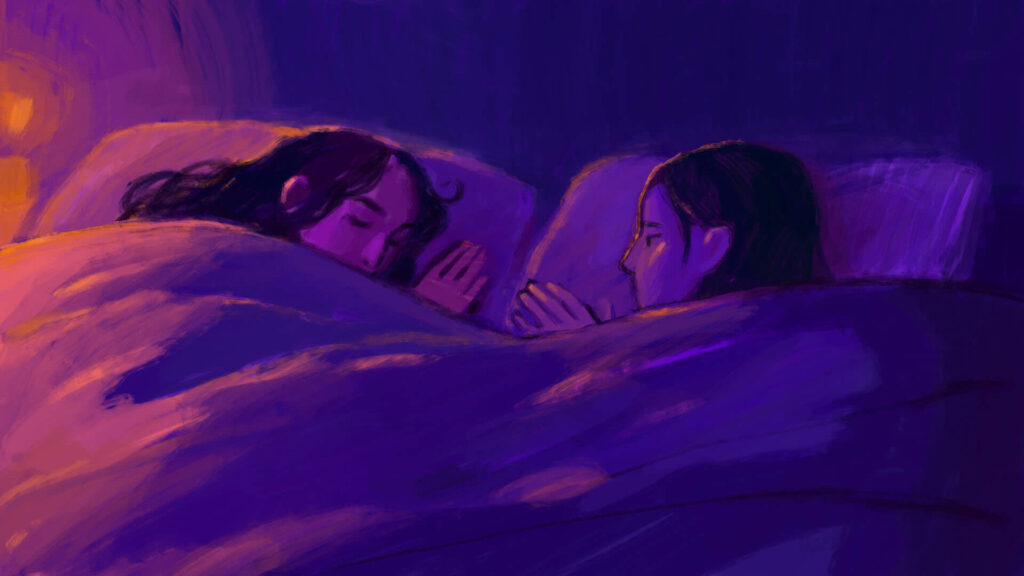
Human beings spent millennia separating themselves from animals in order to become “civilised,” only to eventually create technologies that mirror us back as emotionally vacant patterns. We escaped the jungle and accidentally built another one made of data. The hand-drawn animation meanwhile represented the opposite impulse — the trace of the human hand, imperfection, vulnerability, memory. So the film became a collision between three image forms, or perhaps more accurately: cave painting, cinema, and machine vision all fighting for dominance inside the same organism.
My only concern is that the AI imagery risks distracting from Zee’s extraordinary animation work. That audiences won’t know what is artificial and what is real, even if to me it is obvious. There is a profound difference between an image generated in seconds and one wrestled into existence over months of patient human effort. If the film has a soul, much of it resides in Zee’s sketches.
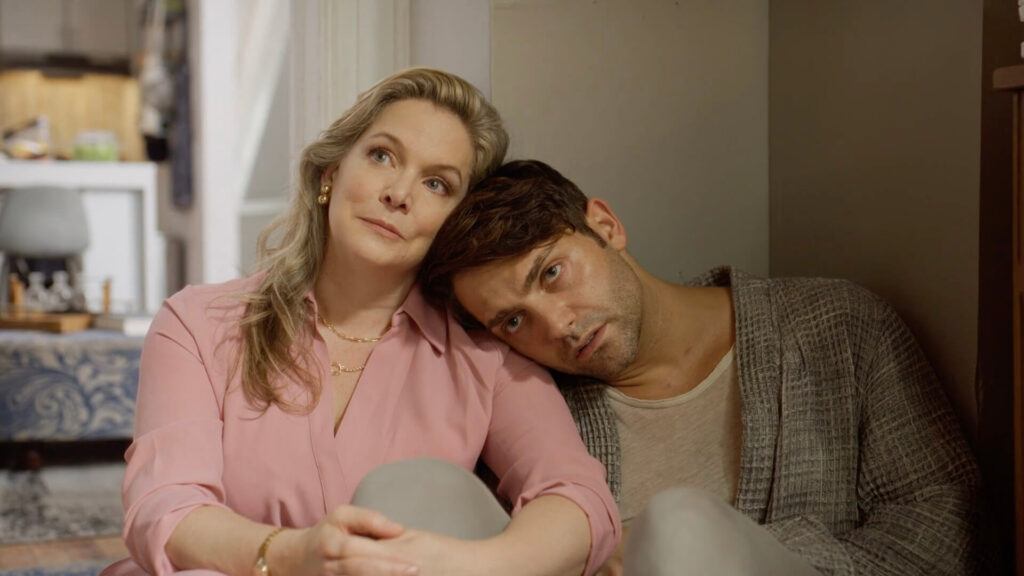
Indie Shorts Mag: The tension in the film stems almost entirely from the ideological collision between Subject A-652 and Psych 2B. How did you work with your actors to balance that sheer apathy with underlying vulnerability, ensuring the film remained a compelling “duel of ideas” rather than descending into a conventional thriller?
James Andrew Murray: I never viewed their relationship as protagonist versus antagonist. They are more representations of two conflicting philosophies pitted against one another.
Most thrillers are built around information: who did what, what happens next. Animus is built around ideological corrosion. The suspense comes from watching two worldviews slowly destabilise each other.
I was very conscious of avoiding conventional psychological realism. Real interrogation scenes are often banal, repetitive and procedural. What interested me instead was something closer to dialectics — almost like two competing evolutionary strategies trying to survive in conversation.
Our perpetrator embodies an uncomfortable kind of honesty. And his doctor embodies a social, institutional rationality. But over time those categories begin collapsing. The “civilised” figure reveals instinctive impulses; the “animalistic” figure reveals disturbing lucidity.
I have never been entirely convinced that civilisation is as distant from the jungle as we like to imagine. Subject A-652 believes morality is a story we tell ourselves after the fact—a thin layer of paint over older and more ancient instincts. Psych 2B believes we can rise above those instincts through reason and culture. But as their conversation unfolds, both men discover something unsettling: the animal possesses wisdom, and the civilised man possesses appetites.
Are compassion and justice evidence that we have conquered nature, or are they themselves products of nature? Perhaps morality is not our escape from the animal kingdom, but one of its most extraordinary creations. The film never attempts to answer these questions. It simply wanders into the night and listens for echoes.
My approach was to strip away as much psychology as possible and focus on ideology. I spoke to the actors less about feelings and more about what each character believed about human nature. I wanted them to understand what each man thought was true about the world and to defend that position sincerely. Once the actors understood those convictions, the performances became surprisingly fragile. A duel of ideas only remains compelling when both participants have something existentially at stake, and for me the vulnerability lies in watching those beliefs gradually begin to unravel.
Haneke often directs actors away from performance and toward behavioural precision. I’m very influenced by that. The more an actor “tries” to emote, the more the audience feels manipulated. Real menace is usually calm.
Indie Shorts Mag: Animus asks whether we can truly rise above our animal instincts or if we’re simply adept at disguising them. Given the film’s six-year development cycle, how did escalating global instability and environmental pressures influence the script’s evolution over time?
James Andrew Murray: When I began writing Animus, climate change seemed to be the great shadow looming over the horizon. There was a growing sense that humanity would soon be forced to reckon with the consequences of its separation from the natural world. But during the six years it took to complete the film, history accelerated in unexpected directions. The world was visited by a pandemic. People retreated into their homes and increasingly into themselves. Social media ceased being a tool and became an artificial environment that the world seemed to blindly accept as reality.
Wars returned to Europe and the Middle East. Artificial intelligence emerged from the realm of speculation and entered everyday life. Economic pressures mounted. Trust in institutions eroded. Everywhere there seemed to be a growing unease, a feeling that something fundamental had slipped loose beneath our feet.
Increasingly, people no longer seemed to inhabit the same reality. They occupied separate worlds, constructed from different facts, different narratives and different fears. The digital landscape became less a public square than a collection of competing mythologies.
Human beings remain creatures of instinct, tribalism and appetite, attempting to navigate a civilisation of extraordinary technological complexity. Our tools have evolved at a breathtaking pace; our psychology has not. We carry Stone Age anxieties into a world of algorithms and artificial minds.
Editing the film through those years was a strange experience because the world kept changing around it. When I first wrote Animus, many of the ideas felt philosophical, almost academic. But as the years passed, the story began to feel less like speculation and more like observation. The social fragmentation that seemed to permeate everyday life altered my relationship to the material.
Sitting alone in the edit suite, I often felt as though I was shaping the same film but within an entirely new ecosystem. Certain scenes acquired meanings I had never consciously intended. What had once been an intellectual exploration of human nature became something more visceral.
The darkness, brutality and alienation at the heart of the film no longer felt like abstract concepts but recognisable features of the world outside my window, and within me. In that sense, the film did not change, but I did.
Indie Shorts Mag: Building an ambitious, 24-minute hybrid film independently is a massive test of endurance. When you’re wearing almost every hat on set—from writing and directing to sound design and promotion—how do you maintain your objective vision, and in what ways does that extreme DIY approach forge a more singular artistic voice?
James Andrew Murray: Herzog once compared filmmaking to crossing a landscape on foot. You do not arrive because you are motivated. You arrive because you keep walking. In larger productions specialisation protects people from existential collapse. Everyone performs a compartmentalised role. But when you are writing, directing, editing, designing, producing and promoting simultaneously, the film invades your nervous system completely.
You stop having a healthy distinction between life and work. But there’s also a freedom in that. Industrial filmmaking often produces stylistic coherence at the expense of thematic coherence. A singular artistic voice usually emerges not from technical perfection, but from sustained psychological fixation.
There is a peculiar loneliness to independent directing because you are forced to inhabit the film long after everyone else has gone home. Years after production wraps, you are still having conversations with it. The work emerges from prolonged confrontation with an idea that refuses to leave you alone.
I think the danger of contemporary content culture is that artists increasingly optimise for productivity rather than necessity. People ask, “What can I make?” rather than “What am I unable not to make?” Those are very different questions.
The DIY process strips away illusion because eventually nobody is coming to save the project except you. That either destroys conviction or purifies it.
And strangely, limitations often generate stronger aesthetic identity than abundance does. Dogme 95 understood this. Constraint forces invention. Scarcity sharpens intuition. If Animus possesses any singularity, it probably emerged because the film had to continuously mutate in order to survive.
Indie Shorts Mag: Despite the grueling nature of independent filmmaking, you rely heavily on the belief and craft of your collaborators working without a financial safety net. How do you foster that unique, honest environment on set where everyone is driven purely by conviction in the material?
James Andrew Murray: Independent filmmaking at this level is less like conventional employment and more like a collective act of faith.
Of course people were paid for their time and expertise, but everyone understood that the rates available on a small independent film could never adequately compensate for the amount of labour, skill and emotional investment being asked of them. Rationally speaking, most independent films make very little sense. The financial odds are poor, the workload is disproportionate, and the commitment required often extends far beyond what appears on a call sheet or invoice.
So what sustains a project like this is not money alone, but belief. Not necessarily belief in success, but belief that the work itself is worth doing.
I think people can intuit very quickly whether a director genuinely means what they are saying or whether they are simply constructing a product. Crews will tolerate limitations and uncertainty for sincerity far longer than they will for commerce.
There’s also something uniquely intimate about low-budget filmmaking because hierarchy becomes more porous. Everyone feels the constraints together. You’re not insulated by vast resources or layers of bureaucracy. Problems are shared. Victories are shared. The film becomes something everyone is actively helping to build rather than simply servicing.
Ironically, that often produces a greater degree of honesty. On larger productions people can sometimes hide behind professionalism. On independent films emotional reality leaks through everywhere—fatigue, anxiety, insecurity, passion, excitement.
I tried to create an environment where people felt ownership over the work rather than servitude to it. Because cinema is ultimately a collective hallucination: a group of people agreeing that something imaginary matters enough to devote a portion of their lives to bringing it into existence.
When that belief becomes genuine, the atmosphere changes completely. It stops feeling purely transactional and begins to feel communal. Everyone is pulling in the same direction, not because they have to, but because they want to see the thing exist.
Indie Shorts Mag: You advocate for a certain fearlessness in filmmaking, noting that committing to a provocative idea sometimes means risking one’s reputation. Was there a specific moment during the creation or release of Animus where you had to actively choose conviction over comfort?
James Andrew Murray: There is a strange pressure today to appear emotionally well-adjusted. Everyone is encouraged to be balanced, stable and optimistic. There were long periods during post-production where I felt strangely alien to the prevailing mood of the time. There seemed to be a growing desire for comfort, stability and emotional reassurance. Everyone was talking about healing, boundaries and finding peace. Again, I understand that impulse. Life is difficult enough. But I have always been suspicious of comfort as a creative destination. In my experience, conflict aversion and a reluctance to communicate directly often results in a steady decay that can become rotten beyond remedy.
Some of the most important discoveries in my life have emerged from periods of uncertainty, embarrassment, failure and isolation. I think we sometimes confuse psychological comfort with truth. They are not the same thing, often they are opposites.
At the same time, life itself became more fragmented for me. Friendships shifted. Some ended. There were long stretches where I found myself wandering alone through Sydney at night, thinking far too much and sleeping far too little, placing myself in situations that were reckless in retrospect. I wasn’t looking for danger exactly. I was looking for something real.
Even working on the damn thing itself could be seen as antisocial, when friends and colleagues are turning their gaze in the direction of mortgages, weddings and children and you are rambling about evolutionary hierarchies. I don’t think people necessarily want the truth; they just want to be happy. There is nothing wrong with that. But art has a responsibility to venture beyond those narratives.
The film became the place where all that energy accumulated. Every frustration, disappointment and moment of loneliness found its way into the edit. The strange thing is that Animus began as an intellectual exercise. By the end, it felt somewhat autobiographical.
Indie Shorts Mag: Looking ahead, your next short, Carcharodon, explores an entirely different kind of tension—an orgy gone wrong. Does this project continue your exploration of human instinct breaking through civilized facades, or does it represent a departure into new thematic territory?
James Andrew Murray: Carcharodon is the completion of a triptych that began with my first film Nangana and continued through Animus. On the surface they appear to be very different films, but all three are ultimately studies of competing worldviews colliding under pressure. In that sense, Carcharodon is absolutely a continuation rather than a departure. There was actually going to be a chapter in Animus dealing directly with sexuality, but the film simply didn’t have room for it. The questions remained unresolved and eventually found their way into an entirely different project.
I’ve always been fascinated by sex because it refuses to remain within the boundaries we assign to it. We speak about it constantly, legislate around it endlessly, build identities around it, create and destroy relationships over it, and yet we still struggle to define exactly what it is. It can be playful, sacred and life-affirming, but it can also be dark, domineering and volatile. Desire is not always gentle. It intersects with power, possession, fantasy, violence and self-annihilation in ways that can be difficult to untangle, if you think about it too much.
Entire philosophies have been built around reason and self-control, yet sexual appetite frequently reminds us that there are older forces moving beneath the surface of consciousness. That ambiguity is what interests me. It is one of the few areas of human life where creation and destruction seem to coexist perfectly. There is something almost oceanic about it. We understand enough of it to navigate the surface, but beneath that lies a vast territory of instinct, fantasy, control, shame, intimacy and desire that remains largely unmapped. Carcharodon is the scientific genus of the Great White Shark.
Contemporarily sexuality has become detached from the social structures that once contained it. Whether one believes that is progress or decline is almost irrelevant, what interests me are the unintended consequences. Freedom always redistributes power, but power itself is psychologically destabilising. Some people discover they possess less of it than they imagined, others more than they know how to carry. The resulting confusion often expresses itself as performance, tribalism or withdrawal. We tend to politicise these behaviours immediately, when perhaps we should first ask what they reveal about being human. The savagery of the social games that return to sex time and time again seems a fitting close to this creative chapter. It is also a funner subject matter to deal with than my previous work. Carcharodon will surely be lighter, but still keep its bite.
Indie Shorts Mag: You’re also developing your first feature, The Tutor, which sounds much more autobiographical and personal. After spending six years in the dark, dystopian headspace of Animus, what has it been like shifting your focus inward to explore your own experiences in music and teaching?
James Andrew Murray: When I began Animus, I was obsessed with ideas. The film emerged from philosophy, argument and the desire to dissect certain questions about human nature. Over time, however, I became increasingly suspicious of my own certainty. The older I get, the less interested I become in answers and the more interested I become in mysteries.
That shift has profoundly affected my creative process.
With The Tutor, I find myself beginning not with theories but with images, moods, fragments of memory and strange observations that refuse to leave me alone. I no longer feel compelled to explain everything. There are truths that can only be approached indirectly. Dreams understand this. Music understands this. Sometimes a single image contains more meaning than pages of dialogue.
I’m allowing myself to get lost more often. Certain scenes emerge from dreams, memories, half-forgotten conversations or images that arrive without explanation. I’ve become increasingly interested in intuition as a creative tool. Some of the most important discoveries I’ve made as a filmmaker have occurred when I stopped trying to control the work and instead listened to where it wanted to go. The script feels less like a blueprint and more like an expedition into unfamiliar territory.
There is naturally a part of me that wants to make the film tomorrow. Every project reaches a point where it begins demanding to exist. But features have a different gravity to them. They require patience. The temptation is always to rush forward, but I’ve learned that some ideas reveal themselves slowly. The challenge is resisting the urge to force certainty upon something that is still becoming.
Before a film exists, all you really have is a conviction that something important is hiding just beyond your understanding. Most people cannot see it yet. They shouldn’t be expected to. The responsibility belongs to the filmmaker to keep moving toward it until the shape becomes visible. I have done that before, and I can sense where this one is leading. If I can remain faithful to that instinct, others will see it too.
The script is still evolving. It remains mysterious, even to me. But I trust that process completely. My responsibility is simply to keep walking.
If James Andrew Murray’s journey with Animus proves anything, it is that true artistic vision doesn’t require massive studio backing or conventional narrative structures—it demands unyielding conviction and a willingness to confront the unknown. By stripping away the safety nets of commercial filmmaking and embracing the isolating realities of DIY production, Murray has crafted a work that serves as both a mirror and a warning. His insights challenge the therapeutic nature of modern media, reminding us that the best cinema doesn’t hand us easy answers; rather, it forces us to look inward and grapple with the beasts we keep hidden in the dark. With his upcoming short Carcharodon set to close this intense thematic chapter, and his deeply personal feature The Tutor simmering on the horizon, Murray is undeniably solidifying his place as a vital, uncompromising voice in independent film. We eagerly await whatever uncomfortable truths he chooses to show us next.
No comments yet.
Got Something to add to this article?
Your email address will not be published. Required fields are marked *