Article too long to read?
For Spanish–British filmmaker David Cordon, directing is shaped by an unusually broad creative and professional journey. From chemistry and music documentaries to more than a decade working in visual effects at companies including DNEG, Framestore and Cinesite, Cordon has spent much of his career observing the relationship between complex systems and the people operating within them. That fascination finds an intimate expression in Afterburn, a psychologically driven science-fiction short in which grief, memory and technology converge. In conversation with Indie Shorts Mag, Cordon discusses the value of restraint, working with actors Ayamé Belkin and Charlotte Pyke, his collaboration with writer Tatty Hennessy, the film’s distinctive 4:3 visual language, and why Afterburn marks an important turning point in his evolution as a filmmaker.
Indie Shorts Mag: Your background is incredibly diverse, spanning chemistry, music, and high-end visual effects. How do you find these seemingly disparate disciplines intersecting and informing your approach to directing intimate, psychologically driven stories?
David Cordon: I don’t think they’re as disparate as they might seem from the outside.
I studied chemistry and then worked as a lab technician in Berlin, and the whole discipline is essentially about watching processes unfold and understanding that what you see on the surface is being driven by forces you can’t see. That’s not so different from directing actors. You’re watching behaviour and trying to understand what’s underneath it. The patience it requires, the attention to small changes, the willingness to let a reaction happen rather than force it. All of that carried over, even though I didn’t recognise it at the time.
Then I spent a couple of years directing over sixty music documentaries, and what that period really taught me was rhythm and instinct. When you’re filming musicians, especially live, you can’t overthink it. You have to feel where the moment is going and be there when it arrives. That’s become central to how I work with actors. I’m not interested in over-rehearsing or micromanaging performances. I want to create the conditions for something real to happen and be ready to catch it when it does.
And visual effects, in a way, taught me the value of what you choose not to show. I’ve spent over a decade in VFX at places like DNEG, Framestore and Cinesite, surrounded by the most extraordinary image-making tools in the world, and the single most important thing I took from that experience is restraint. The best visual effects work I’ve been part of was always in service of story, never in competition with it. That principle sits at the centre of everything I direct. Just because you can show something doesn’t mean you should. Sometimes what’s happening in someone’s face is more powerful than anything you could build around it.
Indie Shorts Mag: You’ve held senior production roles on massive, effects-heavy features like The Jungle Book and Avengers: Endgame. How does navigating the colossal machinery of blockbuster filmmaking influence your process when scaling down to the focused, character-driven world of short films like To Love and to Cherish or La Vida Es Un Tango?
David Cordon: The honest answer is that the two experiences are almost nothing alike in practice, but what the blockbuster world teaches you (and this took me years to understand) is mostly about what doesn’t matter. When you’re inside the machinery of a film like Endgame or Jungle Book, there are hundreds of people, enormous budgets, endless technical conversations, and an almost overwhelming amount of information coming at you from every direction. What you learn, if you’re paying attention, is how to cut through all of that and find the thing that actually matters in any given moment. The scale of the production doesn’t change what makes a shot work, it just surrounds it with more noise.
La Vida Es Un Tango was made in ten days in Cuba under Werner Herzog’s mentorship with almost nothing, just a camera and a ninety-year-old man who wanted to sing. To Love and to Cherish was a tiny crew in a flat in London with virtually no budget.
I think I had to experience the scale of blockbuster filmmaking to truly understand that what I care about most as a director happens in the smallest possible space between a camera and a human face.
Indie Shorts Mag: In Afterburn, you explore the collision of grief and technology. What drew you to this specific fault line, and how did you approach balancing the sterile, near-future sci-fi elements with Agnes’s deeply human emotional journey?
David Cordon: What drew me was something quite personal. Grief is one of those things. You can study near-death experiences, you can measure brain activity, you can build a clinical apparatus around dying, but none of that touches what it actually feels like to lose someone. That gap between what we can measure and what we can feel is where the whole film lives.
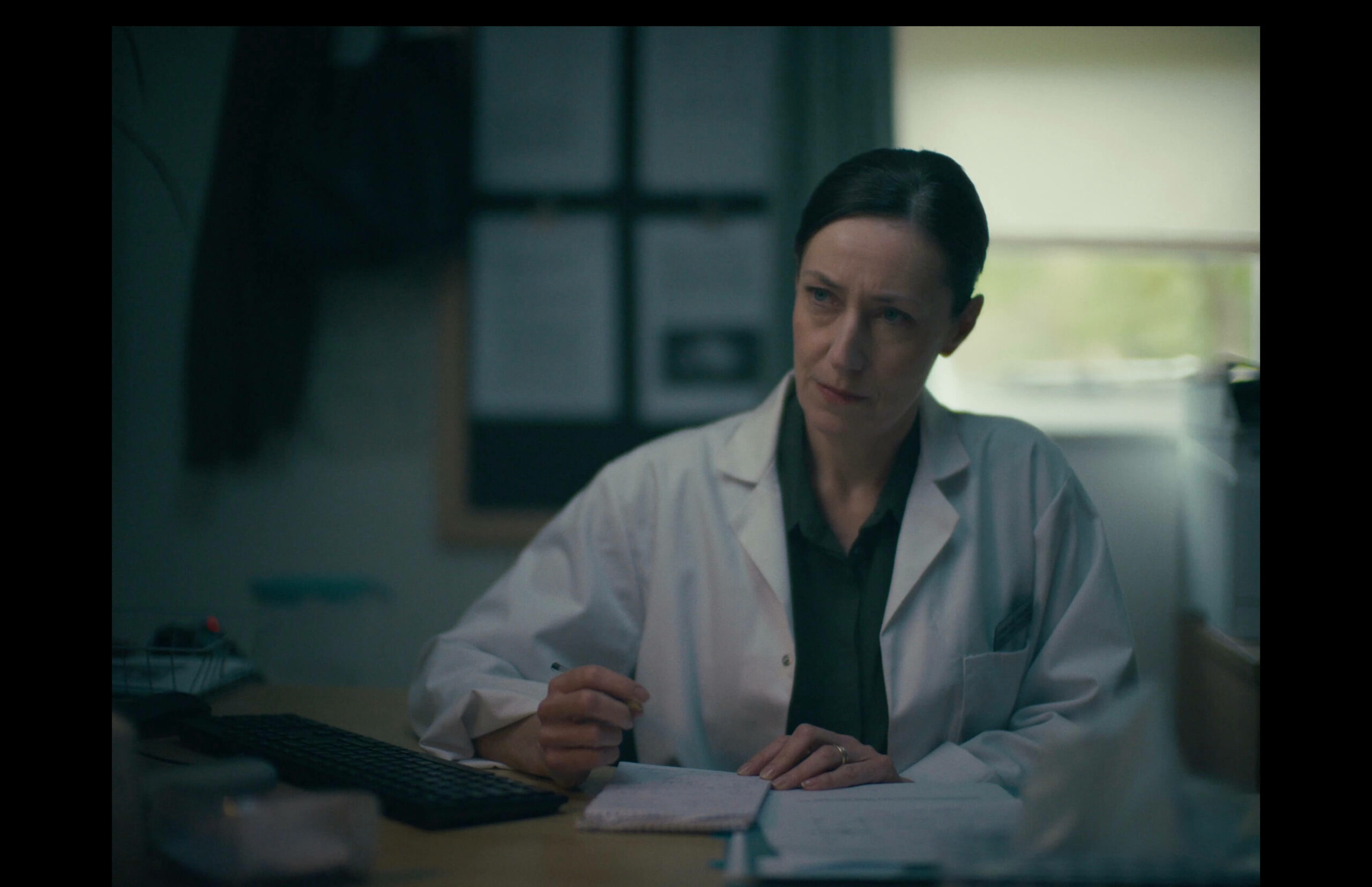
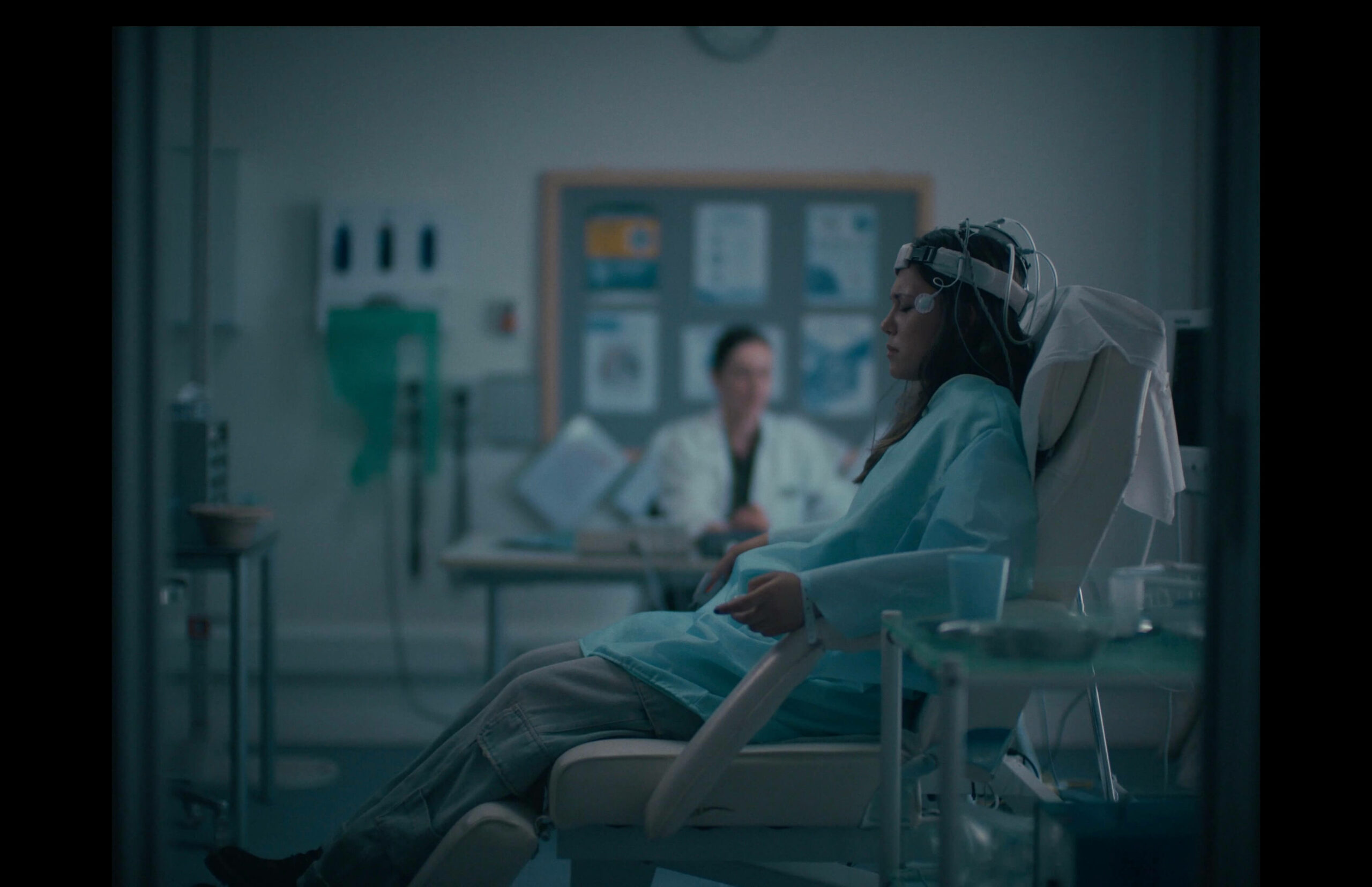
Freya is essentially someone who has built her entire identity around that gap. She’s a neuroscientist at a Centre for End of Life Studies, and her work allows her to intellectualise death without ever having to emotionally confront her own loss. And then Agnes walks in, (nineteen, sharp, completely uninterested in being managed) and the experiment stops being clinical. It becomes personal for both of them, whether they’re ready for it or not.
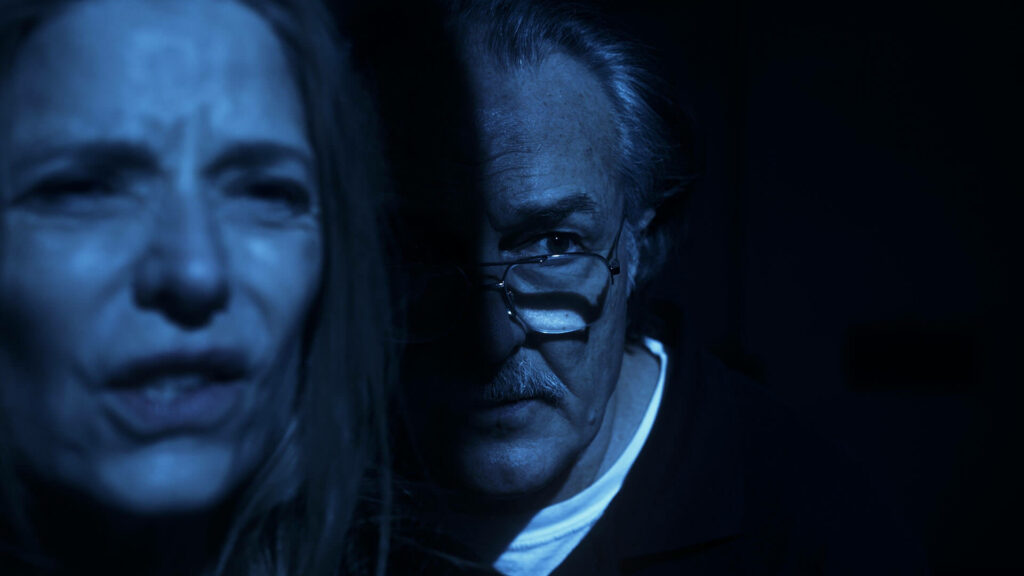
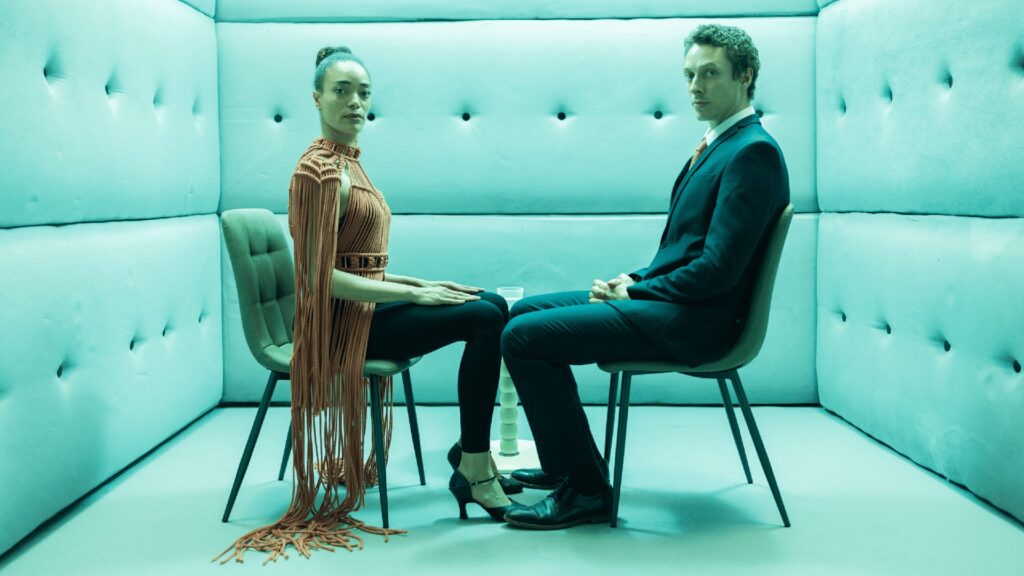
In terms of balancing the sterile and the human, for me it was never really a tension. It was the whole point. The colder and more controlled the environment, the more devastating it becomes when emotion breaks through. We shot in 4:3, which naturally compresses the space and puts the audience closer to the actors’ faces. The clinical setting (the equipment, the white coats, the procedure) is designed to feel contained and safe, almost institutional, so that when the boundary between the experiment and reality starts to dissolve, you feel that loss of control physically. The science fiction in Afterburn is deliberately quiet. It’s not there to impress anyone. It’s there to create the conditions under which two people who have been hiding from themselves can no longer do so.
Indie Shorts Mag: The Indie Shorts Mag review notes that Agnes’s vision allows the film to stretch into an “elegant, dream-like style” with its lighting and staging. How did you approach visually distinguishing the clinical reality of the present from these deeply emotional threshold states of memory?
David Cordon: This was something David Foulkes and I talked about a lot before we shot, and the key decision we made early on was that the distinction should never feel like a gear change. We didn’t want the audience to feel the film shift modes. To feel the edit, so to speak. The transition between clinical reality and Agnes’s threshold states needed to feel like slipping underwater, not like cutting to a different film.
In practical terms, the clinical world is precise, contained, controlled. Cool light, still frames, everything in its place. It’s designed to feel institutional and safe, which is exactly what Freya needs it to be. The threshold sequences are warmer, more textured, more uncertain. But the difference was always achieved optically (through light, through lens choices, through how close we were to the actors) rather than in post-production. David has this beautiful instinct for integrating texture into the image at the point of capture, and I think that’s what gives those sequences their quality. They don’t feel processed or artificial. They feel like a memory feels, familiar and strange at the same time.
The 4:3 frame helped enormously with this. It naturally compresses space, which means the clinical scenes feel tight and enclosed, almost claustrophobic. But when we moved into the threshold states, that same compression pushed the audience right up against Agnes’s experience. There was nowhere to look away. We didn’t open the frame up to signal a shift. We stayed close, which I think is why the dreaming and the waking feel continuous rather than separate. The audience isn’t watching Agnes’s visions from outside. They’re inside them with her.
The one rule we had was that nothing in the threshold sequences should be impossible, just displaced. Real light, real space, real faces, but not quite where they should be. That felt more honest to how memory and grief actually work. They don’t take you somewhere fantastical. They take you back to somewhere real and rearrange it just enough to break your heart.
Indie Shorts Mag: Both Afterburn and your podcast, Pixel Puzzle, suggest a deep fascination with the human element within complex systems or technologies. What is it about this friction—between the clinical or mechanical and the emotional—that you find so compelling as a storyteller?
David Cordon: I think it comes from having spent most of my professional life inside systems. VFX is a system. A lab is a system. A film set is a system. And what I’ve noticed, over and over, is that the people inside them are always doing two things at once. Performing the function they’ve been assigned, and being human underneath it. Those two things are constantly in tension, and most of the time the system wins. People adapt, they comply, they get efficient. But every now and then something breaks through (an emotion, a connection, a moment of honesty that the system wasn’t designed to accommodate) and that’s when things get interesting. In fact, this is very much what our next short: Ex Humo is about. The podcast came out of exactly that same observation. The VFX industry is full of extraordinarily talented, passionate people working inside a machine that often doesn’t recognise what makes them valuable beyond their output. When AI entered the conversation, that tension became impossible to ignore. Suddenly the most human aspects of creative work were the ones being called expendable. That felt worth talking about publicly. Afterburn is the same question in a completely different skin. Freya has built a scientific system around dying. She’s structured her entire life around the idea that if you study something rigorously enough, you can contain it. And then someone walks into her study who can’t be contained by the apparatus. Someone whose pain is too real, too alive, too messy to fit inside a clinical framework. The system cracks. That’s the moment I’m always looking for. I think the honest answer is that it’s autobiographical in a way I didn’t fully understand until recently.
Indie Shorts Mag: The emotional climax of Afterburn rests heavily on the performances of Ayamé Belkin and Charlotte Pyke. As a director, how do you cultivate an environment on set that allows actors to reach those raw, cathartic spaces, especially when dealing with themes of profound loss and reconciliation?
David Cordon: For me, authenticity is about creating the right environment and providing the trust and safety actors need to do what they do best. But that starts at casting. You can have the most supportive, generous atmosphere in the world, but if you haven’t found the right people, it won’t matter. Grief on screen becomes unwatchable very quickly if it’s being demonstrated rather than felt.
Ayamé had never placed herself in front of a camera like this before, which was actually an asset. Everything she gave was arriving from instincts, and you can feel that in the performance. Charlotte brought something very different. Precision, control, a deep understanding of how to hold things back. The combination was extraordinary, because Agnes and Freya need exactly that contrast. One is all surface emotion looking for structure. The other is all structure trying not to feel.
In terms of the set itself, I keep things very simple. Small crew, quiet space, no unnecessary energy in the room. We didn’t have a lot of prep time (one proper rehearsal, for budgetary reasons) but we made it count. It was less about blocking or running lines and more about having deep, open conversations about who these women are and what they’re each carrying. What they want from each other. What they’re afraid of. My job on the day is mostly about protecting the space and knowing when to stay out of the way.
The one thing I will say is that they both worked incredibly hard and supported each other throughout. There was a generosity between them that went beyond professionalism. The best example is a moment that didn’t even make the final cut, which was an improvised hug from Agnes to Freya during a goodbye scene. I’d asked Ayamé to go for it without telling Charlotte, and it triggered something completely real between them. That’s not something you can direct. You can only make it possible and hope it happens.
Indie Shorts Mag: You worked with writer Tatty Hennessy on Afterburn. Can you describe your collaborative process? How did you work together to ensure the sci-fi premise never overshadowed the intimacy of the character study?
David Cordon: Tatty and I are very aligned on this, which is probably why the balance works. From the very beginning, the near-death study was only ever a mechanism. It’s the door that lets these two women into the same room and gives them a reason to be emotionally exposed to each other.
Our process is quite organic. We talk a lot before anything gets written. Long conversations about the characters, about what they want, what they’re hiding, where the tension actually lives. Tatty comes from theatre, what that gives her is an extraordinary discipline around scene construction. In theatre, you can’t cut away. You can’t solve a problem with an insert or a montage. You have to hold the audience inside the scene with nothing but the actors and what’s happening between them. Every time you’re tempted to lean on the sci-fi concept to create tension, Tatty’s writing asks you a much harder question: what’s actually happening between these two people right now?
My job as director was to protect that. The clinical apparatus had to feel real and credible. Functional, present, never the subject. The subject is always Agnes and Freya. The moment you start explaining how the technology works or drawing attention to the procedure, you’re inviting the audience to think about plausibility instead of feeling what the characters feel. So we kept it lean. Just enough for the audience to understand the situation, and then the science steps back and the two women take over.
What makes the collaboration work, honestly, is that we trust each other’s instincts and everything is always about how to make it better, nothing else. When Tatty pushes a scene deeper into character, I know she’s right. When I pull something back visually to keep the focus intimate, she understands why. We’re still learning and growing together in this medium, but the foundation is solid because we care about the same things.
Indie Shorts Mag: Editing plays a crucial role in Afterburn, with our review praising how it weaves “together the past, the present, and the unreal onto a plane of longing.” How did you approach the edit to shape that rhythm and maintain the tension between the sci-fi premise and the intimate character drama?
David Cordon: When you’re shooting something this restrained (long takes, minimal dialogue, very little happening on the surface), and you combine that with a non-linear structure, it’s genuinely difficult for people to visualise the finished film while they’re making it. On set, it can feel like you’re not doing enough.
Bringing Oli Bauer on board just before shooting was one of the best decisions we made. Having an editor involved at that stage meant I had a second pair of eyes already thinking about how the pieces would fit together, and I had direct feedback on what was coming in. He could flag things I might need before I lost the location, and I could share my thinking about where the transitions would live. That dialogue between set and edit was invaluable, because by the time we got into the cutting room, Oli already understood the film’s logic from the inside. He wasn’t arriving cold to a pile of footage and trying to decode it.
The rhythm of the edit mirrors how grief actually works. It circles, it stalls, it pulls you back to a moment you thought you’d moved past. We deliberately avoided signalling the transitions between clinical reality and Agnes’s threshold states. No visual cues telling the audience “this is a dream now.”
I also have to give real credit to the sound team, because the film relies on sound as much as it relies on the edit, possibly more. So much of Afterburn’s atmosphere, its tension, the way it moves between states, that’s all carried by the sound design. They went above and beyond what we could have reasonably asked for. Without them, the edit wouldn’t land the way it does.
Indie Shorts Mag: Having worked in visual effects for over a decade, you have a very specific understanding of what is possible in post-production. Does this knowledge liberate you during the writing and directing process, or do you find you have to consciously pull back to focus on the story in front of the camera?
David Cordon: Very much so. It’s liberating, without question.
The most valuable skill a good VFX producer develops isn’t the financial acumen or the ability to lead a team to the finish line with their sanity intact. Those are things you learn along the way from earlier roles. The most valuable skill is the ability to give filmmakers advice and provide them with choices. To look at a problem and say, here are three ways we could approach this, each with different implications for schedule, budget and creative outcome. A lot of the time that’s done in partnership with a VFX supervisor, but on smaller shows or at smaller companies, producers wear many hats and need to be knowledgeable and confident enough to provide solutions and options themselves. I spent years doing exactly that.
Taking that experience into directing is incredibly liberating. When I’m writing, I already know what my decisions will cost downstream. I know which shots will need VFX support and which can be solved practically. I know where I can be ambitious and where I need to be disciplined. And when I’m on set, I’m not guessing about what post-production can rescue. It means I can commit fully to the performance and the story in front of the camera, because I’ve already accounted for the technical side before I arrived. It’s like having a divination spell scroll in your back pocket, particularly when you’re working under the kind of budget restrictions we deal with on short films.
Indie Shorts Mag: Looking back at your body of work, from your earlier shorts to Afterburn, how do you feel your artistic voice has evolved, and what thematic territories are you eager to explore in your future projects?
David Cordon: Afterburn is my debut short in any real sense. I’ve made shorts before, but I think of those as my film school. I’m very much a self-taught filmmaker. I never went through a formal programme. Instead, I experimented in as many roles as I could (directing, producing, editing, shooting), and treated each one as another step in the ladder.
Although I know I’ll keep growing as my career evolves, I do feel I now have the right foundations, a distinctive voice, and the right people around me to be able to tackle more ambitious projects with confidence. There’s a difference between wanting to make films and being ready to make them, and I think Afterburn is where that line was crossed.
In terms of what’s next, human behaviour is what fascinates me most in life. Why we do what we do. The eternal questions: who we really are, where we’re going, and why we’re here. I want to keep exploring the virtues and vicissitudes of being human, but from different perspectives and across different genres.
What emerges from Cordon’s journey is a filmmaking philosophy built less around scale than observation: knowing when technology serves the story, when a director should intervene, and when the most powerful choice is simply to leave space for something human to happen. Afterburn may operate within the language of science fiction, but its concerns are distinctly personal—grief, memory, emotional avoidance and the fragile moments when carefully constructed systems cease to protect us. For Cordon, the film also represents a creative threshold of his own: “There’s a difference between wanting to make films and being ready to make them, and I think Afterburn is where that line was crossed.” With another short, Ex Humo, already emerging from his continuing fascination with people inside systems, Cordon’s next chapter looks set to take that curiosity across new genres while keeping human behaviour firmly at the centre.
No comments yet.
Got Something to add to this article?
Your email address will not be published. Required fields are marked *