Article too long to read?
For director Mark Móhn, filmmaking has been as much a process of self-discovery as it has been an act of storytelling. Drawn to movies from an early age—particularly comedy, horror, thrillers, and other genre-driven work—Móhn gradually moved from wanting to perform in front of the camera to developing his voice behind it. From the resource-conscious visual storytelling of A Good Man? and Good Mourning to the difficult lessons of Heart of the Cards and his return with the thriller-comedy Keep Out, each project has helped clarify both his strengths and the kind of filmmaker he wants to become. His latest reflections reveal a director increasingly comfortable embracing open-ended character studies, tonal experimentation, and the limitations of independent production while holding onto a larger ambition: helping short films earn the attention he believes the form deserves.
Indie Shorts Mag: Movies were an escape for you growing up, particularly thrillers, horror films, and comedies. What did those genres offer you emotionally, and how have their influences found their way into your filmmaking?
Mark Móhn: I personally love all types of film genres, especially horror and comedy but also sci-fi, action and I’m especially a massive superhero nerd. However, Comedy movies were particularly what got me into filmmaking originally as humor was something that really helped distract me from how stressful life was for me growing up. I originally wanted to be an actor and make people laugh for these reasons as well, and then I started to write my own stories and would envision how these stories would translate to the screen. This is what pushed me into learning about behind the scenes work and made me gravitate more towards being behind the camera instead of being in front of it. I attended my first film class in high school and I in believe my junior year there was a horror film festival going on at one of the other high schools in my area that was open to any high school student that wanted to enter. This is when I filmed my first official short film “The Dreamer” when I was 16. As campy and cheesy as the short film turned out to be, it’s where my appreciation for filming horror truly began. I started to grow more interested in film directors more than actors and started to study a directors film styles and techniques. From there, I started to take elements from the filmmakers I admired the most and incorporate them into whatever I worked on, and while comedy was something I always had a soft spot for, it was more so the the filmmakers with more of a thriller element to them that I feel influenced me the most.
Indie Shorts Mag: Working as a production assistant on Billboard in 2016 appears to have been an important step in your development. What did that production teach you about filmmaking that you had not learned during your five years in film school?
Mark Móhn: Being a production assistant for that movie is where I truly learned the ups and downs of filmmaking as it was my first time working on a genuine film set. Sure I’ve worked in studios before that in both high school and college, but those studios were more so designed for television and broadcasting purposes, whereas the Billboard movie was more my cup of tea. While taking film classes, I never really worked on a project that was as big as a film. Working with the films Director, Zeke Zelker, I got to see how much blood sweat and tears was put into a genuine film set. I also got to meet some great people on that set who had their own experience and knowledge to share with me, most notably Nicholas Paul Pontoski. Before meeting on the set of Billboard, he had made an indie film called Within The Woods of Undead County, a film production that was definitely more up my alley, though no disrespect to Billboard movie as I am very glad to have worked on the movie. To sum it up; there were good days, stressful days, and days I genuinely don’t even have the words to describe. That’s what it’s like on a film set though, if you’re having an easy time, you’re not trying hard enough.
Indie Shorts Mag: You created A Good Man? despite having limited resources and went on to establish yourself within the short-film community. How did working within those constraints help shape your resourcefulness and creative voice as a director?
Mark Móhn: A Good Man? was the very first short film I made after working on the Billboard movie, and something that I’ve always kind of known when I was in film school but became very crystal clear on Billboards set was to not overestimate yourself. Don’t shoot for the moon if all you got is a trampoline. I knew that I couldn’t make the next Avengers movie without millions of dollars at my disposal, so I started brainstorming ideas that weren’t too out of my league. Audio was also something tht I knew wasn’t my strong suit in media production so I stuck to what my strengths were. All of this together is what led to using no dialogue to tell a very straight forward story and message, and I believe that that is what led to A Good Man? standing out as much as it did.
Indie Shorts Mag: Films such as A Good Man?, Sleep!, and Good Mourning placed a strong emphasis on visual storytelling. What do you believe an image, performance, or edit can communicate more effectively than dialogue?
Mark Móhn: To put it simply, a picture is worth a thousand words, thus actions speak way louder than words. People can say whatever they want to you, but a lot of times their actions can contradict those words completely. One of the main reasons I don’t really watch the news as much as I probably should is because i’ve learned that the media only really tells you what they want to tell you because most of the time they have an agenda, and sometimes that agenda doesn’t always lineup with the truth, and I believe that film can express this exact issue. With A Good Man? I specifically wanted to send a message that on the surface, things are not always as they seem. It’s sequel Good Mourning carries this message as well, as it’s a lot harder for your eyes to lie to you.
Indie Shorts Mag: Heart of the Cards was a deliberate attempt to move beyond your comfort zone and focus more heavily on narrative storytelling. Looking back at the criticism and frustration surrounding the film, what did the experience teach you about experimentation and accepting imperfect work?
Mark Móhn: Heart of the Cards wasn’t just me stepping out of my comfort zone, it was also the first short film of mine in which I shared executive creative control over. The other two creative leads were Ryan Shannon and Deion Bonilla. Looking back at how this short film was made and how it turned out, I think the biggest thing I learned was how much of a problem it is having “too many cooks in the kitchen.” Not only that, but it’s also very clear looking back that all three of us had completely different interpretations of what Heart of the Cards was supposed to be, and thus led to the short film becoming the mess of a production that it was. For me personally, there were also a lot of elements where it felt like I was overestimating myself and what I personally was capable of, especially given the subject matter of this particular short. At the time, I was very bitter and jaded over the situation and have since become a little embarrassed over how resentful I was towards at all. Nowadays, I’ve grown more appreciation towards the short film and it more as a meme, my “ bad anime adaptation” so to speak. I think what helped me get to that point was accepting where I was in the wrong and not letting this one stinker define me as a filmmaker, as I’ve shown both before, and after making Heart of the Cards that I’m better than that.
Indie Shorts Mag: You have described Heart of the Cards affectionately as your “bad anime adaptation.” How important has it been to develop a sense of humour and perspective about your earlier work rather than allowing its reception to define you?
Mark Móhn: It’s very important to learn from your mistakes and do your best to improve on them in order to not let them define you. If I would’ve let the disappointment of Heart of the Cards define me as a filmmakerthen I probably wouldn’t have went on to creat my latest short film Keep Out, which I personally think is my best work to date. That being said, your past is essentially what shapes you into who you are today, and those who ignore history are doomed to repeat it, which is why it’s important to learn from mistakes and grow as a result, instead of allowing them to consume you. I’ll admit that I’ve always struggled with letting go of the past and trying to see positives in bad situations, but I like to think that I’ve been improving a lot lately, and my perspective on Heart of the Cards I think is a very good example of that. I just really hope Ryan and Deion feel the same way about it as I genuinely can’t recall the last time I ever spoke to them about Heart of the Cards.
Indie Shorts Mag: After TRIP, you stepped away from filmmaking to focus on personal matters before returning with Keep Out. Did that break change your relationship with filmmaking or clarify what kind of stories you wanted to tell?
Mark Móhn: Definitely. A little before TRIP was released my son Sammy was born, hence stepping away to focus on him. However, having him didn’t just change my perspective on filmmaking, but media in general. Growing up, I used to be very desensitized to the movies I watched and music I listened to. Having him made me grow quite sensitive to things i watch and listen to, and even to an extent the work I put out there. It also gave me the opportunity to look back at my filmography and really analyze how I want to be viewed as a filmmaker to the public. I was practically humbled with the release of Heart of the Cards being followed by my son being born, and I honestly couldn’t be more thankful for the “wake up call” for the lack of a better term.
Indie Shorts Mag: Keep Out combines thriller conventions with comedy while deliberately moving beyond strict realism. How did you control that tonal balance so the humour intensified the film’s unease rather than diminishing its suspense?
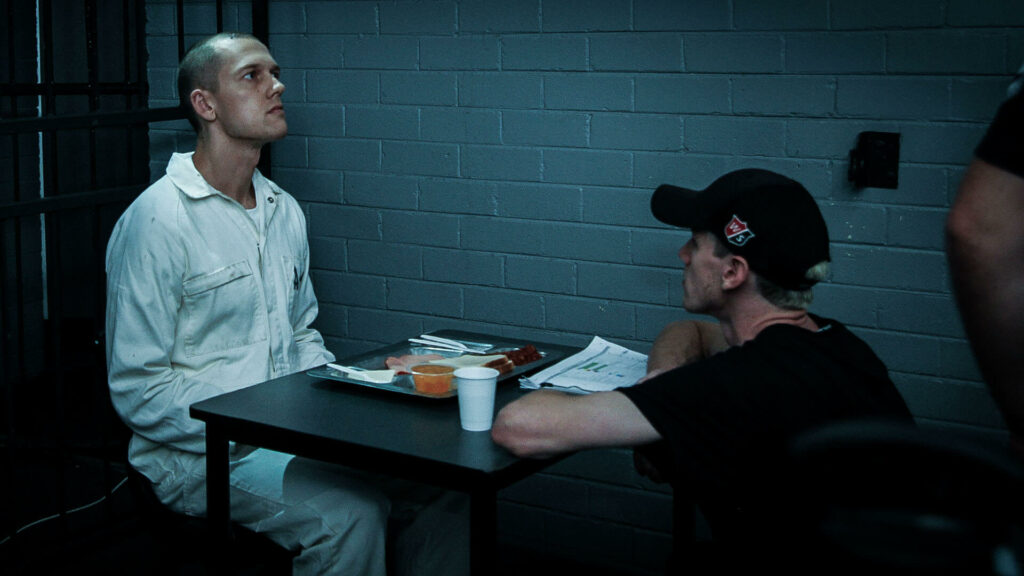
Mark Móhn: I wanted to make the conversation between the two characters as awkward and uncomfortable as possible. Actors Marcas and Sophia never actually interacted with each other on set, as their scenes were both shot on different days due to scheduling issues. They’ve only ever met once when I got them together to talk about working on the short film before filming even began. The lack of their interaction I believe helped a lot with removing any chemistry they could’ve had, adding to the unease. The humor, on the other hand, I feel was more enhanced by how subtle it was. With Keep Out, I learned that the more you try to force humor, the more artificial and unfunny it becomes. Therefore, I was trying to be as subtle and sparing as possible when it came to funny moments so that it wouldn’t diminish everything else going on.
Indie Shorts Mag: As someone who frequently works across directing, writing, cinematography, editing, producing, music, and other creative roles, how does being involved in so many parts of production influence the consistency of your films—and when does that level of control become challenging?
Mark Móhn: I actually really enjoy having my hand in so many elements of production because it means I’ll be able to have more control over how the project will turn out. It only really becomes more challenging when I have a lot more people involved and how big/long the project will be. Heart of the Cards is a good example of this due to it being as big of a project as it was compared to my other short films and having so many other creatives in charge of it, whereas A Good Man? And Good Mourning were much less stressful due to being the only creative head in charge of the projects and having as minimal people involved.
Indie Shorts Mag: Looking across the progression from A Good Man? to Keep Out, what qualities do you now recognise as distinctly yours, and what would you like audiences and the wider short-film community to understand about Mark Móhn as a filmmaker?
Mark Móhn: It’s actually quite hard to determine what qualities are distinctly mine and no one else’s since I feel like a lot of my film qualities were heavily inspired from a lot of the filmmakers grew up watching, such as M Night Shyamalan’s twist endings and Tim Burtons gothic visual storytelling being a big influence on some of my more praised work. An element I do believe is consistent in all of my work, even most of the shorts I worked on before A Good Man?, is that I focus heavily on character studies that are left quite open ended by the end. We don’t know if the central characters to A Good Man?, Good Mourning or Keep Out ever face any kind of consequences to their actions. We don’t know what happens to the girls in TRIP or The Dreamer after experiencing what they did. Even in Heart of the Cards we have no idea what the main character went on to do after the events of the short. At the same time, however, we don’t really need to know. Unlike a full length feature, short films have the power to do just as much if not more with a much shorter timeframe. I feel like short films are very under appreciated in the mainstream, and I would like to help change that. I’d like to be known as someone who helped put short films into the spotlight that they truly deserve.
Móhn’s journey demonstrates how an independent filmmaker’s identity can emerge not only through successes, but through limitations, experiments, disappointments, breaks, and the willingness to reassess earlier work. The progression from A Good Man? to Keep Out points toward a filmmaker particularly interested in character, atmosphere, visual communication, genre tension, and stories that resist explaining everything after the final frame. Just as importantly, Móhn has learned to treat creative setbacks as part of the larger filmography rather than as definitions of it. With Keep Out marking a new stage in that progression, his ambitions now extend beyond establishing his own name: he wants to champion the possibilities of short-form filmmaking itself and help bring the medium further into the spotlight.
No comments yet.
Got Something to add to this article?
Your email address will not be published. Required fields are marked *