Article too long to read?
In a world saturated with didactic storytelling, the work of British-Norwegian filmmaker C. S. Nicholson emerges as a breath of fresh air. Armed with a background in philosophy and social anthropology, Nicholson wields the camera not as a tool for ethnographic documentation but as a means of questioning, exploring, and deconstructing the very narratives we tell ourselves. His award-winning short, ‘The Discoverer of the Discoverers,’ serves as a powerful testament to this approach, delving into the complexities of colonial history with a poetic sensibility that has captivated audiences worldwide. In this interview with Indie Shorts Mag, Nicholson discusses his creative process, his upcoming projects, and his unwavering commitment to a cinema that embraces ambiguity and intuition over rigid intellectualism.
Indie Shorts Mag: Your academic background is quite unique for a filmmaker, with degrees in both Philosophy/Social Anthropology and Film & TV Production. How does your education in the humanities influence your documentary filmmaking, both in your choice of subjects and your storytelling approach?
C. S. Nicholson: Both ‘The Discoverer of the Discoverers’ and my upcoming feature doc were shot in a former French colony, and I’ve filmed in Brazil as well. In that sense there has been an unfortunate air of ‘ethnography’ about my work. But I’m not sure whether anthropology has informed my films, or whether I chose to study anthropology and shoot films in far away places just because I love to travel. Being half Norwegian/half English, I’ve never felt at home in either country. When I travel far away, it allows me to be a stranger because I actually am out of place, not because I don’t fit in where I should be at home.
Anyway, I don’t apply sociological method in my filmmaking. I stopped studying anthropology because I was unconvinced of its central premise, which is to scientifically map out mankind. To distil our essence. Seems to me that anthropology says more about the anthropologist than the anthropologised.
Perhaps that’s where the philosophy comes in. I’m a skeptic, also when it comes to the humanities or academia. And so I try to make films that aren’t fixed to any specific theory, school or method. The aim is for the films to be open and inquisitive. I’m not interested in presenting a hypothesis. I’m sure some of my studies inform my work on a subconscious level, but it’s against my better judgment. Life can’t be reduced to rational thought.
Indie Shorts Mag: Your award-winning short, ‘The Discoverer of the Discoverers,’ has an evocative title. Could you delve into the central themes of the film and share what inspired you to explore this particular subject?
C. S. Nicholson: Thanks. On the surface, the film is about the first encounter between Europeans and Africans—although the meeting described in the film can’t actually have been the very first one. But as the title suggests, one crucial theme is how we centre our stories around ourselves. To Europeans, we ‘discovered’ the world during an ‘Age of Exploration’. To the clan in the film, West Africans ‘discovered’ Europeans. Of course, nobody discovered anything. We met.
I also position myself in the film. And so I commit the same fallacy: We see the world through our respective standpoints, while forgetting that that’s what we’re doing. We give primacy to what we ourselves find interesting, which is what both the characters and the filmmaker do in ‘The Discoverer of the Discoverers’.
As to what inspired me, I really couldn’t say. I was researching my work in progress, a feature doc called A Stranger Has No Eyes, when I came across a footnote about the family you see in the short. I felt compelled to know more. Sometimes you become obsessed. I’m sure there’s a reason why, but for creative purposes I think it best not to interrogate that. Intuition is key. Follow it, don’t question it. If you analyse your curiosity and inspiration, you end up with sterile and reductive intellectual posturing.
Indie Shorts Mag: ‘The Discoverer of the Discoverers’ has garnered an impressive 11 awards from a diverse range of international film festivals. In your opinion, what specific elements or messages in the film have allowed it to resonate so powerfully with a global audience?
C. S. Nicholson: Well, from the jury statements, it seems people have responded to what they call the film’s ‘poetic’ atmosphere, and to the overall postcolonial theme. Interrogating the legacy of imperialist expansion and not least identity runs through the age we’re living in. But they’re often done with outrage or bitterness. I think ‘The Discoverer of the Discoverers’ manages to strike a balance. It doesn’t excuse colonialism in any way, but doesn’t overstate the obvious either. It tries to look deeper than the outrage.
Also, I suspect the surprising perspective of the protagonists may have intrigued audiences globally. In the West, we assume the colonised are resentful of colonisers. That seems only logical, but perhaps it’s our guilt talking? In any case, everyone can relate to either having been colonised or having colonised, and both are touched on in the short, but in an unpredictable way that makes you think again. Whether you agree with them or not, the main characters’ take on colonialism is somehow stimulating, in that it’s unexpected. Seems to me audiences like to think, if you make them.
Indie Shorts Mag: You not only direct but also compose the music for your films in collaboration with Stian Kjelstad Granmo. Could you describe your collaborative process? How do you and Stian work together to create a soundtrack that complements the film’s narrative and emotional landscape?
C. S. Nicholson: I never really made music before, but the composer initially slated to do the soundtrack pulled out because he was worried somebody in Benin would cast a curse on him. Luckily, I knew Stian, who had already done some of the sound recording for the film. He’s also a multi-instrumentalist, engineer and music producer who has released records with his bands Locult and Let’s Be Light. So I asked him for help.
I knew I wanted minimalist, ambient music made from loops. My basic concept was to sample vintage recordings relevant to the history: European classical music from the ‘Age of Discovery’ and imperialism, old field recordings of descendants of enslaved people from Benin, and so on. I thought the surface noise of wax cylinders and gramophones would evoke a sense of history. So I found old recordings of operas, motets and folk songs and made some loops. In the opening scene I sample a French grand opéra about an imagined exploration of Africa by Vasco de Gama in the one channel, and a Brazilian song with roots in the Bight of Benin in the other, like a call-and-response between Europe and the New World. And for the enthronement scene I sampled a piece for harpsichord that was composed by a music teacher to the Portuguese royal family. The ritual objects brought out for the ceremony are said to have been gifted by Portuguese navigators, so the loop sort of echoes those.
I asked Stian to manipulate the samples by equalising them, panning them, etc. I wanted changing repetition because history repeats—or at least is never really over. And I wanted a heady, dizzying feel to sort of ‘put the audience under’.
But Stian, being a musician, saw that the score could be a lot more than my crude, little vision and started adding synthesizer overdubs, bass, and the like. He really fleshed the pieces out. They became more melodic. He understands harmony, and found ways to fit my clumsy, incompatible loops together.
Soon, he was making loops and I was suggesting overdubs, so our roles started blending slightly. But the way Stian describes it, I’m the producer.
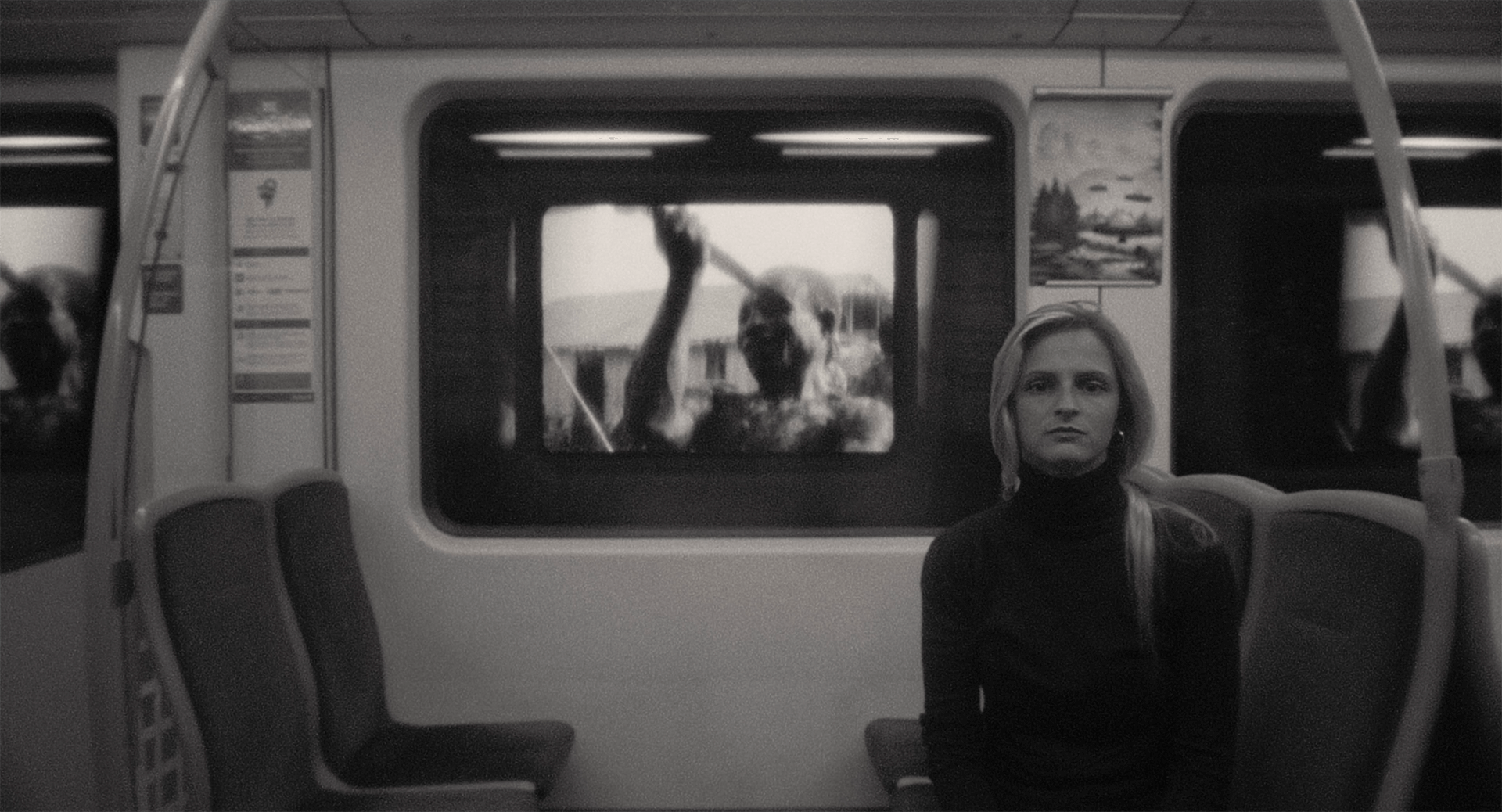
Indie Shorts Mag: In 2024, you were commissioned to create the trailer for the prestigious Chicago Underground Film Festival. How did you approach the challenge of encapsulating the spirit of the world’s longest-running underground film festival into a short piece like ‘Tunnel Visions’?
C. S. Nicholson: I believe Bryan Wendorf, the founder of CUFF, asked me because of what he called my ‘unique style’ or something to that effect. Which is one of the loveliest compliments I’ve received. Except I had no idea what my style was! I had to think, ‘If I were me, what sort of thing would I make?’ I quickly realised I just had to make whatever came to mind. Won’t anything I make be in my style?
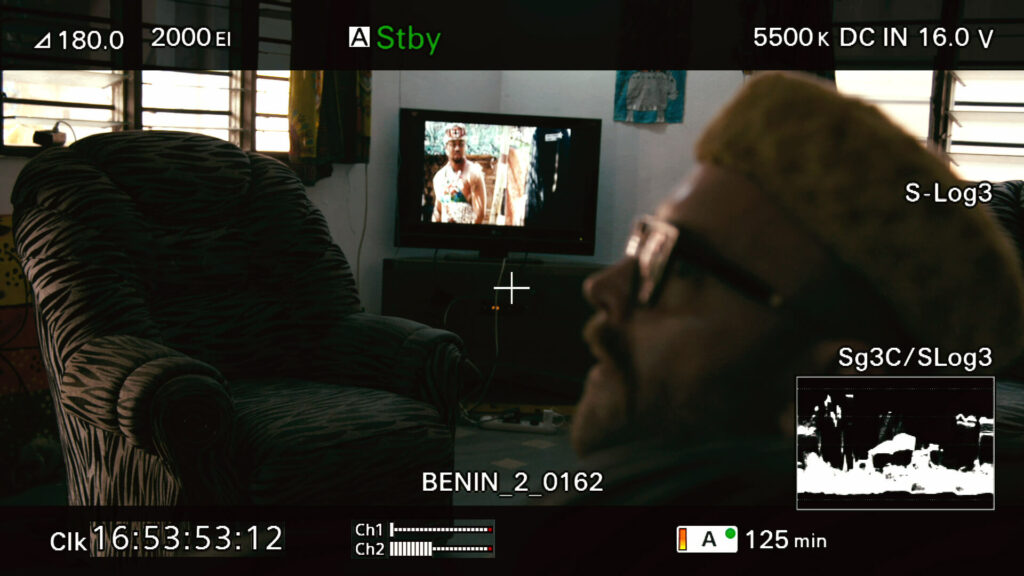
The concept was a bit corny. It’s the Chicago UNDERGROUND Film Festival, so I had the idea—if you can even call it that—to shoot in the actual underground. The passing windows of a train bear some resemblance to rolls of film. So I had the colourist I like to work with, Jens Valberg, plot images I had left over from shoots in Benin into the windows, to give the appearance of film running through a projector.
The close-up of the terrified eye of a cow being sacrificed reminded me of Buñuel’s ‘An Andalusian Dog’, or ‘Blood of the Beasts’ by Georges Franju. A fitting reference to avant-garde cinema. Obviously, the eye has connotations to watching films, so I added a clip of a man slicing his own eyelid with a blunt knife as well. That was shot during a Vodu ceremony to the god Kokou, whose spirit is said to imbue believers with the power to withstand pain and injury. It’s spectacular and painful to behold at the same time. Lastly, there’s the clip of the child brandishing the severed head of a goat. That’s from a Gunnukó ceremony in Porto-Novo. The goat’s head makes me think of Kenneth Anger and his occult cult films, hence the inclusion in a trailer for CUFF, where he screened.
Indie Shorts Mag: Your upcoming concert film features Michael Gira of the iconic art-rock band Swans. What was it like collaborating with such a seminal artist, and what can audiences expect from ‘I Wonder If I’m Singing What You’re Thinking Me to Sing’?
C. S. Nicholson: Working with Michael was a very uplifting experience. We didn’t sit together in an editing suite or anything. Apart from the shoot and a couple of face to face conversations, it was done remotely. But he was very encouraging. Though he had notes and suggestions, he basically gave me full freedom. There was a period when Michael produced records by other artists, and I think I caught a tiny glimpse of that Michael, the nurturer of talent.
It could easily have gone the other way! I decided to remix the live recordings. I remember Stian being very reluctant when I asked him to help me. A musician himself, he thought it was sacrilegous to mess with Michael’s songs like that. He expected Michael to pull the plug on the whole thing! Instead, Michael ended up giving us his blessing.
Of course, if you’ve watched the film, you’ll have seen that the material Michael gave us to work with was exceptional. I tried to do his stellar performance justice by not merely documenting the event. That would only have resulted in a cheap replica. The film had to be its own experience. That’s why it’s in black-and-white, because people didn’t experience the concert that way. Once again I enlisted Jens Valberg to do various VFX, to wrench the images away from the objectivity of cinematography. A concert exists in the intangible headspace between performer and audience, so that’s the space I was going for, and that’s the place I hope viewers will go to.
Indie Shorts Mag: Your first feature-length documentary, ‘A Stranger Has No Eyes,’ is described as a companion piece to ‘The Discoverer of the Discoverers.’ In what ways do the two films connect, and what new territory does the feature film explore?
C. S. Nicholson: A Stranger Has No Eyes was shot during the same period and on the same location as ‘The Discoverer of the Discoverers’. It, too, deals with Europe’s abuses of Africa, though this one focuses more specifically on the slave trade. It also has a clearly defined main character, and follows a more conventional narrative structure. There’s even a plot!
While ‘The Discoverer if the Discoverers’ is about framing—or perhaps re-framing—history, A Stranger Has No Eyes looks at power. At how the acquisition of power might change the way we speak and even think about history. In it, we get to see the multiple ways in which people from all walks of life still worship Francisco Félix de Souza, who was an enormously prolific slave trader in Dahomey. His descendants are still influential in Benin today, and they perform rites of ancestor worship for him. The Catholic Church performs Mass for him… Descendants of his slaves, too, worship him—sometimes in ways that give them symbolic power over his descendants, who in turn wield financial power over them…
It’s quite a dizzying look at the logic of power, and the myriad ways we venerate wealth and influence. We like to think we live in times where we ‘stand up to’ authority figures and ‘speak truth to power’. There have been some gains in the West—the MeToo movement produced some results, statues have been toppled, a few celebrities are in prison, and so on—but in the US, say, or the UK, we’ve been witnessing clear examples of certain people being above the law. Society is essentially role play, and we go to great lengths to submit to power, willingly. I suspect we’re incapable of not being seduced and entranced by it.
In Benin, this trance sometimes manifests itself literally. If you like possession ceremonies, spiritual masquerades and carnevals, you’ll love A Stranger Has No Eyes. Cinematographer Peder Bratterud worked on both ‘The Discoverer of the Discoverers’ and ‘I Wonder If I’m Singing What You’re Thinking Me to Sing’, but some of his most remarkable images can be found in this film.
Indie Shorts Mag: You’ve mentioned that you are currently seeking funding to complete post-production for ‘A Stranger Has No Eyes.’ Could you elaborate on your vision for the film’s grade and sound design, and how that final polish will be crucial to realizing the film’s full potential?
C. S. Nicholson: As A Stranger Has No Eyes is a companion film to ‘The Discoverer of the Discoverers’, I’d like it to have the same look. Jens Valberg did a masterful job on the short, unleashing the painterly potential of Peder Bratterud’s striking cinematography under the hazy, diffused light of the Harmattan, West Africa’s Saharan smog. I want to replicate this aesthetic.
I do have some new things I’d like to try with the sound design. Instead of the ordinary atmos to cover up edits, I’ve toyed with the idea of cutting up and looping the ambience at various intervals, depending on the rhythm of the scene—a bit like some sound artists make music from ambient field recordings. The goal would be to create a pulse you don’t consciously notice. I’d also like to subtly equalise and ever so slowly pan the atmos, much like we do the music, to further any hypnotic swirl the film might lull you into. I’m sure I’ll drive Anna Nilsson, the sound designer on ‘The Discoverer of the Discoverers’, mad if I manage to raise the funds to have her work with me again.
Indie Shorts Mag: After 16 years in the industry working as a director, story producer, and editor, what is the most valuable lesson you have learned about the craft and business of filmmaking, especially for independent creators?
C. S. Nicholson: I wish I had something useful to impart. But I work in TV to get by, and my films remain in the underground. I try to learn as I go, but haven’t come far. At least not in terms of the business of filmmaking. Perhaps if I compromised more, I could enjoy more success in that regard. But I compromise every day I work for somebody else, so I’m not about to water down my own projects. I just power through, despite industry reluctance and audience indifference. But that’s not exactly sage advice.
Indie Shorts Mag: For the aspiring filmmakers reading Indie Shorts Mag, what advice would you give them on developing a unique creative voice and building a sustainable career in a competitive industry?
C. S. Nicholson: I’m not fit to give anybody advice, really. Do I even have a unique creative voice myself? Maybe I’d say, ‘Don’t think about your voice. What does the story require? How do you imagine you’ll emphasise the parts that drew you to it?’ Hopefully a distinctive perspective will emerge.
I’m equally unfit to give advice about a sustainable career. I work in TV for a living, and don’t think of my films as amounting to a career, really. My projects bleed me dry, basically. What I do is not sustainable for my wallet, my health or my relationships. But I can’t see how making somewhat experimental documentaries about non-tabloid subjects can become profitable enough for me to live off them. I mean, if Errol Morris and Todd Field need to direct commercials to pay the bills, what chance do I stand?
What I will say is that when you work for others for a living, try not to give so much that you have little left over for your own projects. I regret getting too sidetracked by paid gigs. Though we all need to eat, of course…
As our conversation with C. S. Nicholson draws to a close, it is clear that his journey as a filmmaker is as unconventional as his artistic vision. From his academic roots to his hands-on approach to music and sound design, Nicholson’s work is a testament to the power of a singular, uncompromising voice in independent cinema. With his feature debut, ‘A Stranger Has No Eyes,’ on the horizon, the film world awaits another mesmerizing exploration of power, history, and the human psyche. For aspiring filmmakers and seasoned cinephiles alike, Nicholson’s journey is a compelling reminder that the most profound stories are often found not in definitive answers but in the courage to ask unsettling questions and to follow one’s creative intuition, no matter where it may lead.
No comments yet.
Got Something to add to this article?
Your email address will not be published. Required fields are marked *