Article too long to read?
You're in the edit bay at 1:13 a.m., staring at a timeline that still needs sound, color, captions, and one last export for a festival deadline that already feels behind. The inbox has a rejection email from a festival you cared about, your bank account is doing the indie-film version of a slow fade, and you've been telling yourself you'll deal with the anxiety after picture lock. That's exactly when online counselling Canada stops being an abstract wellness idea and becomes practical survival.
For filmmakers, the problem isn't just stress. It's the grind of freelance instability, long stretches of isolation, and the emotional whiplash of creative work that asks for total commitment and then often answers with silence. Virtual support fits that reality because it can happen between deliverables, from a home office, or from anywhere with enough bandwidth and privacy to speak openly.
Table of Contents
- The New Reality of Virtual Mental Health Care
- Navigating Provincial Regulations and Cross-Border Care
- Comparing Platform Types and Payment Pathways
- How Interactive Counselling Can Help
- How to Choose a Therapist for Creative Burnout
- Tailoring Support to the Indie Film Lifecycle
- When Virtual Care Is Not the Right Fit
- Building a Sustainable Career Through Mental Wellness
The New Reality of Virtual Mental Health Care
Virtual mental health care has become part of Canada's working reality. In a CIHI analysis of physician mental health services across five provinces, virtual visits rose from 4% in 2019 to 2020 to 57% in 2020 to 2021. During the same period, physician mental health services increased by 15% in January to March 2021 compared with the same months a year earlier, reaching 502,007 services Mental Health Commission of Canada. For indie film, that shift matters because production rarely leaves room for predictable appointments.
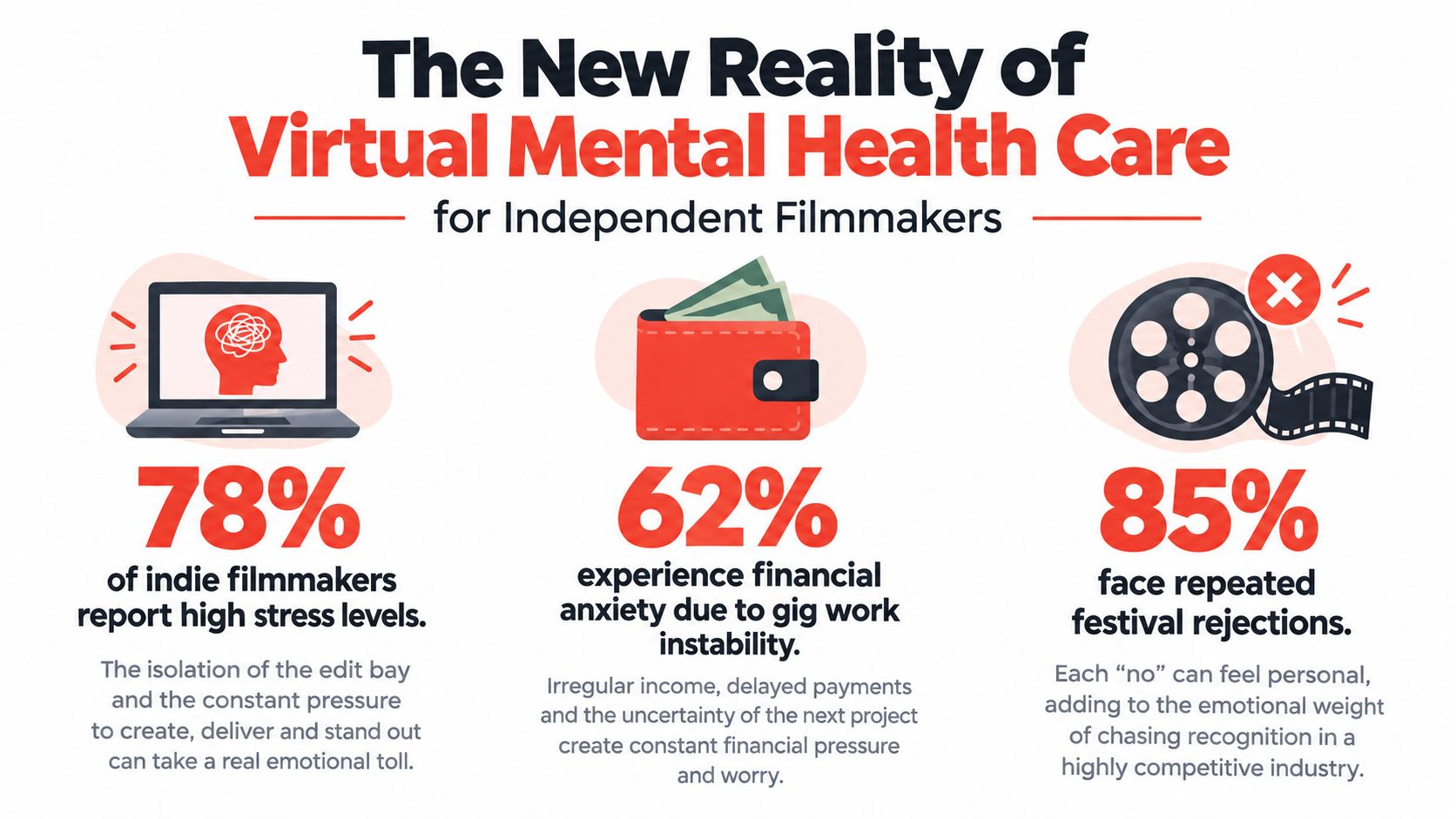
The old instruction to wait until you can reach an office fails during post-production, festival submissions, and grant deadlines. A director managing revisions, a producer assembling financing applications, or an editor tied to the suite can access support without losing half a workday. Remote care also suits the gaps between contracts, when gig income is uncertain and travel across town can feel impossible.
That is a meaningful structural shift in how care reaches isolated creators. A session from a private room can protect continuity when the production schedule changes again.
What the Canadian data actually says
A later national synthesis found that among people in Canada who accessed mental health care in the past year, 45% used virtual services either fully or alongside in-person care. 18% relied exclusively on virtual care, while 27% used a hybrid model Mental Health Commission of Canada. Virtual counselling now sits within mainstream care pathways, alongside in-person treatment.
For filmmakers, Online Counselling Canada is a practical care option during the full production cycle. It can support a creator after festival rejection, during the lonely weeks of editing, or while financial pressure builds between paid contracts. The format matches work conducted through screens, fragmented days, and shifting locations.
Consistency decides whether counselling helps. A therapist you can reach during a production gap is easier to keep than one who requires a long commute and fixed daytime availability.
Practical rule: if you can book a call with a distributor, a lawyer, or a line producer from your laptop, you can book a therapy session the same way.
For a creative perspective on silence, pressure, and lived mental health experience, read this review of Nisaptham from Indie Shorts Mag.
Virtual support reduces travel, preserves appointment access during schedule changes, and gives crews a better chance of maintaining regular care. That regularity matters during the long stretches when stress is easiest to ignore.
Treat virtual counselling as a working part of your wellness plan. For many crew members and creators, it is the format they can sustain.
Navigating Provincial Regulations and Cross-Border Care
Canada has no single national rulebook for online counselling. Regulation sits with the provinces and territories, and regulators generally treat the client as receiving care where they are physically located during the session. A therapist licensed in one province cannot assume they may treat a client sitting in another, even when the appointment takes place online College of Psychologists and Behaviour Analysts of Ontario.
Why this matters for filmmakers who move constantly
Indie filmmakers expose the practical weaknesses in this system. You may live in Alberta, shoot in British Columbia, then spend months in Ontario for editing, grants, or meetings. Festival rejection can hit during one move, post-production isolation during another, and unstable gig income can make consistent treatment harder to maintain. If your clinician is not authorized to practise where you are sitting, treatment may become unauthorized, putting both compliance and continuity at risk.
Choose a service that checks location before the appointment. Strong platforms use jurisdiction-aware intake, location verification, and clinician-licensure routing. The process should establish where you are, which rules apply, and whether the clinician can legally see you there.
Operational reality: a platform that ignores province-by-province licensing is creating a legal problem for you and the therapist.
What to check before you book
Ask three direct questions before the first session:
- Where is the therapist licensed to practise?
- Can they legally see a client located in your province today?
- What happens if you travel or relocate during treatment?
Get clear answers in writing if possible. These checks protect continuity when a shoot moves, an edit stretches late, or a contract ends and you relocate. “Canadian therapist” does not mean “available anywhere in Canada.” Confirm the specific province and your physical location for every session.
Canada also lacks universal best-practice recommendations and national laws or standards for online counselling, according to a rapid-response review. Psychotherapy remains regulated provincially, so requirements differ across the country Ontario Hospital Technology Network. A polished booking page is not proof of authorization. Verify the clinician's credentials and the platform's process yourself.
The access problem is part of the regulation problem
The same review found that 41% of Canadian adults and 36% of youth with diagnosed mental health conditions report needs that are partially met or unmet Ontario Hospital Technology Network. Access matters, but speed should not replace lawful care. Select a service that can explain licensure, location rules, and treatment continuity in plain language.
That is the standard for online counselling Canada. If the provider cannot tell you who may treat you, where the session is legally delivered, and how travel affects care, choose another provider.
Comparing Platform Types and Payment Pathways
A producer in pre-production, a film student finishing a thesis, and a crew member between contracts need different payment routes. Compare counselling with the same discipline you apply to a rental quote: check the full cost, access conditions, and what happens when the project changes.
| Access Route | Cost Structure | Wait Time | Best For |
|---|---|---|---|
| Private direct-pay platforms | Usually out of pocket, sometimes with insurance reimbursement | Often faster access | Freelancers, producers, and crew who need flexibility |
| Employer or union benefits | Covered partly or fully if your plan includes mental health services | Can be moderate | Film workers with access to benefits through a job, guild, or production |
| University counselling | Often low cost or included in student fees | Can vary widely | Film students and recent graduates |
| Public or community services | Free or low cost | Often longer | People who need the lowest-cost route and can wait |
Private pay gives you the most control over clinician choice and appointment timing. That matters when you need focused support for burnout, grief, relationship strain, or industry-related anxiety during a demanding production phase. The cost is direct: you pay for speed, selection, and fewer administrative restrictions.
Where benefits and public services fit
Check your benefits portal or plan booklet before paying privately. Look for coverage under terms such as psychological services, registered social worker, or registered psychotherapist, then confirm whether the provider must be licensed in your province. Ask whether the plan requires a referral, whether direct billing is available, and whether you receive reimbursement only after submitting a receipt. A plan that covers counselling in principle may still exclude the clinician you want or impose a provider-specific limit.
Union, guild, and production benefits deserve the same check. Coverage can change when a contract ends, so confirm the final date of eligibility before booking a longer course of therapy. Save invoices and claim instructions. That small administrative step prevents a rejected claim from becoming another problem during post-production.
Students should contact campus counselling early, especially during a thesis or festival deadline. It can provide a low-cost first appointment or short-term support, while a private clinician may be better for ongoing work. Ask the campus service about referral options if its session model does not match your needs.
Public and community services remain the practical choice when cash flow is unstable. Intake may take longer, but waiting does not make the option lesser. Contact a provincial health line, community health centre, or local counselling program and ask about eligibility, fees, and expected intake steps.
Decision rule: Use private care when clinician choice or rapid support protects a production commitment. Use benefits first when they cover the service you need. Choose public, community, or campus care when cost is the barrier, and ask about interim support while you wait.
Choose based on the production phase and current cash flow. Build counselling into the budget before festival rejection, an isolated edit, or a gap between gigs turns strain into a crisis.
How Interactive Counselling Can Help
A filmmaker can be carrying festival rejection, a broken lease, and an unfinished cut into the same week. The right practice should handle that full picture, not force you to split career stress, relationships, and anxiety into separate appointments.
Interactive Counselling offers a useful model to examine. It is a Canadian counselling practice with licensed clinicians who work with individuals, couples, families, children, youth, and clients dealing with anxiety, depression, grief, trauma, parenting, relationships, life transitions, divorce support, and mediation. That range matters to film workers whose problems rarely stay inside one category.
The scheduling model also fits production life. The practice offers daytime, evening, and weekend availability, along with in-person, phone, and secure virtual sessions. It provides ICBC-funded counselling for clients recovering from motor vehicle accidents, which can matter when an accident disrupts both personal life and paid work. Review its online counselling in Canada information, then compare the same questions with another Canadian practice, such as Inkblot Therapy. The point is not to choose the larger brand. It is to compare clinician fit, session format, availability, privacy procedures, and the provider's rules when you work or travel across provincial borders.
How to vet any practice before the first call
Start with the clinician's scope. Ask about experience with anxiety, trauma, grief, relationship strain, and work-related stress. Confirm how appointments work when your hours change between a shoot, a festival run, and a solitary post-production stretch.
Then assess communication. Film workers need a therapist who can be direct without being cold, compassionate without vague reassurance, and clear about goals, boundaries, and next steps.
Questions worth asking in a consultation
- What problems do you help with most often? Match the answer to your actual concerns.
- How do you handle virtual sessions when the client's location changes? Confirm provincial licensing and cross-jurisdiction limits before travel.
- Do you offer evening or weekend appointments? Production schedules rarely respect office hours.
- How do you work with people dealing with deadlines, rejection, or financial strain? Ask for a practical example, not a general promise.
- What should I do if I need something more intensive than standard weekly talk therapy? A good clinician will explain referral and escalation options clearly.
Why this kind of practice can work for film workers
A filmmaker dealing with festival rejection and a broken lease simultaneously benefits from one clinician who can address both. A practice serving varied client groups may be better equipped for that combination of creative identity, money pressure, relationship strain, and career uncertainty.
Choose the provider who explains its process, limits, clinician credentials, and availability plainly. A polished website is not evidence of fit. Clear answers are.
How to Choose a Therapist for Creative Burnout
Creative burnout in film doesn't look like one thing. Sometimes it's numbness after a brutal post stretch. Sometimes it's irritability on set. Sometimes it's the sick feeling that every rejection confirms your worst fear about your work.
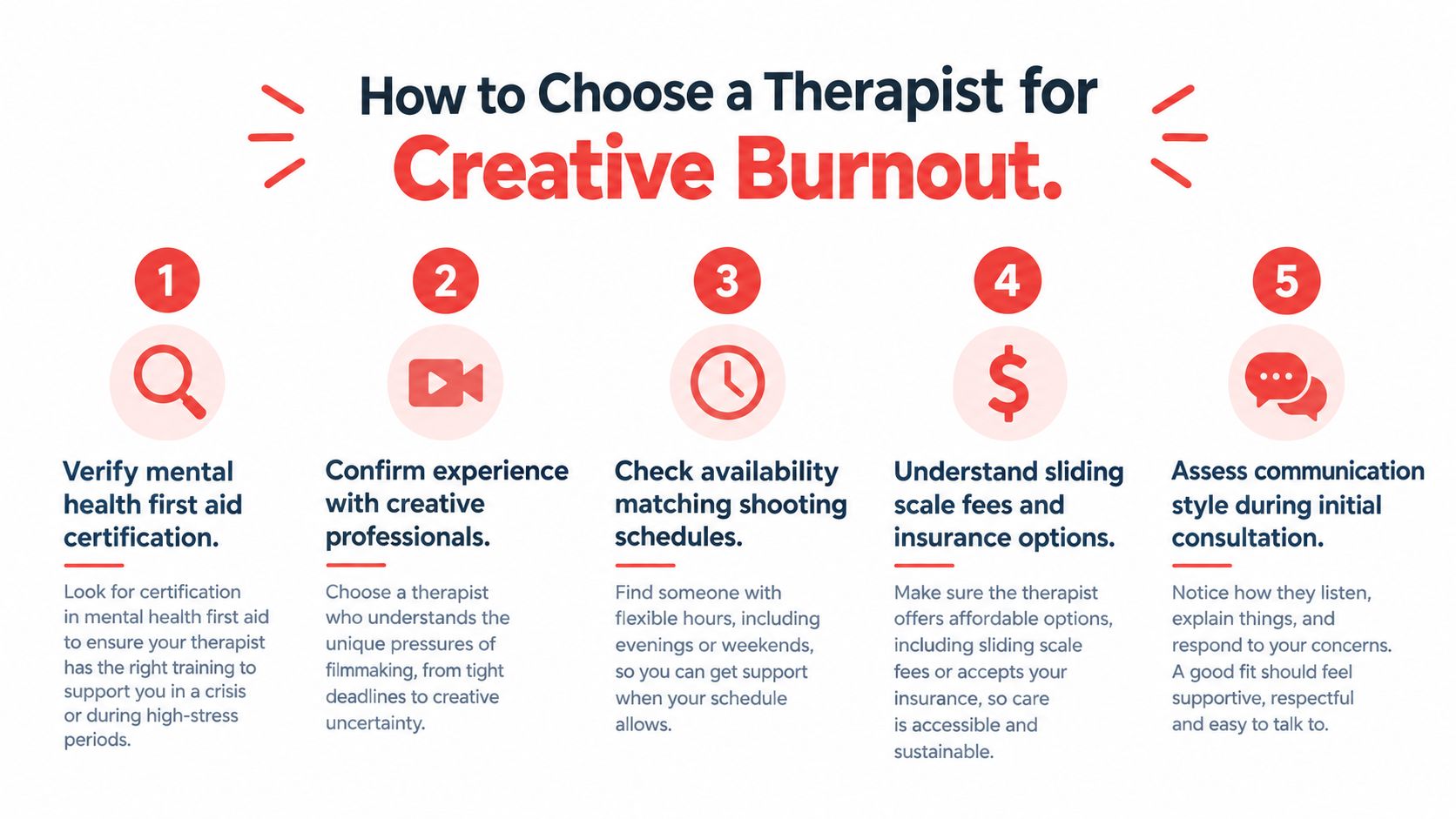
Screen industry competence is the filter that matters
A therapist doesn't need to know every crew role to help you, but they do need to understand how unstable work affects the mind. Ask whether they've worked with freelancers, artists, or other people whose income changes month to month. Ask whether they understand the emotional drop that can follow festival outcomes, especially when months of work get reduced to a short email.
Indie Shorts Mag's interview archive often shows how long and nonlinear creative careers can be, including the grind and uncertainty that shape the job itself James Andrew Murray interview. A therapist doesn't need to read those interviews, but they do need to understand that creative identity and financial instability are linked in this line of work.
Green light: the therapist asks about your production rhythm, not just your symptoms.
Ask for structure, not inspiration
A good therapist should be able to tell you how they work. Do they set goals? Do they give practical tools between sessions? Do they know how to adapt around production weeks, festival travel, or a sudden layoff?
That matters because creative burnout gets worse when therapy feels vague. You don't need pep talks. You need someone who can help you recover sleep, sort priorities, and keep your self-worth from getting welded to each rejection.
Use this checklist in the first conversation
- Verify training and licensure. Confirm they're authorized to practice where you are.
- Ask about creative clients. You want evidence they've worked with artists, freelancers, or media workers.
- Test their schedule fit. If they can't work around shoots or editing sprints, they're not your person.
- Discuss fees and coverage early. No one should be surprised by cost after the first session.
- Notice how they speak. Clear, direct, and calm usually beats abstract reassurance.
The right therapist for burnout gives you traction. The wrong one gives you another thing to manage.
Tailoring Support to the Indie Film Lifecycle
Online support works best when you treat it like part of the production calendar, not a last-minute rescue. The stress profile changes from draft to premiere, and your care plan should change with it.
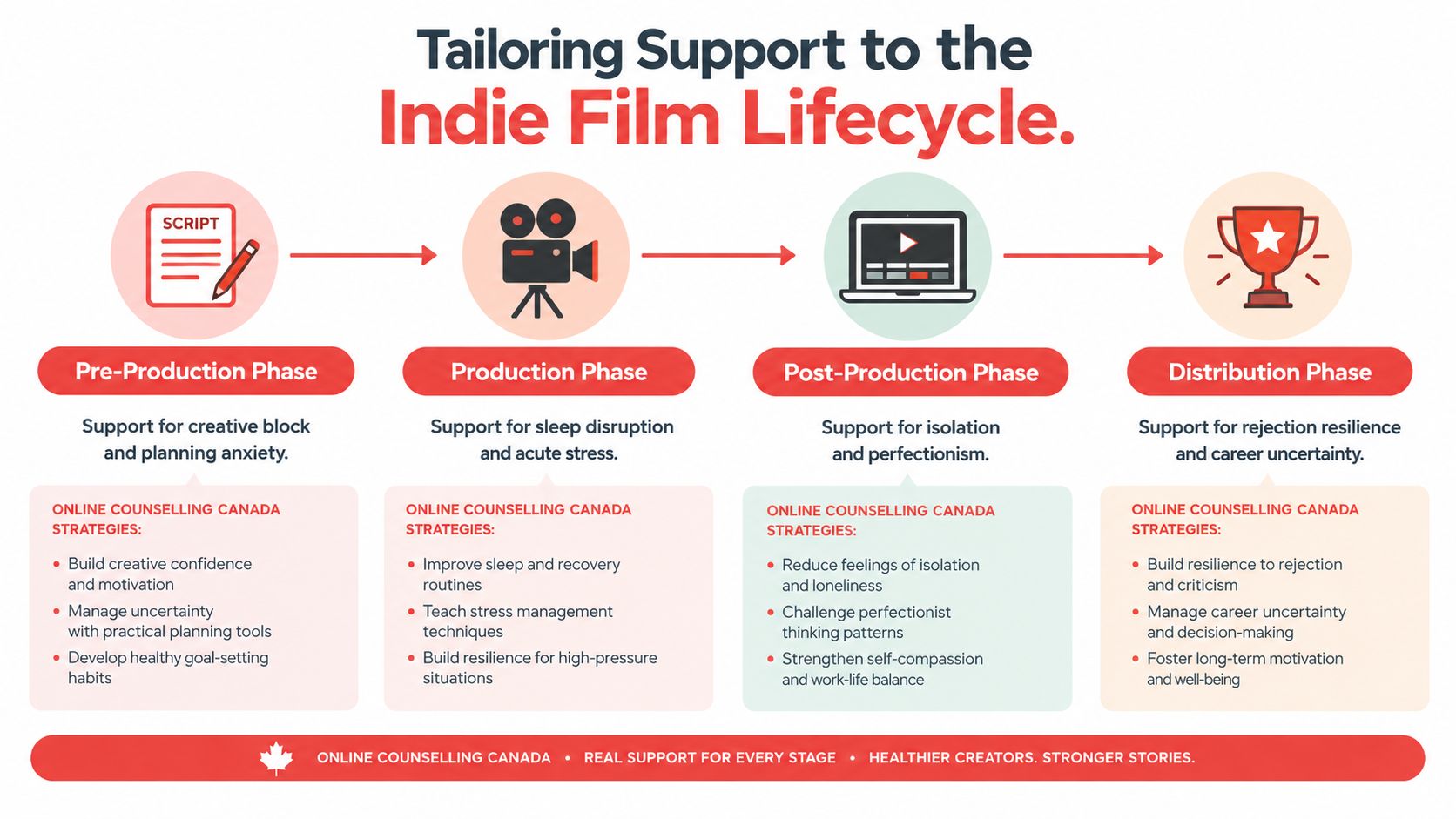
Pre-production needs a different kind of support
Planning anxiety can hit hard before anyone has even rolled camera. Therapy can help you separate useful pressure from panic, especially when you're juggling grants, casting, locations, and the fear of getting it wrong.
A lot of filmmakers think they should wait until the crisis arrives. That's a mistake. Pre-production is the cleanest time to build a mental health habit because your calendar is more predictable and you can still make room for sessions before the crunch starts.
Production is about containment
Once shooting begins, the goal changes. You're not trying to solve your whole life between call times. You're trying to keep stress from spilling into the set, your sleep from collapsing completely, and your communication from turning brittle under pressure.
Short, focused sessions can help here, especially if the clinician understands the reality of early call times and irregular meals. If the therapist keeps asking you to “slow down” without understanding shoot demands, they're missing the point.
Post-production and festival season need blunt honesty
The quiet part of the job is often the hardest part. After wrap, the adrenaline drops, the room gets quieter, and perfectionism gets louder. Festival season can intensify that because every rejection feels personal when you've built the film from nothing.
That's where therapy should help you hold a realistic frame. Your film's journey and your worth are not the same thing, and if your support system can't help you separate them, the process will keep chewing through you.
The same Canadian evidence base that supports virtual care also notes that access improves when travel burden drops and missed appointments fall Canadian Agency for Drugs and Technologies in Health. For filmmakers, that means virtual sessions can fit around shoot blocks, edit deadlines, and travel without making care impossible to maintain.
Don't force one format on every stage
If your situation is complex, hybrid care may be smarter than fully virtual care. Some issues need more than screen-based support, especially when symptoms are severe or the situation is unstable. That's not a failure. That's matching the format to the problem.
Indie Shorts Mag's filmmaking coverage often captures the pressure of moving from script to screen, and that pressure doesn't stop once the footage is wrapped from script to screen. Your mental health plan shouldn't stop there either.
When Virtual Care Is Not the Right Fit
Virtual support is useful, but it's not a cure-all. Some filmmakers use it because it's convenient, then stay stuck because they need a higher level of care or a different format altogether. The honest move is to notice when screen-based sessions aren't enough and say so fast.
The Canadian preference data makes that nuance obvious. A national report found that about 1 in 5 people in Canada would prefer only virtual mental health services, 42% would prefer only in-person services, and about 1 in 3 would choose a hybrid model Mental Health Commission of Canada. That mix matters because it confirms what many clients already feel, virtual is one valid lane, not the whole road.
When to switch formats
Choose hybrid or in-person care if you're dealing with complex trauma, escalating risk, or a situation that feels too unstable to manage through short virtual check-ins. If you keep leaving sessions more flooded than when you entered, that's another sign the format may be wrong.
You should also rethink virtual care if privacy is poor, your location is too chaotic for real conversations, or your symptoms are getting worse despite consistent attendance. Therapy shouldn't become another performance in front of a webcam.
What strong clinicians do when virtual isn't enough
Good providers don't cling to one modality out of convenience. They adjust the plan, refer out, or recommend a blended model when your situation calls for it. That flexibility matters more than brand language about convenience or speed.
Bottom line: the right therapy format is the one that actually supports change, not the one that sounds easiest to market.
If you're a filmmaker carrying heavy anxiety, trauma, or burnout, the real win is getting care that matches the intensity of your life. Sometimes that's online. Sometimes it's hybrid. Sometimes it's in person. The point is to choose the format that gives you the best shot at staying functional, creative, and steady enough to keep working.
Building a Sustainable Career Through Mental Wellness
Treat mental health the same way you treat your gear, your software, and your release planning. If you ignore it until it breaks, the repair gets expensive. If you maintain it steadily, you buy yourself longevity.
That's the career lesson behind online counselling Canada. The point isn't to become endlessly self-improving. The point is to stop letting burnout, rejection, and financial chaos make every year harder than the last.
Make support part of your workflow
Book therapy before the crisis if you already know your pattern. If you usually crash after a festival run, schedule ahead of that window. If money gets tight between contracts, map out the lowest-cost route before the bills pile up.
A sustainable plan also includes people, not just providers. Build a small circle of peers who can tell the difference between normal stress and the kind that needs professional support. Film work gets isolating fast, and isolation is where bad thinking gets loud.
Keep crisis options visible
If you're in immediate danger or thinking about harming yourself, call local emergency services right away. If you're in Canada and need urgent mental health help, connect with your provincial crisis line or emergency department as soon as possible.
Use professional support, but don't make your therapist your only lifeline. That's not how resilient systems work.
The direct path forward
Pick one provider, one benefits check, or one intake form today. If you need a first comparison point, review a Canadian practice that clearly lists formats, availability, and client types, then ask the hard questions about licensure, fit, and scheduling. If you're part of the Indie Shorts Mag readership, keep scanning its interviews and guides for the craft side of the job, then make the mental health side equally concrete by booking care instead of just reading about it.
Your career gets stronger when you stop treating wellness like a reward for surviving production. It's part of the job.
No comments yet.
Got Something to add to this article?
Your email address will not be published. Required fields are marked *