Article too long to read?
In Backstage, a young actor’s opportunity to work with an influential theatre director becomes a study of ambition, manipulation and the difficulty of saying no. Drawing on a personal experience from his early years as an actor, Luxembourg filmmaker Émile V. Schlesser worked with co-writer Jonas Brand to explore how an abusive relationship can develop through gestures that initially seem harmless. In this conversation with Indie Shorts Mag, Schlesser discusses the trust behind the performances, the film’s carefully defined colour palette and the resourcefulness required to bring it to the screen. From selling paintings to help finance the production to recording improvised jazz against the projected film, he offers a detailed look at the choices that shaped Backstage.
Indie Shorts Mag: It took you almost a decade to understand the experience that inspired Backstage and recognise that you did not need to keep blaming yourself. How did that distance shape the perspective from which you wanted to tell the young actor’s story?
Émile V. Schlesser: I hope it helped me craft a believable and relatable story about how an abusive relationship unfolds. In hindsight, having experienced something similar, I can recognise the tactics a person would use to manipulate. When you’re going through it, you’re often unaware of these almost invisible mechanisms. What makes it so difficult to realise is that it usually begins with the smallest gestures. First, a compliment here and there. Then, gradually more transgressive actions. Yet always subtle enough to keep you wondering how that person actually meant it.
Because there’s no clear threat in the beginning, it’s difficult to resist or fight back. You don’t want to cause trouble, so you pretend everything’s fine. But once you’ve missed the opportunity to say “no”, the abuser may interpret your silence as consent and continue crossing one boundary after another. Eventually, when you do start pushing back, the abuser may gaslight you into believing that you’re the one to blame since you started it by having played along.
Indie Shorts Mag: How did you and co-writer Jonas Brand approach making the gradual development of an abusive relationship believable within the compressed form of a short film?
Émile V. Schlesser: Jonas and I really wanted to avoid an oversimplified portrayal of victimhood and culpability. We didn’t want anything black and white. Instead, we wanted to explore the ambiguous grey areas, contradictions and subtle shifts in power that make abusive relationships so impenetrable and disorienting. This felt much closer to how these things actually unfold in real life.
Choosing to show a female abuser allowed us to explore forms of manipulation that are completely different to the methods usually used by men. Much more complex and less straightforward. Cosima can be gentle, warm and sweet, seductive and motherly. She knows when to appear small and vulnerable, seemingly offering Lukas the position of power while giving him a false sense of security. This completely messes with his mind, making it so much more devious and perfidious. But also so much more interesting to watch.
Indie Shorts Mag: What made the dynamic between a young man and an older female authority figure important to the way you wanted Backstage to explore power and vulnerability?
Émile V. Schlesser: One of the reasons we chose to make the protagonist a young man being abused by an older woman (apart from the fact that it’s based on a real-life event) was to further encourage men in the audience to connect and sympathise with the victim. Undoubtedly, most women in the audience know what it feels like to be caught in such a situation. But men? Maybe not so much. By telling the story this way, I think a wider audience might be able to recognise how these situations develop and how easily they can happen.
Another important reason was that my co-writer Jonas Brand and I were keen on exploring the ambiguity and sneaky moral grey areas. We wanted to create relatable characters caught in a complex situation that would leave audiences with enough uncertainty to keep questioning and discussing long after the screening. Whose fault is it, really? It’s not that clear-cut. Lukas isn’t simply a victim, while Cosima, although deeply flawed, possesses many relatable traits that make it possible for an audience to empathise with her.
We felt that portraying a predator as an almost sympathetic character, while never losing sight of the harm they cause or excusing their actions, was only possible if that character was a woman. No one wants to watch a film that asks them to see poor old Harvey as a complex, ambiguous figure they might actually feel sorry for.
Indie Shorts Mag: Philippe Delacroix’s success follows his appearance in Cosima’s previous play. How did you approach his character’s role in establishing what a young actor like Lukas might feel is at stake when working with her?
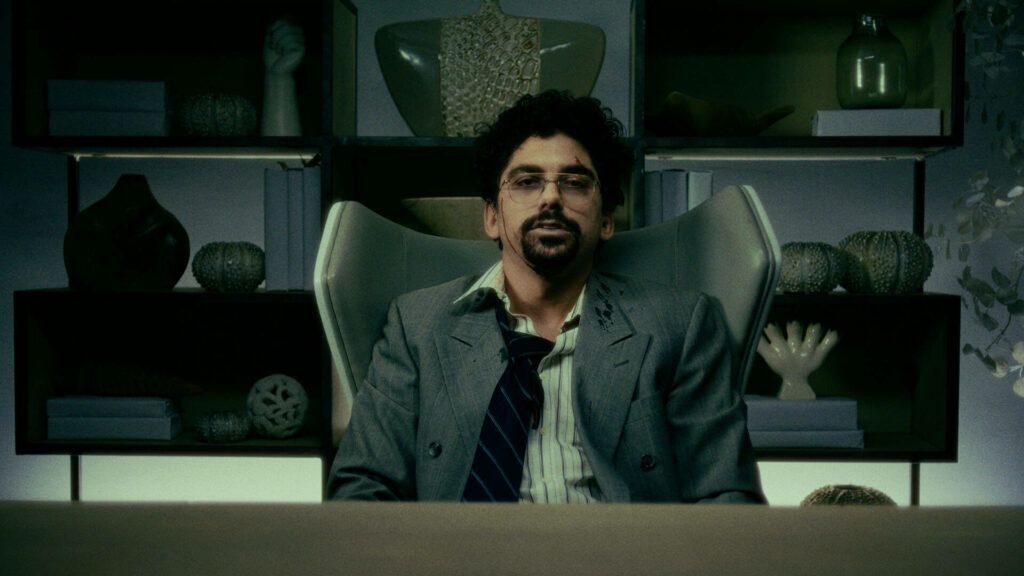
Émile V. Schlesser: For Lukas, Philippe’s fate serves as both a warning and a promise. On one hand, the realisation that Philippe owes his highly successful career to Cosima’s power and goodwill could be very alluring to a young, ambitious actor like Lukas, who is hungry enough and willing to consider making that same bargain. Cosima understands the power of this temptation and actively exploits it for her own personal benefit.
On the other hand, we get a sense that Philippe is still traumatised by the deal he made with Cosima and the emotional harm it caused. He has in effect sold his integrity, his body, his soul. Even after all these years, he still feels controlled by and indebted to his abuser. In that sense, Philippe embodies both the seductive promise of what Cosima can offer and the devastating price that comes with accepting it.
Indie Shorts Mag: Jonathan Joèl Albrecht plays a young actor who is himself performing onstage. How did you work with him to distinguish those layers of performance while keeping the character’s emotional experience clear?
Émile V. Schlesser: Jonathan – as well as Jil Devresse, who plays his acting partner – has experience on the theater stage, so he was already well equipped to navigate these different acting styles. The challenge was switching between the colourful, artificial, theatrical style of the play and the much subtler, intimate naturalism of film acting. Both had to work simultaneously on an actual stage and in front of the camera, often with the camera right up in their faces.
“Python”, the play they are performing in the film, already portrays an abusive relationship between a man and a woman. So, things quickly become quite “meta”, as it gets harder to differentiate between play and real life. Over the course of the film, it becomes increasingly difficult to tell Cosima’s unorthodox directing methods apart from actual abuse. We used this confusion to further blur Lukas’ assessment of the situation, making it increasingly difficult for him to see clearly what’s happening to him.
Indie Shorts Mag: How did you work with Sascha Ley on Cosima’s glances, smiles and small gestures to convey the control she exerts over Lukas?
Émile V. Schlesser: In preparation, as Sascha and I were developing Cosima’s personality, we made sure never to judge her character, even if, objectively speaking, her actions are inexcusable. The truth is, no one sees themselves as a villain. We all have our reasons, motivations and justifications for the way we behave.
What really made it interesting was considering the possibility of what would happen if Cosima were actually in love with Lukas. This would make her susceptible to misinterpreting his reactions and mixed signals as signs that he feels the same way. In the beginning, he may indeed genuinely enjoy her attention and feel flattered that someone of her standing takes such an interest in him. She, on the other hand, is completely oblivious to the fact that, given the power imbalance, it would be very hard for him to communicate his discomfort in any way.
When things finally escalate, Cosima is genuinely stunned when Lukas pushes her away. From her one-sided perspective, it seemed as though there had been consent. She does have a point when she spits out, “You should have said no earlier.” But that’s exactly the dilemma. It’s not that simple.
Indie Shorts Mag: What did creating a safe working environment mean in practice when directing Jonathan Joèl Albrecht and Sascha Ley through a story about manipulation and control?
Émile V. Schlesser: The single most important thing on this production was trust. We did not have an intimacy coordinator on set – which, I know, might seem strange on a project with a topic like this. I talked a lot with my cast members, and together we realised that we had built so much trust between us that the actors didn’t feel the need for an intimacy coordinator. They actually felt more comfortable without an outside third party intervening. For me, it’s all about what my actors want and need to feel safe, so I respected their wishes. In any case, as a director, I believe it is vital to create a positive and creative working environment in which everyone feels safe, respected, and supported.
Indie Shorts Mag: Jil Devresse plays the acting partner who witnesses what unfolds. How did you approach that character’s perspective as a way for the audience to understand the central relationship?
Émile V. Schlesser: Jil’s character, Vero, is the silent observer. She might seem passive, yes, but I believe this character is arguably the one most of us can identify with. We’ve all heard or even witnessed stories about people in positions of authority misusing their power to manipulate and abuse – and have chosen not to act, staying silent instead. I believe most people either turn a blind eye or are reluctant to step in to help for various reasons. It can also be insensitive to pressure a victim into speaking up when they themselves might not even know fully grasp what’s happening to them.
In Vero’s case, we can tell she clearly has a hunch. She knows about Cosima’s past as an abuser and accepts it as part of the industry’s game. There is one scene, though, where she subtly gives Lukas the opportunity to open up and tell her the truth – but he chooses not to.
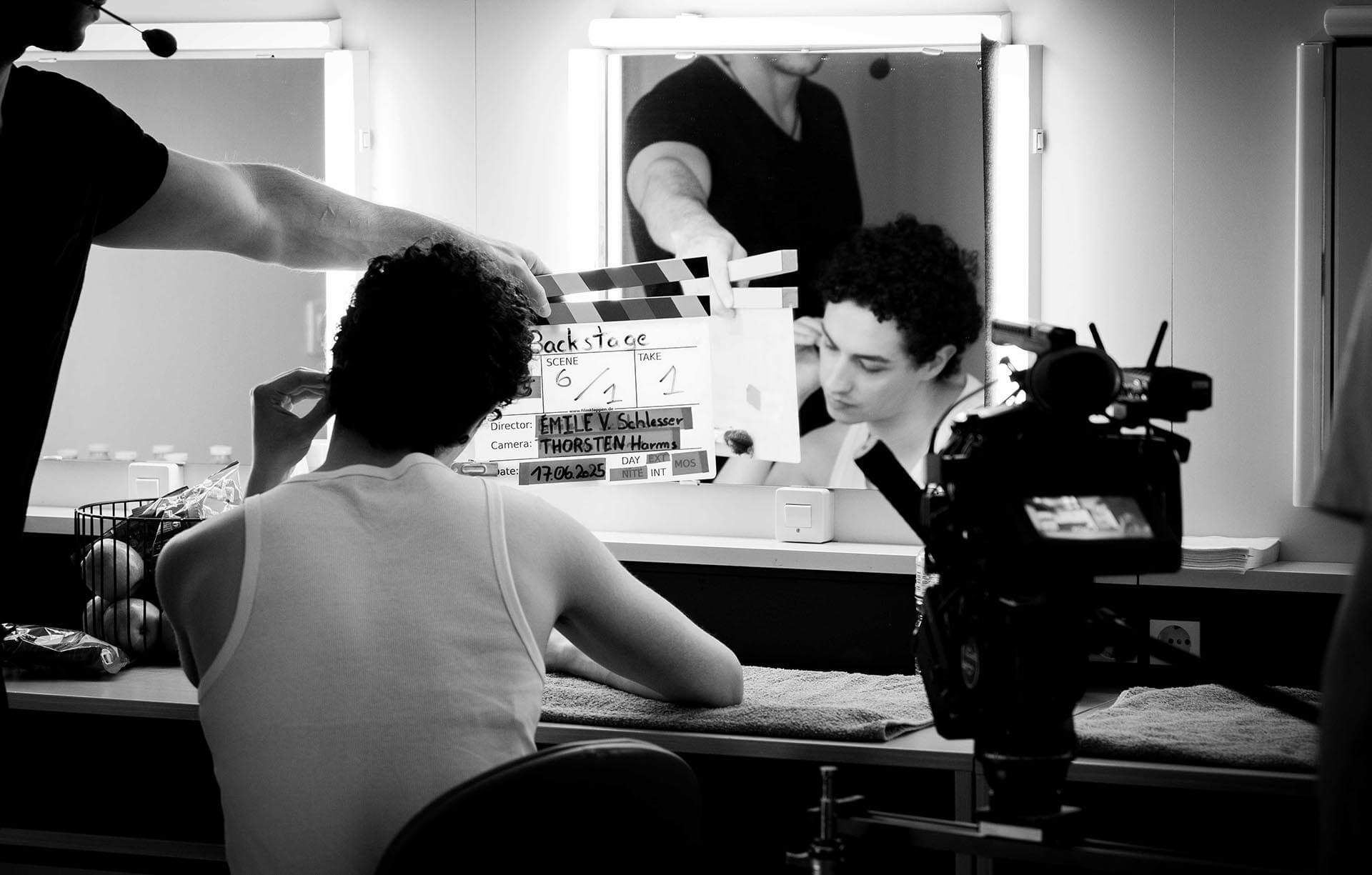
Indie Shorts Mag: How did your background in visual art inform your collaboration with cinematographer Thorsten on developing the visual language of Backstage within a working theatre?
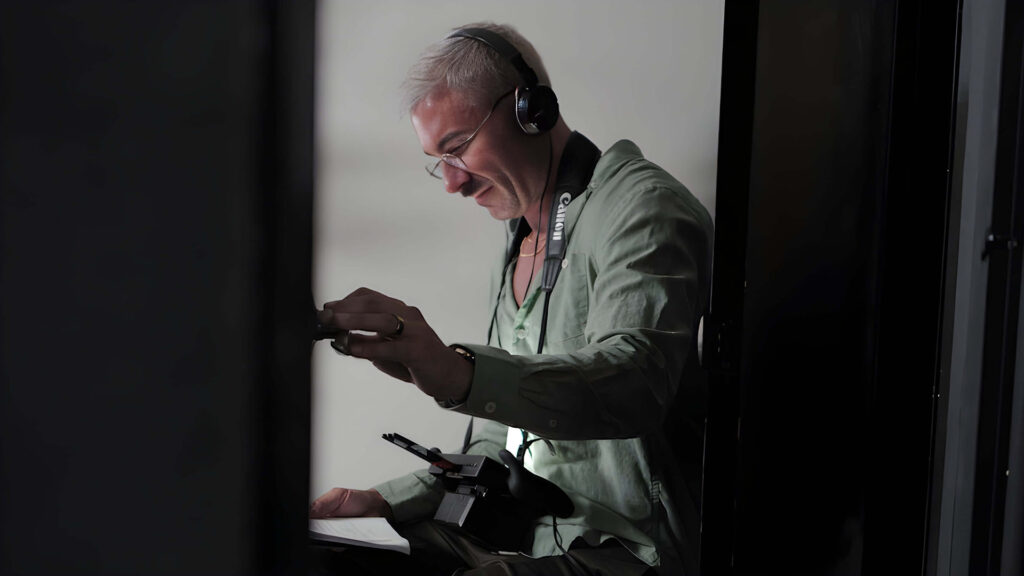
Émile V. Schlesser: Working with Thorsten Harms, my DP, was so easy, as we speak the same language in terms of visual grammar. We were on the same page from the get-go and had a lot of fun working out ways to convey power balance within the frame through blocking and staging. For instance, we enjoyed playing with lines in the composition and how actors would cross them within the frame as they moved around in a scene. The moment of their first kiss is a good example for this.
Indie Shorts Mag: What guided your use of the colour palette to communicate the balance of power between Lukas and Cosima in Backstage?
Émile V. Schlesser: Thorsten and I carefully worked out a colour code that would help tell the story on a purely visual, visceral level. We narrowed it down to red, blue, and gold, giving each a specific meaning and using them very consciously throughout the film. Red symbolises abuse and gradually appears more and more as the story unfolds. Blue, by contrast, represents liberation. The two colours are in constant dialogue with one another throughout the film.
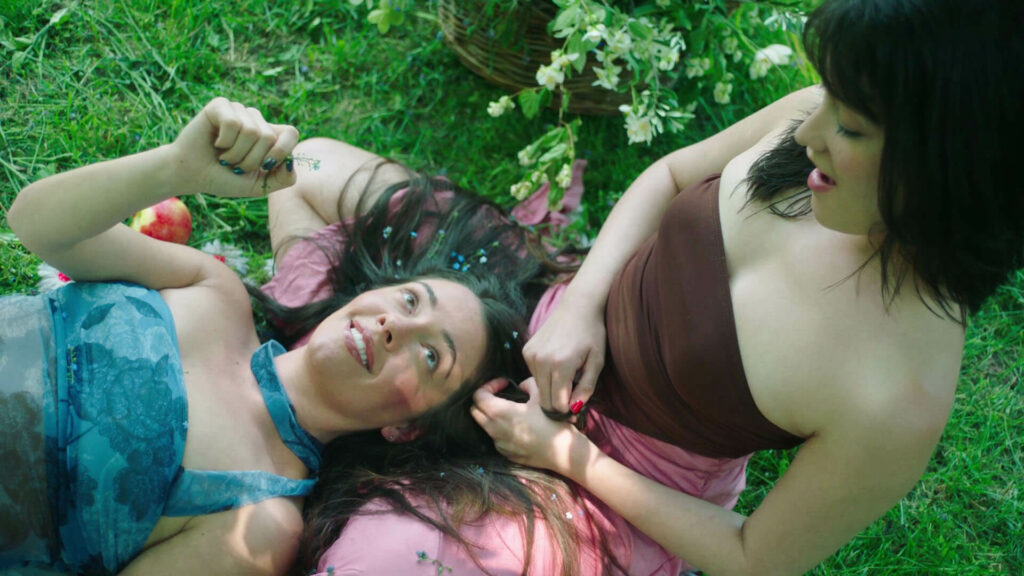
Lighting was another important part of our visual grammar. Whenever Lukas is being seduced, for example, we use a cosy, golden light to make the atmosphere feel warm and inviting. This creates a false sense of security, and an emotional dissonance with the tension, disgust and anxiety that Lukas (and the audience) are actually feeling in these moments.
Indie Shorts Mag: You sold paintings to help finance Backstage and had only one week of access to the theatre. How did you decide which creative elements needed protecting as you allocated the production’s limited resources?
Émile V. Schlesser: I knew this story needed real production value for it to work. The audience has to feel that there’s a lot at stake for Lukas. You have to believe that Cosima is indeed a highly successful director of international renown, someone who has the power to make or break his career. If you don’t get a real sense that this is Lukas’ big breakout opportunity, it becomes much harder to relate to his reluctance to push back against Cosima’s advances. So, elements like shooting in a lavish location and having enough extras to sell the illusion of a sold-out theatre were a must.
Since we couldn’t secure any funding from official institutions, I tried to maximise production value in every detail without spending money we didn’t have. This included costumes, props, production design, but also extras. In the end, we had to cheat a little using optical tricks. For example, the crowd shot during the theatre premiere was a composite shot. We only had around 30 extras sitting there, but we made it look like 300.
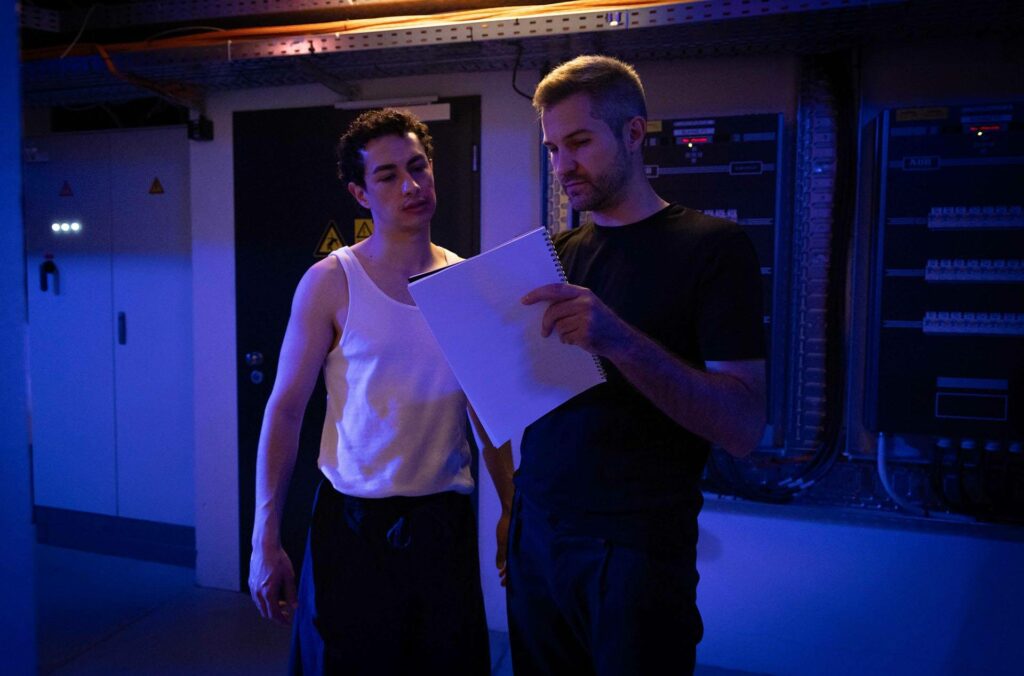
Indie Shorts Mag: Having taken on the editing yourself, what did working with the footage reveal about the performances that was harder to recognise while directing on set?
Émile V. Schlesser: When you sit down in a relaxed environment to edit the material you’ve shot, you inevitably notice details and nuances in the performances that you simply couldn’t catch when you’re immersed in the chaotic frenzy of production. Oftentimes, an actor’s instinct on their first take is what turns out to have the most resonance – before the director steps in and crams their heads with too much information.
In that sense, I have to say that both Jonathan and Sascha made my life as an editor really hard. They gave such strong performances. There were so many great takes to choose from, all different in colour, but each filled to the brim with raw, truthful emotion. Making the right choices wasn’t easy, but that’s a luxury problem I love to have.
Indie Shorts Mag: How did you and composer Rickie Lee Kroell develop the relationship between the score and the edit to create Backstage’s sense of isolation?
Émile V. Schlesser: Creating the music with Rickie was a truly unique experience. First, we didn’t feel the film needed a traditional score, as the tension really lies in the quiet moments and awkward silences. But the diegetic music played on stage eventually turns into a sort of score as soon as we cut to the action behind the curtain.
The way Rickie recorded it was especially exciting. She invited two jazz musicians, a bassist and a drummer (the latter being her father), to improvise freely in response to the film’s dynamics as it was being projected on a screen. Their improvisation was recorded live on the spot, already synced to the image. Nothing had been written beforehand, and the musicians hadn’t seen the film before the recording.
We did it the way Miles Davis and Louis Malle did in 1958 for “Elevator to the Gallows”, and we all thought it was the coolest thing ever.
Indie Shorts Mag: What do you hope Backstage encourages audiences to reconsider about why someone may struggle to say no to a person in authority?
Émile V. Schlesser: Anyone can be abused – and anyone can be an abuser. Men and women alike. If you haven’t lived through a similar situation, it’s easy to look at it from the outside and judge the victims, thinking, “That would never happen to me.” But it really isn’t that simple.
So many factors can make it difficult to even recognise that you’re being manipulated or taken advantage of. And once you do realise what’s going on, it can feel like it’s already too late to speak up. On one hand, what’s paralyzing you is fear – the fear of losing career opportunities, being punished, or provoking the abuser’s temper. On the other hand, it can also be love, admiration, or friendship. You may feel close to the person, or believe you’ve had a good collaboration, and simply don’t want to hurt their feelings. And the longer you avoid taking action, seeking help, or clearly communicating how you feel, the messier it gets.
Schlesser’s reflections on Backstage connect its examination of power with the practical work of filmmaking: directing layered performances, composing images, shaping an edit and finding ways to give limited resources a convincing scale. His account also places trust at the centre of collaboration, describing the conversations that helped the cast feel supported while exploring difficult material. For filmmakers, the interview offers a close look at how artistic choices can carry a story’s meaning. For audiences, it returns to the question running through the film: what makes it so difficult to recognise an abuse of power, and to speak when a boundary has been crossed?
No comments yet.
Got Something to add to this article?
Your email address will not be published. Required fields are marked *