
Article too long to read?
A short film is a standalone motion picture that is shorter than a feature film. For the 99th Academy Awards, the Academy of Motion Picture Arts and Sciences defines a short film as an original motion picture with a running time of 40 minutes or less, including all credits. Other festivals and organizations may use different runtime limits, so there is no single cutoff that applies everywhere.
If you want the fast answer, here it is:
- A short film is intended to stand on its own as a cinematic work rather than simply being a fragment of something longer.
- The Academy defines a short film as 40 minutes or less, including credits.
- Festival limits can be different, depending on the event and competition.
- Short films can be narrative, documentary, animated, experimental, or hybrid.
- A short film is not the same thing as short-form social video such as TikToks, Instagram Reels, or YouTube Shorts.
- Short films can be finished works in their own right, while also giving filmmakers room to experiment, build a body of work, or develop ideas that may later expand into longer projects.
The format covers an enormous range. PES’s Fresh Guacamole (2012), for example, runs just 1 minute and 40 seconds and was nominated for the Academy Award for Animated Short Film, while Damien Chazelle’s Whiplash (2013) runs approximately 18 minutes and later became the foundation for a feature film.
So while runtime matters, it does not tell the whole story. A short film is best understood as a cinematic work conceived to exist in a compact form.
This guide explains how long short films can be, what counts as a short film, the main types, how short-film storytelling differs from feature filmmaking, where shorts are screened, and several notable examples.
What Beginning Filmmakers Should Know About Short Films
sbb-itb-376fc17
Short Film Definition, Length, and What Counts
How Long Is a Short Film?
There is no universal runtime limit that every film festival and organization follows.
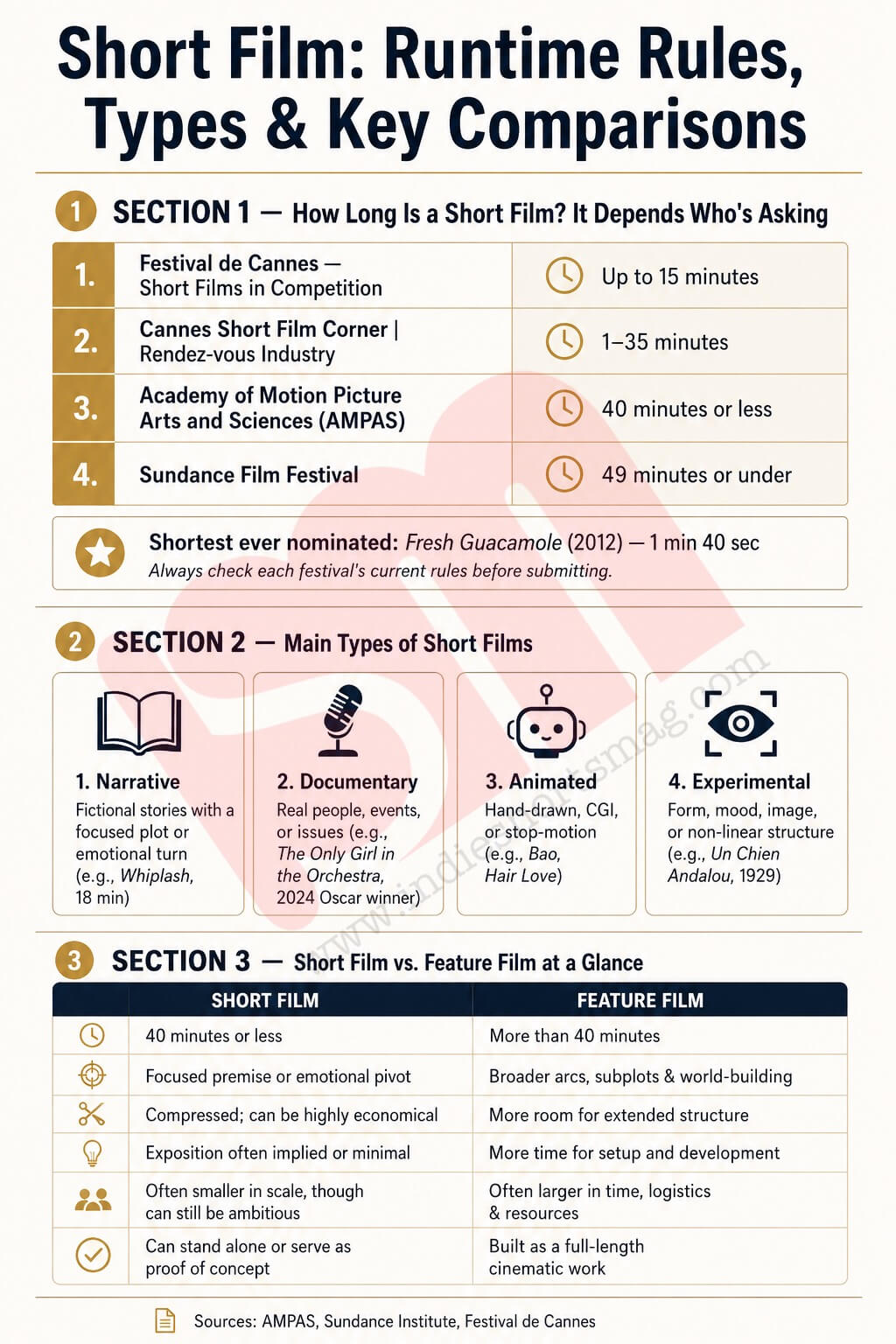
The Academy of Motion Picture Arts and Sciences defines a short film for Academy Awards purposes as an original motion picture running 40 minutes or less, including all credits.
That 40-minute figure is widely referenced, but filmmakers should not assume that every festival accepts shorts of that length. Different festivals establish their own rules based on programming, competition structure, and eligibility requirements.
| Organization / Context | Current Short-Film Runtime Limit |
|---|---|
| Academy of Motion Picture Arts and Sciences (AMPAS) | 40 minutes or less, including credits |
| Sundance Film Festival | 49 minutes or under, including credits |
| Festival de Cannes — Short Films in Competition | Up to 15 minutes, including credits |
| Cannes Short Film Corner | Rendez-vous Industry | 1–35 minutes |
The Cannes distinction is particularly important. The Festival de Cannes Short Film Competition and the Short Film Corner | Rendez-vous Industry are not the same programme. Films entered into the official Short Film Competition are subject to a much shorter runtime limit, while films between 1 and 35 minutes can be registered for the industry-focused Short Film Corner.
For filmmakers, the practical lesson is simple: always check the rules of the individual festival before submitting your film. A 30-minute film may clearly qualify as a short under Academy rules but still be too long for a particular festival competition.
There is also no general requirement that a short film must reach a particular minimum length. A complete cinematic work can last only a few minutes — or even less.
What Counts as a Short Film — and What Does Not?
Runtime is one part of the definition, but it is not the only useful way to think about the format.
In general, a short film is conceived as a standalone cinematic work rather than simply a fragment of something longer. It can tell a conventional narrative with characters and conflict, document real people or events, work through animation, or abandon traditional storytelling entirely in favour of mood, image, sound, rhythm, or experimentation.
A short film therefore does not have to follow a traditional beginning-middle-end structure. Narrative shorts often do, but documentary, experimental, essayistic, abstract, and hybrid films may use very different forms. What matters more is that the work has been conceived to function at its chosen length.
For Academy Awards eligibility specifically, the rules exclude certain works from consideration as short films, including:
- previews and advertising films;
- alternate or re-edited versions of shorts that have already been publicly exhibited;
- material substantially taken from or cut down from a completed, publicly exhibited feature film;
- and works originally created as episodic television, including certain pilots or parts of an ongoing or limited series.
Those are Academy eligibility rules, however, rather than a universal definition governing every festival, platform, or filmmaker. The term "short film" is used across a much wider filmmaking ecosystem than the Academy Awards alone.
Short Film vs. Short-Form Social Video
A short film and a short-form social video can both last only a few minutes, but they are not interchangeable formats.
TikTok videos, Instagram Reels, YouTube Shorts, and similar content can be scripted, cinematic, professionally produced, and artistically ambitious. The difference is therefore not simply production quality, camera equipment, crew size, or budget. The more useful distinction is the work’s intended format, viewing context, and purpose.
| Aspect | Short Film | Short-Form Social Video |
|---|---|---|
| Core format | Standalone cinematic work | Content designed primarily for a social platform or feed |
| Typical viewing context | Festivals, screenings, curated platforms, streaming, and online film channels | Social feeds and algorithmic discovery |
| Structure | May be narrative, documentary, animated, experimental, or hybrid | Can be narrative or non-narrative and is often optimized for immediate attention |
| Orientation | Often created as a film first | Often created around the conventions of a particular platform |
| Length | From very brief works up to festival-defined limits | Usually constrained by platform formats and audience behaviour |
| Production | Can range from one filmmaker with a phone to a large professional crew | Can also range from solo mobile production to large professional productions |
The line can occasionally blur. A filmmaker might release a cinematic work vertically, or a social video might develop into something that functions like a short film. The formats increasingly borrow techniques from one another.
But in the traditional film context, a short film is primarily approached as cinema in a compact form, rather than simply a video that happens to be short.
Main Types of Short Films and How They Tell Stories
Narrative, Documentary, Animated, and Experimental Shorts
Short films can take almost any cinematic form or genre. It helps to distinguish form from genre. A form describes how the work is constructed — such as narrative, documentary, animation, or experimental cinema. A genre describes the kind of story or experience it offers — such as drama, comedy, horror, thriller, romance, or science fiction.
A horror short, for example, could be live-action narrative, animation, documentary, experimental film, or a combination of several forms.
- Narrative shorts tell fictional stories. They may include traditional characters, conflict, dramatic development, and resolution, but their limited runtime often encourages a narrower focus than a feature film.
- Documentary shorts explore real people, places, events, communities, or subjects within a limited runtime. The Only Girl in the Orchestra (2024), directed by Molly O’Brien, won the Academy Award for Documentary Short Film.
- Animated shorts may use traditional hand-drawn animation, CGI, stop motion, cut-outs, puppetry, mixed media, or experimental animation techniques. Domee Shi’s Bao (2018), produced by Pixar, is a prominent modern example.
- Experimental and hybrid shorts may focus on visual composition, montage, sound, repetition, atmosphere, performance, abstraction, or non-linear structures rather than conventional plot.
Luis Buñuel and Salvador Dalí’s Un Chien Andalou (1929) remains one of cinema’s best-known examples of a short work structured around surreal and dreamlike associations rather than conventional plot logic.
Contemporary short filmmaking also increasingly includes hybrid work that combines documentary, fiction, animation, archival material, performance, or other forms. That flexibility is one of the short film’s greatest strengths.
How Short-Film Storytelling Differs from Longer Formats
A short film is not simply a feature film with fewer scenes. The reduction in runtime changes the storytelling possibilities.
A feature may have room for multiple subplots, large casts, extended character development, and gradual changes that unfold across hours. A short film usually works within a tighter dramatic or thematic frame.
That does not mean every short needs to be simple. It means that filmmakers often have to communicate more with less.
Visual storytelling becomes especially valuable. A location, costume, gesture, prop, sound, or brief exchange can communicate information that might otherwise require several scenes of exposition. Shorts also frequently enter a situation later than a feature would. Instead of spending several minutes explaining who the characters are and how they arrived at a conflict, the filmmaker may begin when something is already happening and allow the audience to infer the backstory.
Not every short uses the same structure, but narrative shorts often benefit from focusing on a limited number of dramatic beats.
Damien Chazelle’s approximately 18-minute short Whiplash (2013), starring J.K. Simmons, is a useful example. Rather than attempting to tell the full story later explored in the feature, the short concentrates its energy around an intense rehearsal and the relationship between a demanding instructor and a young drummer. For a more detailed look at constructing your own story, read our guide on how to write a short film script.
Short Film vs. Feature Film: Key Differences at a Glance
The most obvious distinction between a short and a feature is runtime. Under the Academy’s current rules, a short film runs 40 minutes or less, while a feature-length motion picture runs more than 40 minutes.
But runtime affects many other areas of filmmaking as well.
| Aspect | Short Film | Feature Film |
|---|---|---|
| Academy runtime definition | 40 minutes or less | More than 40 minutes |
| Typical narrative scope | Often concentrates on a limited situation, idea, or character focus | More room for multiple storylines, relationships, and character arcs |
| Exposition | Frequently compressed or implied | More time available for setup and world-building |
| Structure | Can be highly compressed, unconventional, or experimental | More runtime for extended structural development |
| Production | Often smaller in scale, though professional shorts can still be complex and expensive | Typically requires greater time and resources because of its length and scope |
| Distribution | Festivals, curated screenings, online platforms, streaming, broadcast, and specialist channels | Theatrical distribution, streaming, television, and other established feature-film channels |
These are tendencies rather than rules. A short can have an enormous crew and budget. A feature can be made by a tiny team with very little money. A short can contain multiple characters and timelines, while a feature can focus almost entirely on one person in one location.
The key difference is that a short filmmaker has less screen time in which to make those choices work.
For a much more detailed comparison, see our dedicated guide to short film vs feature film.
Why Filmmakers Make Short Films and How They Are Made
Why Short Films Matter to Filmmakers and Audiences
Short films are sometimes described as training exercises or stepping stones toward feature filmmaking. They can certainly serve those purposes, but reducing the form to a practice run misses much of what makes short cinema valuable.
A short film can be the finished artistic work.
The format gives filmmakers room to experiment with ideas that may not need — or benefit from — feature length. A filmmaker can build a story around one image, moment, performance, question, visual device, or emotional experience without expanding it simply to reach a longer runtime.
Short films can also be useful professionally. They may function as:
- calling cards for directors, writers, cinematographers, actors, editors, and other collaborators;
- proof-of-concept films for larger projects;
- festival works;
- portfolio pieces;
- experiments in technique or form;
- ways to develop new collaborations;
- or independent works intended to exist only as shorts.
David F. Sandberg’s roughly three-minute horror short Lights Out is one well-known example of a short film that eventually led to a feature adaptation. Damien Chazelle’s Whiplash likewise demonstrates how a short can be used to show the potential of a larger project.
But many celebrated short films never become features — nor do they need to. Their brevity is part of their identity.
How a Short Film Gets Made: From Concept to Final Cut
The basic filmmaking process is similar to that of longer productions: an idea moves through development, pre-production, production, post-production, and eventually distribution or exhibition. The scale of each stage varies enormously.
1. Finding the Idea
Many successful short films begin with a concept that naturally suits a limited runtime. That might be one encounter, one problem, one location, one relationship, one decision, one visual concept, or one moment of change.
If you’re still looking for a concept, our collection of short film ideas can help you get started.
2. Writing the Script
A short screenplay benefits from economy. Scenes, characters, dialogue, and locations should serve a clear purpose, particularly when the film only has a few minutes to establish its world.
That doesn’t mean every short has to be minimalist. It means the filmmaker should understand why each element belongs. Our guide on how to write a short film script explores the process in more detail.
3. Pre-Production
Pre-production can include budgeting, casting, finding crew, location scouting, scheduling, storyboarding, creating shot lists, rehearsals, securing equipment, and planning sound, production design, wardrobe, and logistics.
Budgets vary dramatically from project to project. Some shorts are created for almost nothing; others are professionally financed productions involving substantial crews and resources. For a closer look at the numbers, read our guide to short film production costs.
It is also worth reviewing these common short film mistakes before cameras start rolling.
4. Production
Production is where the planned material is filmed or otherwise created. Shorter runtime does not automatically mean production is easy.
A five-minute film with complex locations, stunts, visual effects, animation, or elaborate production design can require more work than a much longer film made under simpler conditions. What the short format does offer is the possibility of designing a project around the resources actually available.
5. Post-Production
Editing determines the final rhythm and structure of the film. Post-production may also involve sound editing, sound design, dialogue cleanup, ADR, music, visual effects, colour correction and grading, titles, subtitles and captions, and final deliverables for festivals or distribution.
Our short film post-production guide covers this stage in greater detail.
Where Short Films Are Screened and Distributed
Film festivals remain one of the most visible homes for short cinema. Major international festivals including Sundance, Cannes, Berlin, and TIFF programme short films, while specialist events such as Clermont-Ferrand focus heavily or entirely on the short form.
There are also festivals devoted to particular genres, countries, communities, filmmaking methods, student work, animation, documentaries, experimental cinema, and many other areas.
If you’re planning a festival run, start with our guide to film festivals for short films.
Festivals are only one part of short-film distribution. Short films can also reach audiences through online film platforms, curated YouTube and Vimeo channels, streaming services, television, dedicated short-film channels, educational institutions, museums and galleries, community screenings, film societies, theatrical short-film programmes, and filmmakers’ own websites or social channels.
Platforms and curators such as Short of the Week, Omeleto, Vimeo Staff Picks, and ShortsTV have helped audiences discover short cinema outside the traditional festival environment.
Distribution strategy can depend heavily on a filmmaker’s goals. A filmmaker aiming for a festival premiere may choose to keep a film offline during the early stages of its festival run, while another filmmaker may prioritize immediate online reach.
Because premiere and online-availability rules vary among festivals, filmmakers should research those requirements before releasing a film publicly.
Notable Short Film Examples and Final Takeaway
A Curated List of Notable Short Films
The following films demonstrate how varied short cinema can be.
| Title | Filmmaker | Year | Approx. Runtime | Form | Why It Matters |
|---|---|---|---|---|---|
| Whiplash | Damien Chazelle | 2013 | 18 min | Narrative fiction | Demonstrated the potential of a story that Chazelle later expanded into an acclaimed feature film |
| Thunder Road | Jim Cummings | 2016 | 13 min | Narrative fiction | Won the Short Film Grand Jury Prize at the 2016 Sundance Film Festival |
| Hair Love | Matthew A. Cherry | 2019 | 7 min | Animation | Won the Academy Award for Animated Short Film |
| Night and Fog | Alain Resnais | 1956 | 32 min | Documentary | A landmark documentary work examining the Holocaust and the remains of Nazi concentration camps |
| Un Chien Andalou | Luis Buñuel & Salvador Dalí | 1929 | 16 min | Experimental | One of the best-known examples of surrealist cinema and non-linear visual storytelling |
| Fresh Guacamole | PES | 2012 | 1 min 40 sec | Animation | An extremely brief film that received an Academy Award nomination for Animated Short Film |
These films have little in common stylistically. That is precisely the point. "Short film" describes a format, not a single style of filmmaking.
A short can be funny, frightening, political, abstract, intimate, documentary, commercial-looking, handmade, animated, silent, dialogue-heavy, experimental, or almost anything else. The limitation is primarily time. What filmmakers do with that limitation is remarkably open.
Conclusion: What You Need to Know About Short Films
A short film is more than simply a movie that does not last very long.
In practical terms, major organizations define the format partly through runtime. The Academy currently uses 40 minutes or less, including credits, while individual festivals may impose different limits.
But as a creative form, the short film is much broader. It is cinema designed to work within a compressed space. That may mean one dramatic encounter, a focused documentary portrait, an animated story, an abstract visual experiment, or a form that does not fit neatly into any category.
Short films can help filmmakers learn, experiment, reach festivals, develop careers, or prove the potential of larger projects. They can also exist for no purpose beyond being short films.
And that is important. A great short does not have to apologize for not being a feature. Its length is part of the form.
If you have completed your own project and want independent editorial feedback and coverage, you can submit your short film for review.
FAQs
Can a short film be under one minute?
Yes.
There is no universal minimum runtime that a film must reach before it can be considered a short film. Under the Academy’s current definition, the important runtime requirement is the upper limit: 40 minutes or less, including credits.
A very brief work can therefore function as a short film if it has been conceived as a standalone motion picture.
Does every festival use the same short film length limit?
No.
Runtime limits vary considerably. The Academy uses a maximum of 40 minutes including credits, Sundance accepts shorts running 49 minutes or under, and the Festival de Cannes uses a much shorter limit for its official Short Film Competition.
Always check the current rules of the festival you intend to enter.
Is a 40-minute film still a short film?
Under the Academy’s current definition, yes.
A film with a running time of exactly 40 minutes, including credits, falls within the Academy’s definition of a short film. Individual festivals may use lower limits.
Can a short film become a feature later?
Yes.
A filmmaker can create a short film that works as its own piece and later expand the idea, characters, or world into a feature. Whiplash and Lights Out are prominent examples of short-film projects that developed into feature films.
That does not mean a short needs to be designed as a feature-film teaser. Ideally, the short should still give audiences a satisfying experience on its own terms.
What types of short films are there?
Short films can take many forms, but common categories include narrative fiction, documentary, animation, experimental film, and hybrid work combining several forms.
Within those categories, shorts can belong to virtually any genre, including drama, comedy, horror, thriller, romance, science fiction, fantasy, and others.
What is the difference between a short film and a feature film?
The clearest distinction is runtime.
For the Academy Awards, a short film is 40 minutes or less, including credits, while a feature-length motion picture runs more than 40 minutes.
In practice, the difference also affects storytelling, production, scheduling, budgeting, and distribution because feature films have considerably more screen time in which to develop their material.
Related Blog Posts
No comments yet.
Got Something to add to this article?
Your email address will not be published. Required fields are marked *