Article too long to read?
If you want short film funding in 2026–2027, the best move is to sort by stage, location, and who can apply first. This roundup shows that awards range from $2,500 to $60,000, with some funds adding post services, gear, mentorship, or festival help.
Here’s the short version:
- Narrative filmmakers can look at programs like Shore Scripts, Pandora, Vimeo, and First Flights
- Films already shot should focus on finishing support like Shore Scripts Finishing Fund, Genesis House x Gotham, BlackStar x FotoKem, and Frameline
- Documentary teams have options such as Sundance Documentary Short Fund, IF/Then Shorts, Switchboard, BFI Doc Society, and DOC NYC’s The Louies
- Students and early-career filmmakers can check Austin Film Society, Harrison McClure, and FFC Global Short Film Fund
- International and public funding includes options like First Flights and Doha Film Institute
A few patterns stand out fast:
- Micro-grants often sit under $5,000
- Many production and post grants land in the $5,000–$15,000 range
- Top awards can reach $30,000+, with Vimeo going as high as $60,000
- Some of the best-fit funds are not the biggest cash awards; gear, color, sound, and screening support can matter just as much
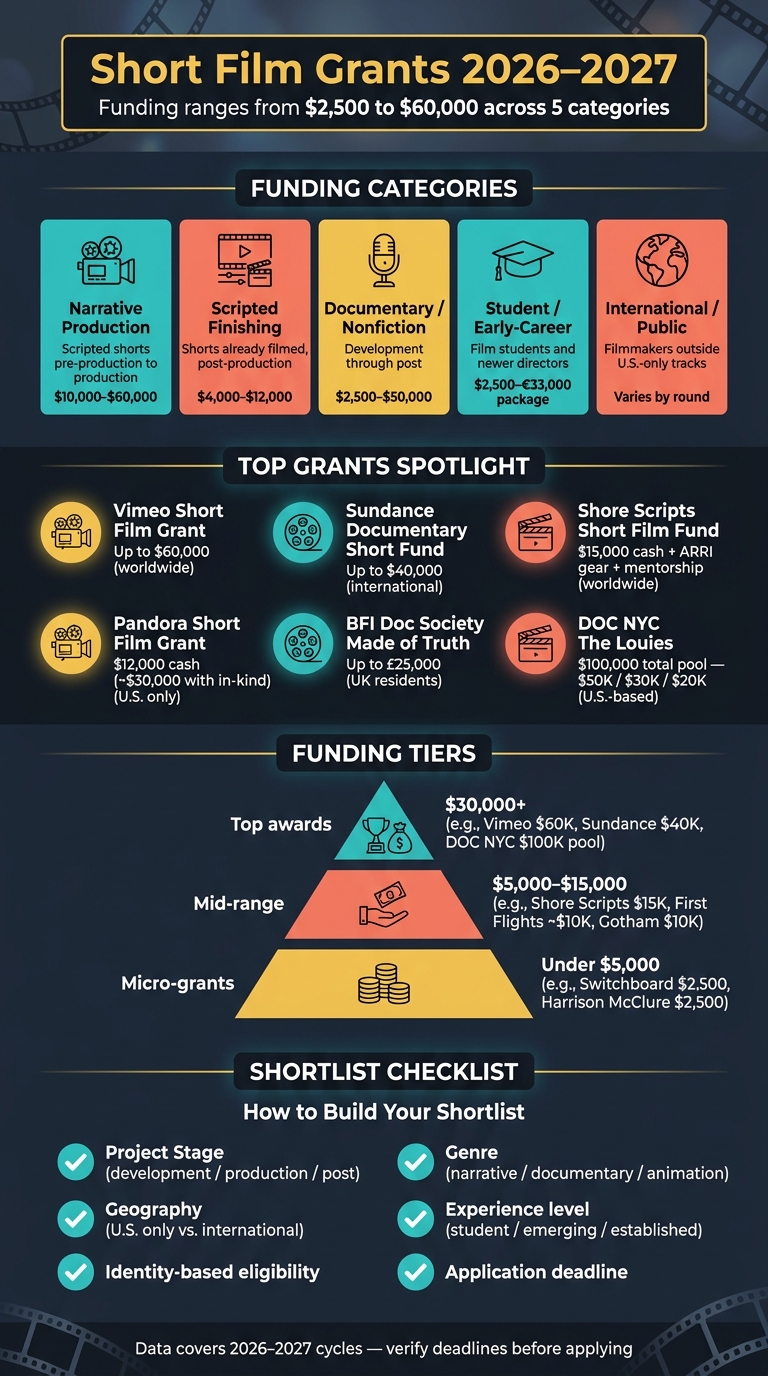
Short Film Grants 2026–2027: Funding Ranges by Category
Quick Comparison
| Category | Best Fit | Typical Stage | Sample Funds | Funding Range |
|---|---|---|---|---|
| Narrative production | Scripted shorts getting ready to shoot | Script, pre-production, production | Shore Scripts, Pandora, Vimeo, First Flights | $10,000–$60,000 |
| Scripted finishing | Shorts already filmed | Late production, post | Shore Finishing, Gotham, BlackStar | $4,000–$12,000 |
| Documentary | Nonfiction shorts | Development to post | Sundance, IF/Then, Switchboard, BFI, Louies | $2,500–$50,000 |
| Student / early-career | Film students and newer directors | Pre-production to post | AFS, Harrison McClure, FFC Global | $2,500–€33,000 package |
| International / public | Filmmakers outside U.S.-only tracks | Production or post | First Flights, DFI | Varies by round |
My main takeaway: don’t build a long list. Build a tight one. Match your project to funds by deadline, geography, runtime, genre, identity rules, and project stage, then tailor each application to that fund’s focus.
sbb-itb-376fc17
Narrative Short Film Grants Open or Recurring in 2026–2027
Production Grants for Emerging Narrative Filmmakers
Five recurring programs stand out for narrative short filmmakers in 2026–2027.
Shore Scripts Short Film Fund runs two cycles each year, Spring and Fall, and accepts applicants worldwide. The Fall 2026 cycle has an early deadline of August 20, 2026, a regular deadline of September 30, 2026, and a final deadline of October 30, 2026. The main production grant gives $15,000 in cash to one unproduced narrative short screenplay. Eligible scripts are 2–30 pages, or up to 45 pages with an extra fee. The package also includes ARRI camera rental, mentorship from producer Maria Gracia Turgeon, festival strategy support from a Tribeca programmer, script development, and production support. It accepts live-action narrative shorts, animation, and proof-of-concept shorts for features or TV.
Pandora Short Film Grant is a U.S.-only option aimed at early-career filmmakers. Applicants must be U.S. citizens or lawful permanent residents and must not have directed a feature with a budget over $250,000. Submissions open May 30, 2026, and the deadline is October 1, 2026. The grant gives $12,000 in cash each year, and the full package is worth about $30,000 when cash and in-kind support are combined. That support includes Panavision gear, Kodak support, and mentorship. It backs short narrative projects at the script stage.
Vimeo Short Film Grant Program is open worldwide and supports both narrative and documentary shorts. It belongs here because it does fund narrative work, even if documentaries are part of the mix too. In the 2026 cycle, Vimeo will award up to $60,000 each to five emerging filmmakers. Applications for the 2026 cycle open September 21, 2026.
First Flights Short Film Fund offers non-recoupable grants of up to £7,000 – about $10,000 – for scripted short films under 30 minutes that are ready to move into production within six months of the deadline. Some cycles are open worldwide, while others require the film to shoot in the UK. Applicants usually need a completed script, logline, synopsis, director’s vision, director bio, budget, and often a lookbook. A sizzle reel is optional. The 2026 cycle has two rounds opening on February 4, 2026, and August 4, 2026, and some rounds also include mentorship and festival strategy support.
Completion and Finishing Support for Scripted Shorts
Once principal photography is done, the target changes. At that point, production grants matter less, and finishing support becomes the better fit. If your short is already shot, focus on finishing funds. These usually ask for a rough cut or picture lock, along with a clear post plan.
Shore Scripts Finishing Fund awards $4,000 in cash to one short already in post-production, with a projected final runtime of 40 minutes or less. Applicants must submit a rough cut or scene assembly, the screenplay, a synopsis, and a post-production plan that shows how the money will be spent.
Genesis House x The Gotham Shorts Fellowship is a New York City-specific option. Three scripted narrative shorts in late production or post each get $10,000 in finishing funds, plus industry mentorship and a screening during Gotham Week 2026. To qualify, principal photography must have been completed between April 1, 2025 and April 1, 2026. Applicants also need to be U.S.-based and authorized to work in the U.S. Films cannot premiere before Gotham Week.
BlackStar x FotoKem Lodge Finishing Grant provides $12,000 in professional post-production services, including color grading, sound, and mastering, to one filmmaker of color based in the U.S., U.S. territories, or Canada. It is limited to narrative shorts under 30 minutes. Applications opened September 3, 2026 and close October 1, 2026.
“Competitive projects should ideally be picture-locked.” – BlackStar Projects
That last point matters. Finishing funds usually want a rough cut or picture lock, not just a script.
Comparison Table: Narrative Short Production and Completion Funds
Use the table below to compare award size, stage, and eligibility at a glance.
| Program | Award Amount | Project Stage | Filmmaker Profile | Geographic Eligibility | Runtime Cap |
|---|---|---|---|---|---|
| Shore Scripts Production Grant | $15,000 cash | Pre-production | Emerging filmmakers; first-time directors eligible | Worldwide | 2–30-page script (up to 45 pages with fee) |
| Pandora Short Film Grant | $12,000 cash (~$30,000 with in-kind support) | Script stage | Early-career filmmakers | U.S. citizens and lawful permanent residents | Not specified |
| Vimeo Short Film Grant | Up to $60,000 each | Production | Emerging filmmakers | Worldwide | Not specified |
| First Flights Short Film Fund | Up to £7,000 (about $10,000) | Pre-production / production-ready | Emerging filmmakers | International; some cycles may require UK production | Under 30 minutes |
| Shore Scripts Finishing Fund | $4,000 cash | Post-production | Emerging filmmakers | Worldwide | Under 40 minutes |
| Genesis House x Gotham Shorts | $10,000 cash each | Late production / post | U.S.-based filmmakers | U.S.-based, authorized to work in the U.S. | Not specified |
| BlackStar x FotoKem Finishing Grant | $12,000 in services | Post-production | Filmmakers of color | U.S., U.S. territories, Canada | Under 30 minutes |
Documentary and Nonfiction Short Film Funding
If your short is nonfiction, the funding logic changes. Access, urgency, and footage usually matter more than screenplay polish. And because many of these programs return on set cycles, timing can make or break an application.
Short Documentary Grants and Labs to Watch
Sundance’s Documentary Short Fund runs on a biennial cycle. The 2026 round opened May 18, 2026, and offers up to $40,000 for short documentaries.
IF/Then Shorts works more like a lab than a plain cash grant. Four filmmaking teams join a year-long program centered on story development, impact strategy, and industry mentorship. Each team also gets production support for its short documentary. Past partners have included Hulu.
Switchboard Shorts Grant is small, but it can still move a project forward. It gives $2,500 to one short documentary filmmaker for production, plus in-kind help like legal support, music licensing, post sound, and audio description. It’s a good match for early-stage nonfiction projects that need a modest push.
BFI Doc Society’s Made of Truth: Short Film Fund supports non-fiction live-action or animated short films between 5 and 40 minutes. It offers grants up to £25,000 per project and backs up to 13 short documentaries each year. The 2026 round opened May 18, 2026, and closed July 1, 2026. Both the director and producer must be UK residents.
DOC NYC’s The Louies Fund is aimed at U.S.-based producers whose short documentary has already qualified for the Academy Awards. It distributes $100,000 across three awards: $50,000, $30,000, and $20,000.
Frameline’s Completion Fund rounds out the list for LGBTQ+-focused shorts, including documentaries. It has no nationality restriction, accepts short films of any length, and has awarded $717,500 to 203 projects since 1991. Projects must be about 90% complete and entering post-production.
What Documentary Applications Need to Show
Once you’ve found funds that match your stage, the next hurdle is simple: proving you can make the film.
For documentary shorts, access is the big separator. Funders want to see that you can actually film the story. That means your subjects have agreed to take part, you can get into the places you need, and the project isn’t just an idea on paper. A letter of support, a signed release, or even a short note about your existing relationship with contributors can help.
Beyond access, nonfiction funders tend to look for the same core pieces: a concise director statement that explains your connection to the subject and why the story matters now, a visual sample that shows your cinematic approach, a realistic budget that makes clear how the grant will move the project ahead, and a production timeline that shows the film is doable.
Impact framing matters most for public-interest and social-justice funds. If your project has a public-facing angle, say it plainly in one or two sharp sentences. Then show how the short could reach people beyond festivals, whether through community screenings, educational use, or advocacy partnerships. For completion-stage funds like Frameline, a rough cut is usually required, and a trailer alone often won’t be enough.
Comparison Table: Documentary-Only and General Short Film Funds
Use the table below to separate documentary-only funds from general short film grants.
| Fund | Doc-Only or General | Max Award / Support | Stage Supported | Best Fit | Geographic Eligibility |
|---|---|---|---|---|---|
| Sundance Documentary Short Fund | Documentary only | Up to $40,000 | Development, production, post | Projects with a strong access plan and visual sample | International |
| IF/Then Shorts Lab | Documentary only | Production support and mentorship | Development + production | Teams seeking mentorship and impact strategy | International |
| Switchboard Shorts Grant | Documentary only | $2,500 + in-kind support | Production | Early-stage short docs needing a modest boost | U.S.-based |
| BFI Doc Society Made of Truth | Documentary only | Up to £25,000 | Production | Early-career nonfiction shorts | UK residents only |
| DOC NYC The Louies | Documentary only | $100,000 total; top award $50,000 | Post / awards season | Oscar-qualified shorts | U.S.-based producers |
| Frameline Completion Fund | General (LGBTQ+ focus) | $1,000–$5,000 | Completion / post | Near-finished LGBTQ+ shorts, including documentaries | International |
| Vimeo Short Film Grant | General | Up to $60,000 | Production | General short film fund; useful for documentary shorts with strong production plans | International |
Funding Options for Students, Emerging Directors, and Underrepresented Filmmakers
The programs below are grouped by the filmmakers they’re meant to help. That makes it easier to skip the poor fits and focus on the grants you can actually use. If you’re a student, a regional filmmaker, an early-career director, or looking for equity-centered funding, this section helps narrow the field.
Student and Regional US Short Film Grants
The Austin Film Society (AFS) Grant for Short Films is built for emerging Texas filmmakers making shorts under 40 minutes. It supports projects in pre-production, production, or post-production. It does not fund development or distribution costs. Filmmakers can ask for up to $10,000 in cash. On top of that, the grant includes in-kind support: a multi-day camera and lighting package from MPS Studios worth up to $10,000, plus a color/conform/DCP deliverables package from TBD Post worth up to $12,000. The application window usually opens in the summer and closes in late August. For the 2026 cycle, the deadline was August 27, 2026, at 6:00 p.m. CT, and the next round is expected to reopen in summer 2027.
Within AFS, the Harrison McClure Endowed Film Fund offers a separate $2,500 cash award for undergraduate students who are incoming juniors or seniors and enrolled full-time at a four-year Texas college or university. The project must meet a course or degree requirement, which makes this fund a strong match for thesis films, capstones, and upper-level class work. For the 2026 cycle, applications opened on April 15 and closed on May 20.
Equity-Focused and Emerging Filmmaker Funds
Some programs do more than hand over a check. They may also include mentorship, post services, or access to people in the field. That mix can matter just as much as the cash.
The FFC Global Short Film Fund 2026 is open to women and non-binary filmmakers worldwide. It gives one winning project a package worth €33,000: a €10,000 cash production grant, €15,000 in post-production services from Disauthority, and €8,000 in virtual production support from Mo-Sys. The fund accepts narrative, documentary, animation, experimental, and proof-of-concept shorts up to 30 minutes. Projects can be in production or post-production, but they must be able to finish by October 2027.
The Pandora Short Film Grant is another option for early-career U.S. narrative filmmakers. Alongside the main award, the three finalists get camera rental support from Panavision and $10,000 in color grading and finishing from Harbor. Winners may also use an optional $1,000 Kodak Film Grant for film stock and lab costs.
Comparison Table: Student, Emerging, and Equity-Focused Opportunities
Use the table below to sort these options by eligibility, project stage, and type of support.
| Fund | Filmmaker Profile | Geographic Limit | Support Type | Project Stage | Award Size Band |
|---|---|---|---|---|---|
| AFS Grant for Short Films | Emerging Texas filmmakers | Texas only | Cash + in-kind (camera, color/post) | Pre-production, production, or post-production | Up to $10,000 cash; up to $32,000 combined value with in-kind support |
| Harrison McClure Endowed Film Fund | Undergraduate juniors/seniors | Texas four-year schools | Cash | Course- or degree-required short | $2,500 cash |
| FFC Global Short Film Fund | Women and non-binary filmmakers | International | Cash + in-kind post + virtual production | Production or post-production | €33,000 package |
| Pandora Short Film Grant | Early-career U.S. narrative filmmakers | United States | Cash + in-kind support + mentorship | Script stage or post-production | $12,000 cash plus in-kind support |
International and Public Funds, Plus a Shortlist Strategy for 2026–2027
Internationally Open and Publicly Backed Short Film Funds
If your project doesn’t fit U.S.-only programs or identity-based funds, it makes sense to look at public programs and internationally open grants.
First Flights Short Film Fund is the clearest globally open option in this group. It doesn’t require a co-production setup and offers non-recoupable grants for production costs on shorts under 30 minutes. Your project also needs to be ready to go into production within six months of the deadline. So this fund is best for filmmakers who are close to an actual shoot, not just shaping an idea.
If you need public support instead of a private grant, DFI is the other main international path here.
The Doha Film Institute (DFI) Grants Programme backs short films in development, production, and post-production across MENA, Qatari, and international categories, but access is limited by region. If you’re a U.S. filmmaker, check the eligible-country list and producer rules before you apply, since you may need a regional producer attached to the project. DFI runs two cycles each year. The Spring 2026 deadline was January 8, 2026, and the Fall 2026 round opened around June 22 and closed around July 2, 2026.
How to Build a Shortlist
A short, well-matched list usually works better than spraying applications everywhere and hoping something sticks.
Start with your project stage: development, production, or post-production. Most funds are strict on this point. First Flights is for projects that can enter production within six months, while finishing funds like Frameline want projects to be about 90% complete.
Then filter by fit:
- Geography
- Identity-based eligibility
- Genre
- Experience level
- Deadline
- Application fee
That step cuts the list down fast and helps you line up your effort in a sane order.
Most applications ask for the same core materials: a logline, synopsis, director statement, script or treatment, budget top sheet, timeline, and work samples. Some programs add extra items. FFC Global asks for a character prototype and script coverage through IMGN, while DFI requires a passport scan and a producer attached in a separate way.
Conclusion: Where Most Short Filmmakers Should Start
Start with the fund that fits your stage and eligibility, then shape each application around that program’s focus.
FAQs
How do I know which grant stage fits my film?
Match your film’s current stage to the fund’s stated rules. Production grants are for projects that have not started principal photography yet.
If filming is finished and you need help with editing, sound, color, or other final work, apply for finishing or completion funds instead. Some grants tied to festival exhibition or awards-season positioning only accept films that are already complete or Oscar-qualified. Before you apply, check that your project stage is clearly listed as eligible.
What should I include in a strong short film grant application?
Include a professional package, not just a pitch.
That usually means:
- a strong script
- a clear proposal
- a logline
- a one-page synopsis
- director and producer statements
- core team bios or CVs
You should also include a budget, schedule, and visual materials.
If you’re applying for post-production funds, send a rough cut or working cut and spell out exactly what the money will cover.
It also helps to check the funder’s rules on AI disclosure before you submit. Some groups want that information spelled out. Others have more specific limits.
Most of all, shape the package around the funder’s goals and mission. A good application doesn’t just say the project is worth backing. It shows why it fits that funder in particular.
Should I prioritize cash awards or funds with in-kind support?
Prioritize funds with in-kind support alongside cash if you want more day-to-day value from your budget. These programs can pair funding with equipment, mentorship, or post-production help.
That can be more useful than cash alone when those services would otherwise turn into major out-of-pocket costs. Look closely at whether the in-kind support solves your project’s current logistical or financial bottlenecks.
No comments yet.
Got Something to add to this article?
Your email address will not be published. Required fields are marked *