Article too long to read?
When Adrián Pérez began programming Lonely Wolf International Film Festival’s sixth edition, he doubled down—after five years championing outsiders, building a virtual festival reaching 3,500 viewers yearly with 10,000 streams, Perez looked at 987 submissions from 54 countries and chose the 43 winners that scared him most. “This is a very risky edition,” he admits, “Lonely Wolf has never felt more authentically itself—a selection that doesn’t just represent our brand, it is our brand.”
The 2025 virtual premiere (December 18-31) represents the festival’s “Home of Outsiders” philosophy taken to its logical extreme: ten Best Picture nominees refusing to harmonize, 73 films demanding genuine engagement, exemplified by Albert Bullock’s Love Is Real—at 24, the London filmmaker created a 17-minute meditation on sexual identity culminating with altar sex that YouTube pulled after 900,000 views, sweeping five awards whilst granting permission to depict intimacy as alienation, sex as search, connection as collision.
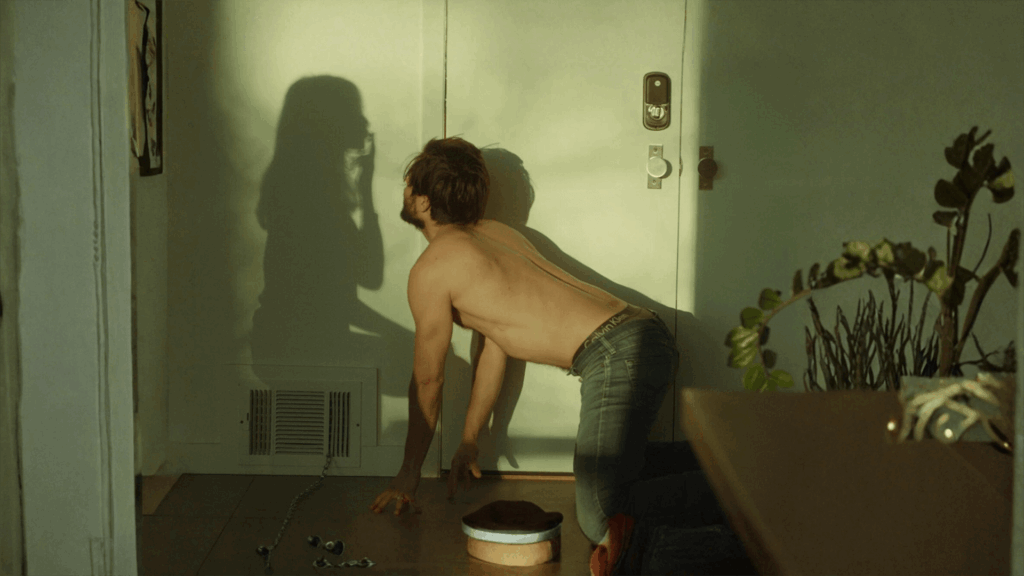
Something haunts the 2025 selection—men on leashes, performing animality, surrendering power—as Laura Calle’s Missing, Romi Banerjee’s Ghee (where “Enthrallium” renders conscious thought obsolete), and others independently arrived at the same image for 2025’s anxieties about agency and submission. The feature selection showcases curatorial confidence: Zhihui Long’s Where The Flowers Blooming transforms Cultural Revolution violence into 128-minute meditation alongside Lasse Kissow’s Hólmganga (8th-century Danish Viking epic winning Best Feature Film), whilst documentaries like Rajesh PK’s Blu’s (in Academy Award contention) and Tom Dey’s JUMPMAN explore the invisible made visible.
Beyond the Official Selection
Chuck Harding’s Bella Lune – Blissful Escape weaponizes medical authority iconography—nurses in fetishized uniforms become tormentors in psychological theater. For $200 and four minutes, bracingly ambitious filmmaking creates music video functioning as both entertainment and exorcism.
Elliott Forrest and Kelly Hall-Tompkins’s Face to Face: Forgotten Voices Heard crafts 16-minute meditation transforming Carnegie Hall’s acoustics into democratizing amplifier for society’s sonically invisible—radical humanist cinema weaponizing classical music as Trojan horse smuggling socio-economic critique.
Maki Natalis’s Foreclosure literalizes spectacle anxiety through audacious necromancy resurrecting Ragona’s 1964 The Last Man on Earth, reanimating its corpse with entirely new neurological system in metamodern palimpsest proving archives aren’t dead material but living tissue.
Konstantin Karpeev and Anatoliy Trofimov’s Frankly functions as 71-second séance summoning millennial ennui—models confessing hatred of slow walkers, dropping toilet water from seventeen storeys. The bifurcated structure oscillating between high-fashion tableaux and rooftop confessionals captures peculiar melancholy of existing under capitalist realism.
Steve Hunyi’s Garbage Rex descends into urban decay where our Virgil is garbage collector dwelling at civilization’s margins. This nineteen-minute proof-of-concept layers Dickensian consciousness atop neo-noir framework mining psychological terrain between documentary objectivity and participatory intervention.
Romi Banerjee’s Ghee understands horror emerges from systematic agency erasure disguised as hospitality. When Geet accepts Sanju Aunty’s lunch invitation, he walks into pharmacological fascism where “Enthrallium” renders independent thought obsolete. At twenty-six, Banerjee has created film understanding horror’s function isn’t escape but excavation.
Jonathan Moratal and Arthur Deschamps’s Immram modernizes Orphic descent replacing lyre with clinical technology—Alexandre Donel as techno-scientific necromancer wielding “augmented autopsy” to interrogate dead for three precious minutes, exploring suicide’s epistemological void.
Yulia Ruzmanova’s Kozlov Mitya, 81+ crafts profoundly tender road movie where octogenarian’s romantic quest becomes unwitting rebellion against gerontophobia and Russian autocracy’s shadow. Channeling Varda, Ruzmanova refuses to sanctify or infantilize Mitya—he emerges gloriously, messily human. Ksenia Gapchenko (producer of How to Save a Dead Friend) and Anna Artemyeva (cinematographer and animation director), both teachers at Un/filmed School, joined Ruzmanova as story editors and producers. The film performs multiple cultural defiances documenting ordinary humanity persisting despite Putin’s grip in observational documentary where camera’s gaze functions as benediction not intrusion.
Ulisse Lendaro’s The Saint of Brooklyn collides hagiography with pugilistic cinema vérité refusing easy sports redemption. Lendaro crafts something theologically complex: Chiara Dituri portrait oscillating between Bresson and Scorsese examining masochistic devotion required to pursue transcendence through physical brutality.
Tatiana Sokolova’s Mary Chris Max orchestrates deceptively simple premise where archetypal Christ-child narrative collides with noir sensibilities—two men encountering abandoned Mary materializing from Floridian wilderness in unnerving meditation on provisional family units forged in desperation.
Nick Conedera and Tom Pritchard’s My Father: The Healer excavates something extraordinary from intergenerational trauma’s bedrock—documentary transcending biographical constraints. We simultaneously watch Master Li’s QiGong origin story and his son’s contemporary struggle understanding a father who “always felt like unreadable abyss.”
Raphael Oettel’s The Filthy Three hurls us into 1945 Nazi Germany’s twilight with supremely stylized caper-noir marrying Tarantino’s irreverence with Italian poliziotteschi aesthetics. Three gentleman burglars humiliate Third Reich’s elite by swapping priceless art with forgeries in zero-budget filmmaking at absolute apex.
Viliam Poltikovič’s THE MYSTERY OF DEATH arrives as radical epistemological intervention into Western culture’s pathological terror of mortality. Across 95 minutes spanning four countries, Poltikovič marshals interdisciplinary voices—quantum physicist Amit Goswami, philosopher Ervin László, psychiatrists Stanislav Grof and Raymond Moody—into towering achievement in transpersonal documentary cinema.
Viliam Poltikovič’s The Help of the Invisibles – Himalayan Oracles positions camera as portal inviting us through veil separating manifest from unmanifested in 87-minute ethnographic meditation documenting Ladakhi oracles’ trance-state possessions, functioning as both documentary and indictment of Western epistemological impoverishment.
Leigh Tarrant’s The Presence of Snowgood emerges as compelling exercise in topographical uncanniness excavating psychogeographical anxieties beneath England’s pastoral veneer. Tarrant transforms Kent and Sussex borderlands into palimpsest of temporal disturbance where detective’s search becomes archaeological dig through communal trauma.
Andre Semenza and Fernanda Lippi’s Turning to Birds – 200 Years of Evil Chill births harrowing cli-fi fever dream operating as apocalyptic augury. The culminating image—naked figure ascending electricity tower—represents profound engagement with “eschatological intimacy,” paradoxical closeness to our own extinction.
Nick Benjamin’s Under excavates Freudian das Unheimliche returning us to primal childhood battleground: space beneath bed where shadow-dwellers feast on pre-rational fears. Benjamin’s pyjama-clad protagonists don makeshift soldier helmets navigating grandparents’ nocturnal domain in existential battle against unknowable void.
Iván David Nieves’s Victoria – Triumph of Puerto Rican Theater! breathes cinematic life into Victoria Espinosa’s metamorphosis from Santurce’s margins into Puerto Rico’s first female theater director, transcending documentary convention to become manifesto for endangered cultural legacies.
Ricardo Koller Morales’s Visions of You drags us into Cassandra-esque nightmare where prophecy becomes prison. Bruce’s precognitive curse renders him passive spectator perpetually colonized by predetermined futures’ tyranny in devastating meditation on whether future knowledge constitutes agency or sophisticated fatalism.
Dale Loon and Alyssa-Rose Hunter’s Waking Conundrum transcends budgetary constraints delivering labyrinthine thriller where man awakening in room with endless ceiling becomes potent metaphor for masculine obsolescence, understanding true dystopian fiction interrogates power’s very nature.
Aldéric Demay’s Zorrito constructs devastating temporal meditation on absence in 145 seconds of pure alchemy. The coup de grâce: Polaroid tumbling from comic book, proof positive father did attend—Xavier never knew. Some revelations arrive too late to heal, only to complicate.
Screenplay Selection
Leslie Anne Lee crafts Tolkienesque epic where abject half-breed body becomes radical transformation site, positioning Anda in perpetual liminality embodying Bhabha’s “third space.” The forbindelse soul-bond functions as Lacanian recognition whilst Dagsbrún’s vampiric nature manifests as Freudian death drive made flesh. What moves most profoundly is unwavering faith in love as revolutionary praxis—Anda’s “Let me love you anyway” becomes simultaneously romantic gesture and political manifesto.
Robert Marshall Tartell’s domestic inferno transforms innocuous reptilian intruder into Lacanian objet petit a exposing marital fissures. Mike embodies “complicit masculinity” desperately performing competence, the VISA statement revelation functioning as dramatic irony masterstroke. The gasoline-and-torch finale operates as hyperbolic catharsis where American dream’s immolation becomes preferable to dishonesty cohabitation.
Brian Herskowitz resurrects Frankenstein’s Promethean nightmare through modern psychological thriller. Laura Drummond emerges as contemporary crime fiction’s most psychologically complex protagonist—rape survivor turned homicide detective investigating brutal murders that become something far more personal. The screenplay’s Gothic sensibilities bleed through hardboiled exterior—those ritualistic wounds aren’t merely signature elements but symbolically loaded violence exploring reproductive trauma whilst Catholic Church’s presence transforms institutional corruption into Spotlight filtered through Seven.
Brian Herskowitz drags Arthurian mythos into fluorescent-lit purgatory of American high school. The screenplay’s genius lies in psychoanalytic excavation of imposter syndrome—when Merlin (ponytailed janitor wielding Windex) declares Artie “Once and Future King,” the boy’s response is pure Sartrean nausea. The crown jewel remains Merlin: part Gandalf, part Mr. Miyagi, part burnt-out Gen-Z nihilist in manifesto for every kid cosmically miscast.
Ellen Rooney engineers staggering labyrinth rivaling Greengrass’s United 93 whilst excavating techno-scepticism’s eschatological anxieties, transforming Cleveland’s fountain into axis mundi where trauma theology collides with anti-transhumanist fervour. The medieval hatchet sequence achieves Cronenbergian transcendence when Erin amputates Ali’s arm whilst the ad-libbed prayer—”pray for me NOW”—achieves devastating pathos.
Tim Lott hurls us into American underbelly where sex work and child exploitation coalesce into Dantean nightmare charting Riley’s odyssey from childhood trauma to precarious redemption. Gabriel’s transformation from detective to avenging angel discovers authentic faith demands violent intervention. What elevates this beyond genre is Lott’s refusal of resolutions—Q reduced to panhandler constitutes not triumph but another exploitation cycle.
Kathleen Regan and Simon Barracchini’s Importers emerges as prescient dystopian meditation excavating totalitarian pedagogy whilst orchestrating polyphonic resistance across three generations—Dead Poets Society transmuted through dystopian 1984 lens. The interrogation room crystallizes Kafkaesque bureaucratic horror whilst final image—Docent57’s evaluation marked “Dissolve” beside student’s “Pass”—transforms administrative violence into revolutionary praxis.
Elizabeth Searle thrusts us into contemporary American xenophobia’s belly with searing thriller excavating race, gender, and justice intersectional fault lines. Searle dismantles “model minority” myth transforming Sylvie Chin Flynn into lightning rod for the nation’s corrosive anxieties in Kafkaesque descent. The screenplay’s masterstroke lies in tripartite violence structure culminating when Sylvie wields pool cue—”model minority” stereotype shatters alongside Troy’s skull yet Sylvie becomes criminal.
Joy E. Joseph constructs beguiling temporal labyrinth where artificial intelligence devours reality itself. May 2nd operates as Derridean hauntology where Tess’s nightmares function as mnemic fragments of aborted timeline. The screenplay’s formal innovation reaches apex in credit roll glitch before Joseph delivers knockout: rewinding to WGA strike revealing nightmare as Tess writing toward truth in Saramago’s The Double transplanted into Hollywood labour politics.
Marie Smalley’s Searching for Shadow devastates as grief’s labyrinthine psychogeography wherein missing cat search becomes trauma excavation. Every black cat glimpsed becomes Lacanian objet petit a structuring perpetual longing whilst missing cat functions as displaced signifier for lost sister Gracie whose seizure death Kate witnessed as child. What moves most is Kate’s children’s books achieving publication suggesting genuine catharsis without false consolation.
Smith, Perez, and Rothblatt construct theological cosmology transforming Cleveland’s fountain into axis mundi where trauma theology collides with anti-transhumanist fervour. Drawing from Jewish mysticism’s Sephirot, nephilim folklore, and Catholic exorcism, Ben’s journey becomes perpetual liminality. The ending’s abruptness demonstrates rare narrative courage letting hero fail catastrophically as Allison dies, world transforms, Ben abandons Earth.
Lynn H. Elliott thrusts us into liminal bildungsroman where the Crossingway becomes young Howell Evans’s crucible for self-actualisation—Campbellian monomyth for TikTok generation and brilliant psychogeographical excavation. Elliott refuses colonial impulse appropriating Indigenous spirituality, instead positioning Diné, Mixtec, and Welsh mythologies as coequal cosmological frameworks challenging Western rationalism’s hegemony.
Carla B. Boone authors contemporary Count of Monte Cristo refracted through American racial capitalism and music industry predation—Boone’s answer arrives via grandmother with red wig and smoking gun. The screenplay tracks rapper Kieon watching superstar producer Terrell Williamson monetize “Holla’back” into platinum whilst creators deliver mail and sell drugs in essential American cinema too raw, too furious for Hollywood.
The 2025 Lonely Wolf International Film Festival premieres virtually December 18-31. After six years building the ultimate virtual festival experience—combining traditional prestige with digital accessibility, nurturing a “Wolfpack” community of 650+ five-star reviews—this edition represents the festival fully embracing its identity. Not a collection, but a conversation. Not safe programming, but genuine curation. In an ecosystem where “independent” often means “studio-adjacent,” Lonely Wolf remains home for outsiders, sanctuary for cinema’s uncompromising voices. These aren’t films seeking franchise potential—they’re howls in the digital wilderness. And Lonely Wolf ensures they’re heard.
For complete program information and festival access, visit www.lonelywolffilmfest.com
About the Author

No comments yet.
Got Something to add to this article?
Your email address will not be published. Required fields are marked *