Article too long to read?
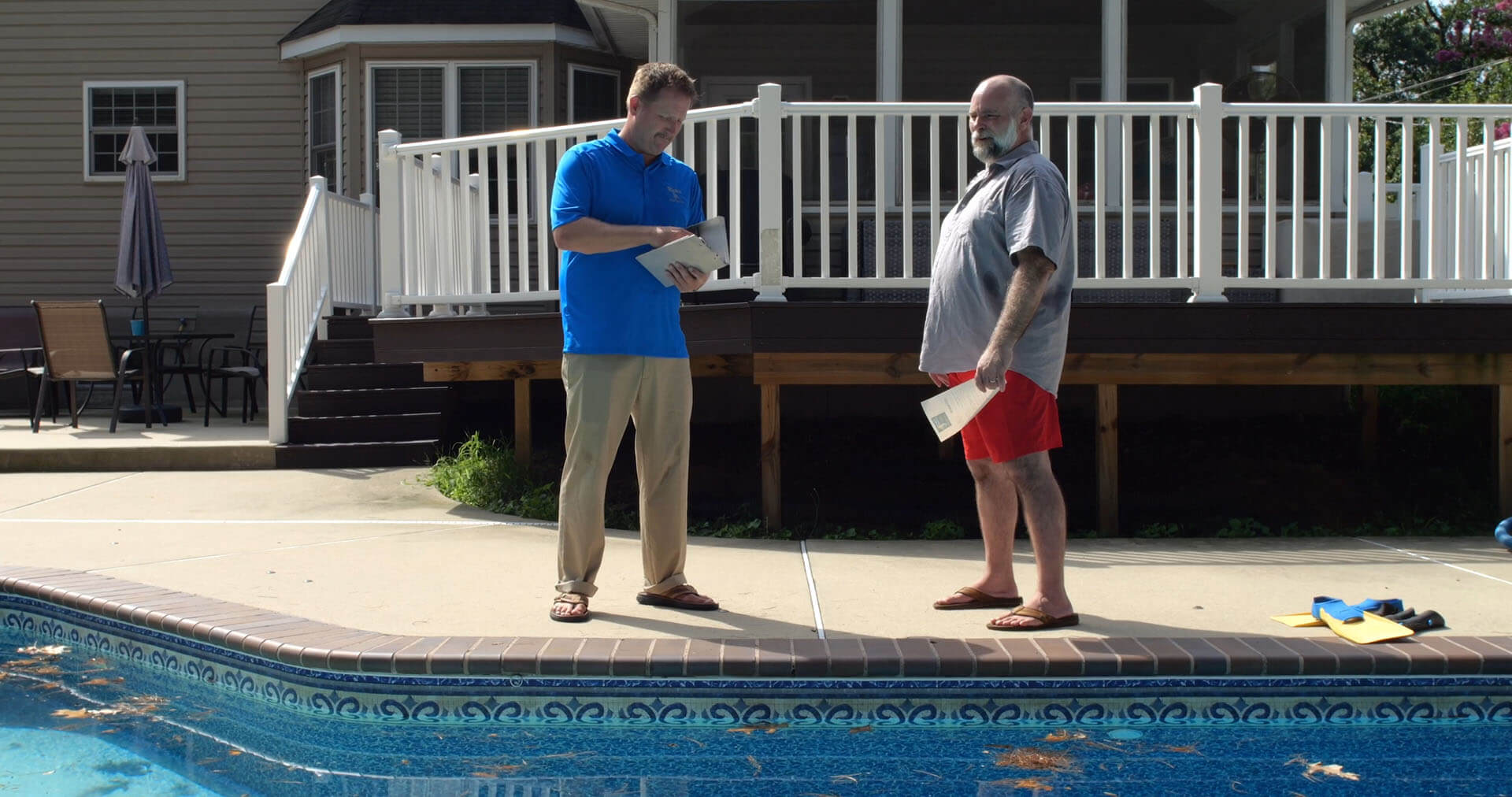
Derek Frey knows how to navigate the complexities of scale. After two decades of helping steer multi-billion-dollar studio behemoths and carefully cultivating the eccentric cinematic universes of Tim Burton, Frey continually finds his most profound creative liberties in his independent ventures. When we last spoke with Frey in 2024, he detailed the therapeutic balance between his massive studio projects and the suffocating, mortality-laced shadows of his award-winning short Viaticum. Following that dark exploration, his latest directorial effort, The Current State of the Backyard Pool Industry, marks a joyous and deliberate pivot toward the light. Co-written with his longtime collaborators, The Minor Prophets, the film utilizes a broken suburban pool as a canvas to explore macro-anxieties—economic strain, climate dread, and familial disconnect—through a lens of unapologetic, “Mary Poppins-esque” absurdity. In our latest exclusive conversation with Indie Shorts Mag, Frey opens up about the power of theatrical intrusion, the cinematic rhythm of editing dark comedy, and how embracing the constraints of a single backyard can crack open the most expansive emotional truths.
Indie Shorts Mag: The Current State of the Backyard Pool Industry explores heavy realities—economic strain, climate anxiety, and lost familial connection—through a wonderfully absurd lens. What was the genesis of using a whimsical, “Mary Poppins-esque” intruder to shatter the Osgood family’s indifference?
Derek Frey: There’s actually a long lineage behind that “whimsical intruder” device.
The writers/actors The Minor Prophets have always been fascinated by the catalytic outsider. In their earlier films such as Sexual Genius, In Vino Veritas, and The Devil’s Handyman, you see these colorful, almost mythic trickster figures step into otherwise grounded domestic spaces and destabilize everything. They aren’t villains exactly. They’re forces. They expose hypocrisy. They accelerate suppressed tensions. They force characters to confront truths they’ve been avoiding.
That idea goes back in my own work as well. In Captain Crabcakes, The Curse of the Sacred Stone, and Born on the Fifth of July, I was already playing with this notion of an unexpected presence entering a closed system and revealing what was already broken inside it. I’ve always been interested in that collision between the ordinary and the heightened, between suburban routine and something slightly supernatural, absurd, or theatrical.
So when we began shaping The Current State of the Backyard Pool Industry, the “Mary Poppins-esque” figure didn’t feel like a new invention. It felt like the next evolution of a long-running creative impulse.
The Osgoods are numb. They’re economically strained, emotionally disconnected, and quietly resentful of one another. Their indifference is a symptom of exhaustion. We didn’t want a dramatic catastrophe to wake them up. We wanted something tonally off-balance. Something whimsical. Something that doesn’t belong in their world.
There’s something powerful about absurdity as an intervention. A cheerful, almost musical-theatre-like intruder stepping into a backyard filled with deferred dreams and ahalf-functioning pool creates a tonal friction. That friction is where the story lives. The absurdity disarms the audience just enough to allow the heavier themes to land without becoming didactic.
In a strange way, whimsy becomes a delivery system for confrontation.
Mary Poppins doesn’t arrive to destroy a family. She arrives to recalibrate it. Our intruder functions similarly, but filtered through The Minor Prophets’ slightly unhinged suburban surrealism. The character is a mirror, a provocation, and a test. When something joyful and theatrical collides with apathy, you either reject it or you transform.
The genesis, ultimately, comes from a belief that sometimes the only way to crack open heavy realities is not with realism, but with theatrical intrusion. Comedy, absurdity, and a bit of magical logic can pry open emotional doors that straight drama sometimes can’t.
And in our cinematic universe, there’s always been someone knocking at the door.
Indie Shorts Mag: You’ve built a rich, enduring creative partnership with The Minor Prophets over the years. Given that this new project features real-life family members (the Damons) alongside your regular collaborators, how did that existing intimacy shape the writing process and the on-set dynamics?
Derek Frey: The intimacy was everything.
With The Minor Prophets, there’s already a deep creative shorthand. We’ve spent years building a shared rhythm. We understand each other’s timing, instincts, and tonal boundaries. That kind of collaboration allows you to take risks because the foundation is solid.
But with The Current State of the Backyard Pool Industry, we made a very conscious decision to introduce a different energy into that ecosystem.
The Damon family brought sincerity. Real sincerity. And we leaned into that deliberately.
The story was rooted in their lived experience. Their pool, their backyard, their real frustrations and absurdities. The house wasn’t a set, it was home. So instead of heightening everything into pure Prophets-style satire, we asked ourselves: what happens if we protect the authenticity of this family unit and let the absurdity orbit around them rather than consume them?
We felt that pureness would translate. And we’re thrilled that it does.
The Damons are all incredibly attuned performers. They’re musicians, stage veterans, and natural storytellers. There’s an innate rhythm in that family. You can’t fake that kind of familial cadence. When a look passes between them, it carries history.
There’s also something special about filming a family in their own home. The environment carries emotional residue. It’s textured. You’re not dressing a space to look lived in, it already is. That authenticity seeps into performance in subtle ways.
Ultimately, the intimacy deepened the work. The existing trust with The Minor Prophets gave us the freedom to evolve. And welcoming the Damons into that circle didn’t dilute that chemistry. It expanded it.
In many ways, the film became what it’s about: connection. Creative connection. Familial connection. And the fragile effort to hold both together in a world that feels increasingly unstable.
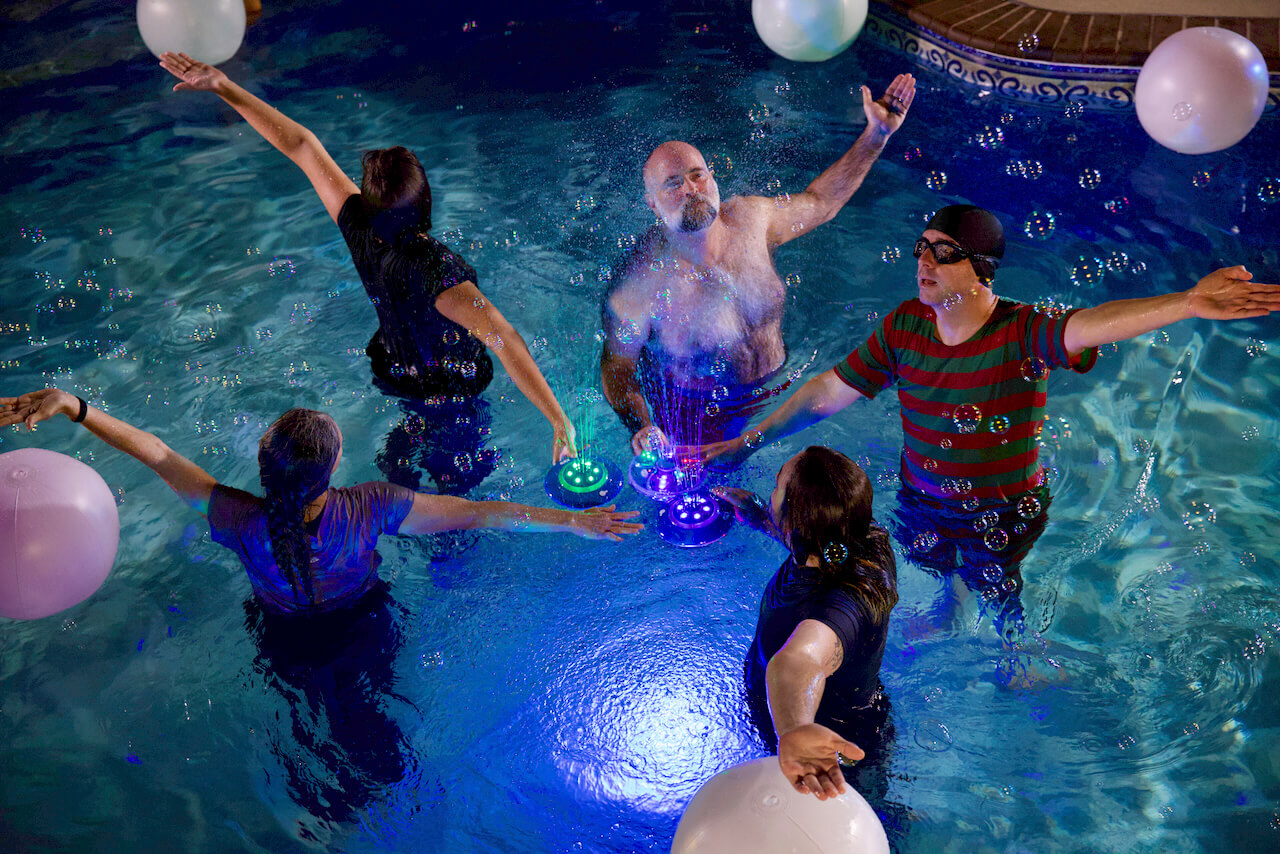
Indie Shorts Mag: The film fearlessly embraces theatricality, even making room for Tchaikovsky’s Swan Lake and joyous fourth-wall breaks. As a director, how do you calibrate those heightened, unapologetically silly moments so they still serve the genuine emotional catharsis of the story?
Derek Frey: The tone in this film is a particular tight rope.
When you invite Swan Lake into a suburban backyard and allow characters to break the fourth wall, you’re announcing that we’re stepping into theatrical territory. The calibration comes from protecting emotional truth at all costs.
By the time Tchaikovsky swells, we want the audience firmly rooting for the Osgoods. The music isn’t there as a joke. It’s propulsion. It elevates their struggle to something almost operatic. In their minds, the stakes are enormous, and the score validates that internal intensity. It encourages the audience to lean forward rather than pull away.
The fourth-wall break is particularly important. Up until that point, the family has been avoiding eye contact and connection. They’re living parallel lives in the same space. When they finally engage one another, something shifts.
And when they turn toward the camera, it’s not a wink. It’s an invitation.
They’re no longer closed off. It’s as if they’re saying, “You’re part of this too.” The audience isn’t just observing a transformation, they’re being welcomed into it and sharing a communal release.
We’re careful never to mock the family. The satire may orbit the cultural and economic pressures surrounding them, but their emotional lives are treated with sincerity.
The heightened silliness becomes an amplifier of catharsis. The music lifts it. The direct address opens it. The absurdity gives it oxygen.
Indie Shorts Mag: Will Chamieux is such a fascinating catalyst—spouting profound wisdom that almost sounds like advertising copy for vinyl-lined pools. How did you work with David Amadio to anchor such an eccentric character so he felt like a natural remedy to the family’s specific anxieties?
Derek Frey: Willy was never designed to be a full on caricature, even though he enters the story in heightened territory.
Dave invested a tremendous amount of care in shaping the character’s internal logic. On the surface, Willy moves through theatrical beats, heightened delivery and gestures, along with musical flourishes. But we made a very conscious decision about where the audience would finally see the grounding.
We don’t really feel that grounded core of Willy until his conversation with Henry after the chaos.
Up until that point, he functions almost like a force of nature. He disrupts. He provokes. He accelerates everything around him. The temptation could have been to play that energy broadly the entire time. But Dave held something back.
In that quieter exchange with Henry, the theatrical scaffolding falls away. The delivery becomes simple. Direct. Truthful. And that’s where the sincerity reveals itself. It’s not that Willy suddenly changes. It’s that we’re finally allowed to see the emotional engine underneath the spectacle.
That choice was deliberate. If we had shown his grounding too early, the mystique would dissipate. If we never revealed it, he’d remain abstract. The balance was letting the audience experience the chaos first and then discover the human intention behind it.
Dave’s commitment to playing every line with conviction made that turn possible. Even in the most flamboyant moments, he wasn’t chasing a laugh. He was protecting the character’s belief system.
When the quiet lands after the storm, it lands because it’s honest.
And that honesty is what allows the emotional catharsis to feel earned rather than manufactured.
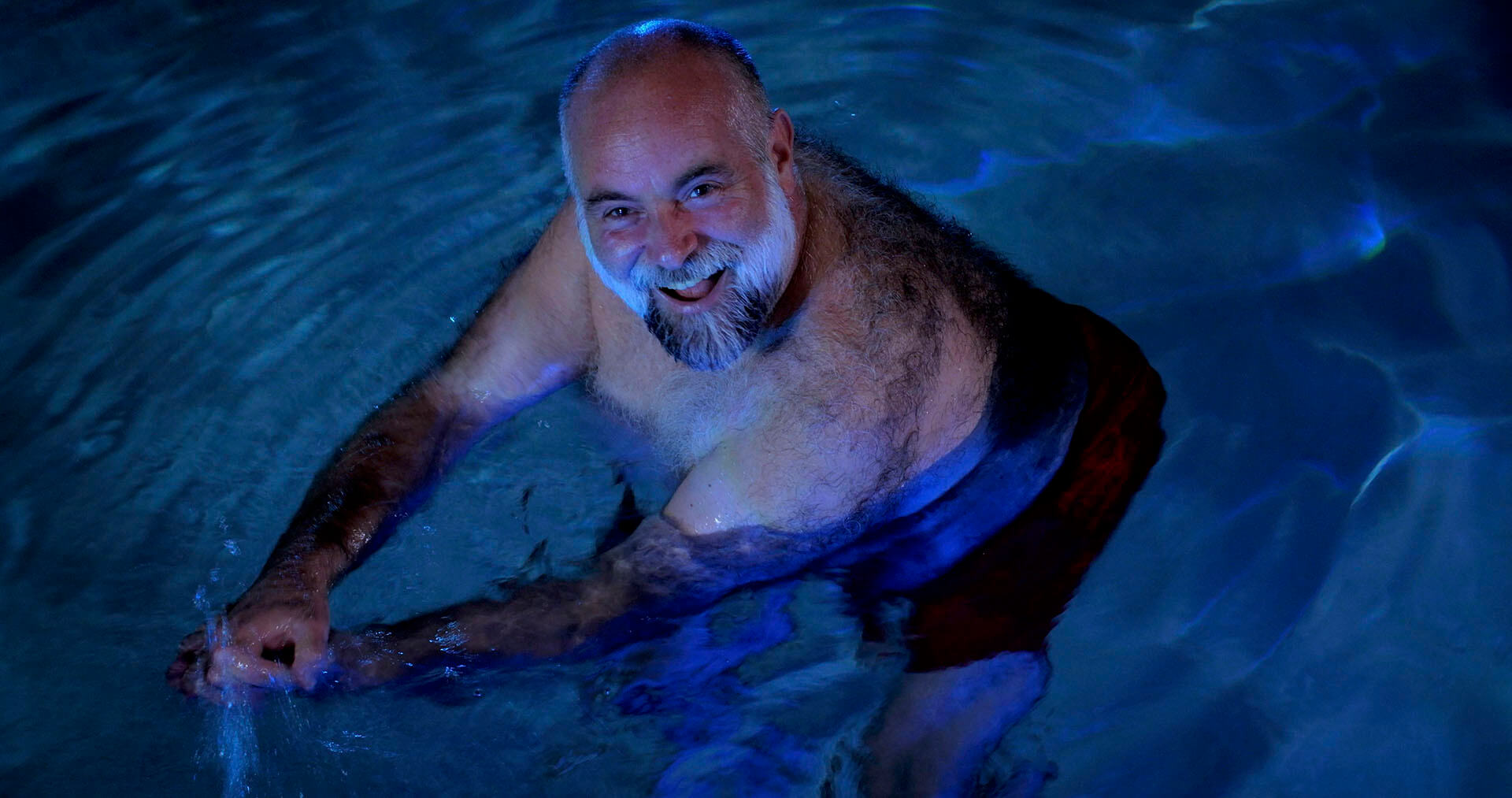
Indie Shorts Mag: Visually transforming a broken, empty pool from a symbol of financial burden into an oasis of joy is no small feat. How did you approach the cinematography and framing to reflect the emotional shift within this singular physical space?
Derek Frey: Visually transforming the pool was not just about lighting or lenses. It was about the cultural weight that object carries.
In American life, the backyard pool has long been more than water and concrete. It is a status symbol and an icon of aspiration, something that embodies both the promise and the contradictions of the American Dream. It is tranquil yet loaded with narrative history, and in film and television it often becomes a mirror for isolation, desire, or lurking danger.
Because of that history, I wanted the pool to feel like a character with its own arc.
In the first act, it is a dying, joyless presence. A financial burden. A stalled promise. The camera treats it as such through static compositions, wide and mid shots, and distance. The pool is not seductive yet. It is simply an object of frustration. We deliberately avoid getting in the water. We remain observers on the margins.
The choice not to enter the pool with the camera until Henry does was intentional. Up to that emotional turning point, the cinematography maintains visual restraint. Static cameras reflect emotional inertia. That is the space the family is in.
Once Henry enters the water, everything changes.
The camera gets closer. It moves. We go above the surface and below it. The lens becomes fluid and expressive. The lighting shifts so the water and surrounding environment awaken. It glows and shimmers, inviting rather than oppressive. Underwater shots were crucial because they physically immerse the audience in the transformation. Instead of peering at the pool from a distance, we share the space with the characters.
That shift in framing and movement mirrors the emotional shift of the story. What was once a symbol of anxiety, strain, and unrealized leisure becomes a site of joy and reconnection. Cinematically, the pool begins to look like the ideal it has always promised to be, shimmering, magical, kinetic. The camera’s movement reflects that emotional opening.
In the way that classic films have used pools to signify everything from escapism to existential dread, our film uses it as a barometer of a family’s internal world. When they are shut down, the pool is still. When they open up, we dive in with them, physically and emotionally.
Indie Shorts Mag: You’ve navigated massive logistical puzzles on studio films, but independent projects often live or die by their constraints. Did centering this narrative largely around one restrictive location—a dilapidated backyard pool—present any unexpected hurdles or creative breakthroughs?
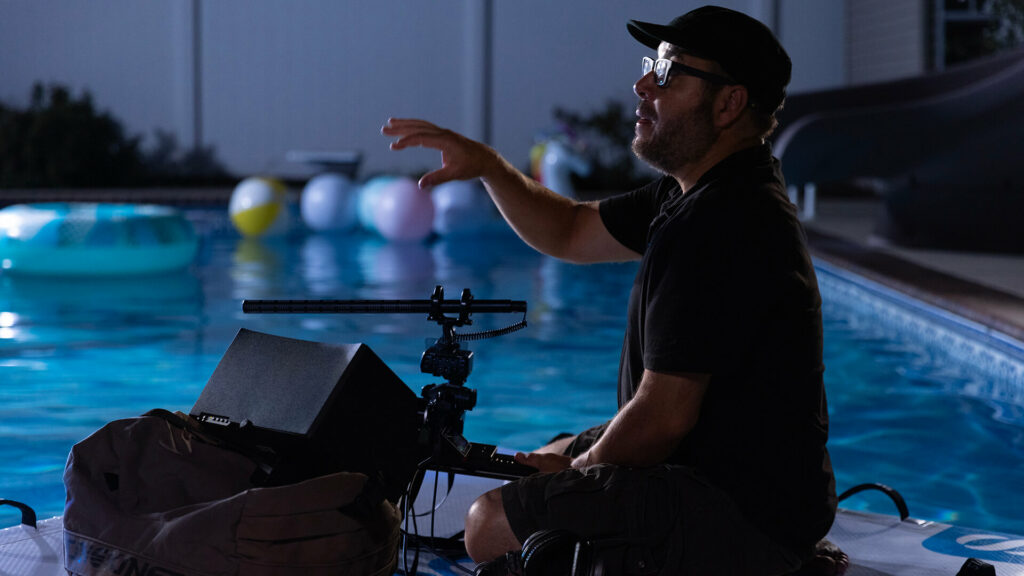
Derek Frey: One of the gifts of having worked on large studio films is that you develop a deep respect for logistics. You understand coverage, scheduling, contingencies, weather, equipment, flow.
Going in, I knew what we needed to execute the story efficiently on almost no budget.
It is also deeply cathartic to work at this scale after the bigger productions. The challenges are different, but they are no less real. There are no layers of infrastructure insulating you. Every choice matters. Every hour matters. I have always been energized by the challenge of doing more with less.
There were practical hurdles. Water is never simple. It affects lighting, sound, safety, continuity. Fortunately, from my experience on films like Green Lake, I understood what it takes to shoot moody water effectively.
The location itself added another unexpected layer. The backyard sits directly beneath the flight path of Philadelphia International Airport. During the day, planes were constantly overhead. Instead of fighting it, we embraced it. The overhead traffic became part of the atmosphere. It subtly reinforces the sense of life moving on above this family’s stalled situation. There is motion in the sky while they remain stuck below. That texture added authenticity rather than distraction.
On larger films, scale often comes from expanding outward. Here, scale comes from intensifying inward. The backyard becomes a universe. The pool becomes a character. The constraint becomes the canvas.
Independent films often live or die by their limitations. In this case, the limitations sharpened the story rather than restricting it.
Indie Shorts Mag: While your previous film, Viaticum, leaned heavily into the shadows of mortality and dark comedy, this latest project feels distinctly warmer and more optimistic. Was this shift toward feel-good catharsis a deliberate pivot, or simply where the creative winds took you and the team?
Derek Frey: It was absolutely a deliberate pivot.
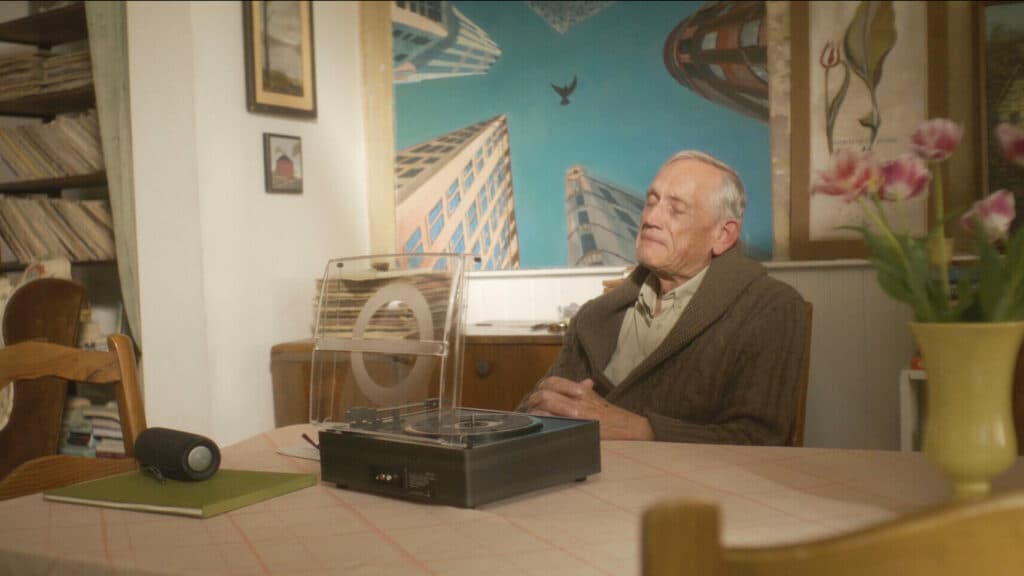
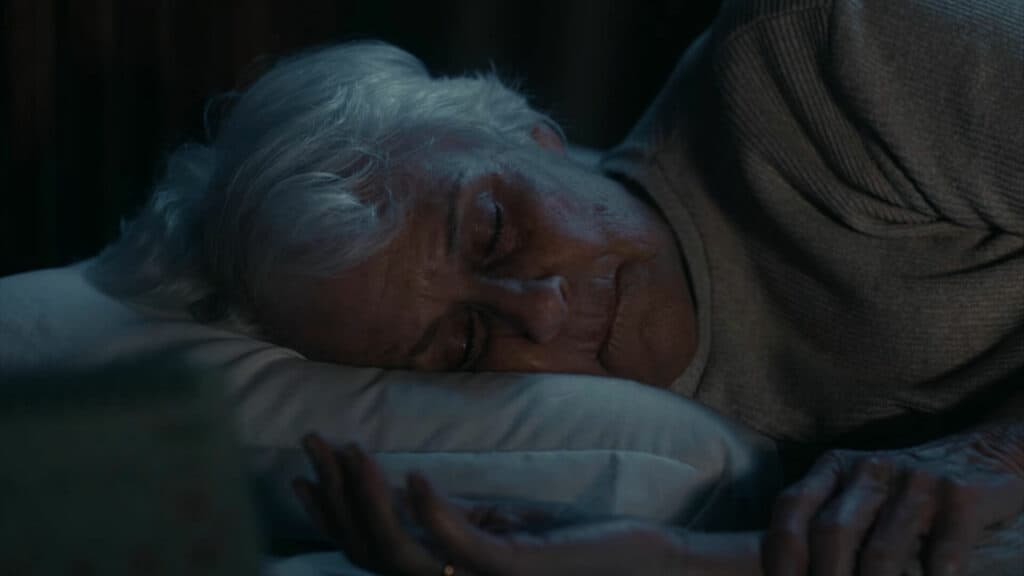
Viaticum is about a last breaths. It lives in the shadow of mortality. The film is confined to one small room, shot in black and white, highly controlled, intentionally somber and suffocating from start to finish. The camera is restrained. The compositions are tight. Everything presses inward. It is about endings.
After living in that creative space, we were all yearning to swing the mood pendulum in the other direction.
If Viaticum is about a final breath, The Current State of the Backyard Pool Industry is about learning to breathe again and ultimately living life.
I was also eager to let the camera move again and to embrace color, glow and shimmer.
A backyard pool is geographically small but emotionally vast. It gave us intimacy without suffocation. It allowed us to explore heavy themes like economic anxiety and disconnection, but through warmth and eventual catharsis rather than darkness.
Both films deal with existential weight. One confronts the inevitability of death. The other asks what it means to reengage with life.
Indie Shorts Mag: With your extensive background in editing—both in film and in curating complex visual publications—how does your editor’s eye influence your approach on set, particularly when capturing the delicate comedic timing required for this kind of absurd humor?
Derek Frey: Editing is one of the parts of the process I enjoy the most.
It is where the film truly reveals itself. With comedy, and even more so with dark comedy or dramedy, the timing of the edit is everything. It is incredibly specific. A fraction of a second too early or too late can change the emotional temperature of a scene entirely. The balance between absurdity and sincerity lives in those microscopic decisions.
Because of my long experience editing, I am always cutting in my head while we are shooting. I am aware of where the breath should land, where the pause should stretch, where the reaction shot might carry more weight than the line itself. That awareness influences how I stage scenes, how I design coverage, and how long I let a performance live before moving on.
With The Minor Prophets, that process becomes especially rewarding. They are incredibly attuned to timing and delivery. Their instincts are sharp and disciplined. They understand that sometimes the strongest comedic choice is restraint, or that holding a look just a beat longer can transform a moment. When you are working with performers who have that rhythm embedded in them, the edit becomes about shaping rather than correcting.
My love of music also informs the process and it has always played a central role in my projects. Having directed and edited music videos, I think in terms of tempo and cadence. Even dialogue scenes have rhythm. In this film, particularly during the musical and choreographed sequences, I approached the edit almost like composing. Visual beats had to align the way musical beats would.
I am my own harshest critic in the edit bay but there were moments when the sequences clicked into place and I felt the emotion and glee. I knew we had something hard to describe but special on our hands.
Indie Shorts Mag: The character of Rick the pool repair guy brings a “casual stoicism” to the very real anxieties of modern life. In an era where so many artists feel the pressure to tackle macro global crises head-on, what drew you to this micro, backyard approach to navigating those same fears?
Derek Frey: Rick represents a reality many people are living right now.
He is practical, transactional, and outwardly easygoing, but beneath that is someone navigating real economic pressure. He understands how quickly something aspirational, like a backyard pool, can become a liability. He is just trying to get by, like so many others, and sometimes finds himself in situations where he has to deploy extraordinary means to get the job done.
We are living in a moment of macro anxiety. Climate instability, financial strain, constant digital noise. But most of us experience those pressures in very small, domestic ways. Through tension with our families. Through deferred maintenance. Through conversations we avoid.
The pool becomes a microcosm of those larger fears. It is tied to leisure and the American promise, yet it can easily feel like dead weight. It requires presence and care at a time when technology is pulling us away from real, elemental experiences.
Rick lives at that intersection. His stoicism is not indifference. It is adaptation.
I was less interested in addressing global crises head-on than in showing how they echo through one backyard, one family, one repair visit. The macro exists, but it reveals itself through the micro.
Sometimes the most honest way to explore overwhelming fears is to shrink the frame and let them play out in a very human space.
Indie Shorts Mag: Ultimately, the film serves as a joyous reminder to embrace life’s silliness before “pulling the plug.” What do you hope fellow independent filmmakers and audiences alike take away from the Osgood family’s journey of rediscovery?
Derek Frey: I hope filmmakers feel emboldened.
We made this film with very limited resources but very big intention. We did not wait for perfect conditions or ideal financing. We worked with what we had and committed fully to the vision. I am proud that the energy and emotion shine through the rough edges. In some ways, those rough edges deepen the sincerity. They remind you that real people made this with care.
If fellow independent filmmakers take anything from it, I hope it is permission to dream big even when the scale is small. Constraints can sharpen your voice. You can create something emotionally expansive inside a single backyard if you lean into intention and performance.
For audiences, my hope is simple.
We are living in a time of constant distraction. The film gently suggests that reconnection does not require grand gestures. It can begin with eye contact. With laughter.
If you open yourself to experience and play, you can be rewarded in meaningful ways.
The Osgoods do not escape their problems. They rediscover each other. And sometimes that is enough.
If the film nudges people to put down their devices, reconnect with loved ones, and choose presence over distraction, then it has done its job.
As The Current State of the Backyard Pool Industry continues to make waves, Frey’s creative philosophy stands as a vital reminder to the independent filmmaking community: true scale is not defined by budget, but by intention. By intensifying inward and treating practical constraints as a creative canvas, Frey and his collaborators have crafted an emotionally expansive micro-epic that challenges us all to look up from our screens. The Osgood family’s beautifully absurd plunge back into life proves that we don’t need a perfectly functioning world—or even a fully repaired pool—to rediscover our joy. Sometimes, as Frey so brilliantly illustrates, all it takes is a willingness to break the fourth wall, embrace the silliness of the moment, and simply dive in.

About the Author

No comments yet.
Got Something to add to this article?
Your email address will not be published. Required fields are marked *