Article too long to read?
Natural light is one of the most cost-efficient and visually impactful tools for filmmakers. It leverages sunlight and ambient daylight to create organic, realistic scenes. However, it comes with challenges like unpredictable weather, shifting light, and limited control. This guide covers everything you need to know, including:
- Why use natural light? It’s budget-friendly and adds depth and realism to scenes.
- Challenges: Weather changes, inconsistent light, and harsh shadows – solved with tools like reflectors and diffusers.
- Planning tips: Scout locations, understand golden/blue hour, and prepare for weather shifts.
- Techniques: Position subjects for front, side, or backlighting; use diffusion and reflection to shape light.
- Gear recommendations: Affordable tools like reflectors, ND filters, and wide-aperture lenses.
Natural light demands preparation and flexibility, but its dynamic qualities can elevate storytelling in ways artificial lighting often can’t. Learn how to work with it effectively for stunning, cinematic results.
Planning Your Shoot Around Natural Light
Scouting Locations for Natural Light
When planning a shoot, picking the right location is key to making the most of natural light. Outdoor spots like open fields, beaches, or rooftops are ideal because they provide direct access to sunlight without being blocked by nearby structures. These spaces also let you experiment with different angles as the sun moves throughout the day.
For indoor shoots, look for spaces with large south-facing windows, which let in consistent daylight. The size and direction of the windows influence how light enters and shifts across your scene. Reflective surfaces like light-colored walls, snow, sand, or even calm water can amplify natural light, acting as natural "bounce boards" to fill in shadows and create smoother lighting.
Be mindful of potential obstacles like trees, buildings, or awnings. While they might cast unwanted shadows, they can also act as natural diffusers, softening harsh sunlight. To get an accurate sense of the light, visit your chosen locations at the same time of day you plan to shoot. Take photos or notes during scouting to help you plan.
Understanding Timing and Weather Conditions
Once you’ve picked a location, it’s time to think about when to shoot. Certain times of day offer distinct lighting conditions that can set the mood for your scenes:
- Golden hour, with its warm, soft light, happens shortly after sunrise or before sunset. This light flatters subjects and adds depth, making it perfect for portraits and cinematic shots. However, it’s a short window, so timing is everything.
- Blue hour occurs just before sunrise or after sunset. Its cooler, softer light creates a moody, atmospheric vibe, ideal for dramatic or introspective scenes.
- Midday light can be tricky. It’s harsh, with strong contrasts and deep shadows, but it can work for dramatic effects if you use shade, diffusers, or position your subjects strategically.
- Overcast days provide even, shadow-free lighting. The clouds act like a giant softbox, creating flattering light for close-ups or dialogue scenes, though it might lack contrast if not balanced carefully.
Weather plays a big role in natural light quality, so stay prepared. Sunny days offer strong, directional light, while cloudy days diffuse sunlight, softening shadows. Apps like Sun Seeker and PhotoPills help you track the sun’s path, while weather apps like AccuWeather keep you informed about conditions that may affect your shoot.
| Time of Day | Light Quality | Best For | Challenges |
|---|---|---|---|
| Golden Hour | Soft, warm, cinematic | Portraits, most shots | Short window, quick changes |
| Blue Hour | Cool, soft, moody | Atmospheric scenes | Very brief duration |
| Midday | Harsh, high contrast | Dramatic scenes | Deep shadows, overexposure |
| Overcast | Even, diffused | Close-ups, dialogue | Can appear flat without contrast |
Creating Backup Plans
Even with the best planning, nature can be unpredictable. Always have a backup plan. Build extra time into your schedule to handle delays caused by sudden weather changes, and avoid scheduling critical scenes during times of uncertainty.
Scout alternative locations that can work in different conditions. For example, if your outdoor shoot gets rained out, a pavilion or an indoor space with large windows could still provide suitable natural light. Flexibility is vital – what was planned for an open field might work just as well in a covered area.
Keep portable reflectors and diffusion materials handy. These tools are easy to set up and can help you adapt to changing light conditions quickly. If the weather shifts unexpectedly, consider reordering your shot list. For instance, if clouds roll in, switch to scenes that benefit from softer, diffused light instead of bright sunlight.
Stay on top of weather updates – not just the night before, but throughout the day. Real-time forecasts can guide decisions on when to shoot, when to pause, and when to pivot to your backup plans. Communicate clearly with your team about these contingencies, so everyone is ready to adapt as needed.
How to Light a Cinematic Scene with Only Natural Light
Techniques for Shaping and Controlling Natural Light
Mastering the art of shaping natural light can help you create the perfect cinematic mood for your scenes. While natural light might seem unpredictable, with the right techniques, you can manipulate it just like artificial lighting to enhance your storytelling.
Positioning Your Subject
How you position your subject in relation to the light source can dramatically influence the mood of your shot.
- Front lighting: When your subject faces the light source directly, it creates even illumination. This setup works well for interviews or dialogue-heavy scenes, offering a neutral and approachable feel.
- Side lighting: Placing the light source to the side of your subject introduces depth and texture. This technique casts shadows on one side of the face while illuminating the other, adding drama and emphasizing facial features. It’s especially effective during golden hour, where the angled sunlight enhances contrast and reveals fine details in skin, clothing, or backgrounds.
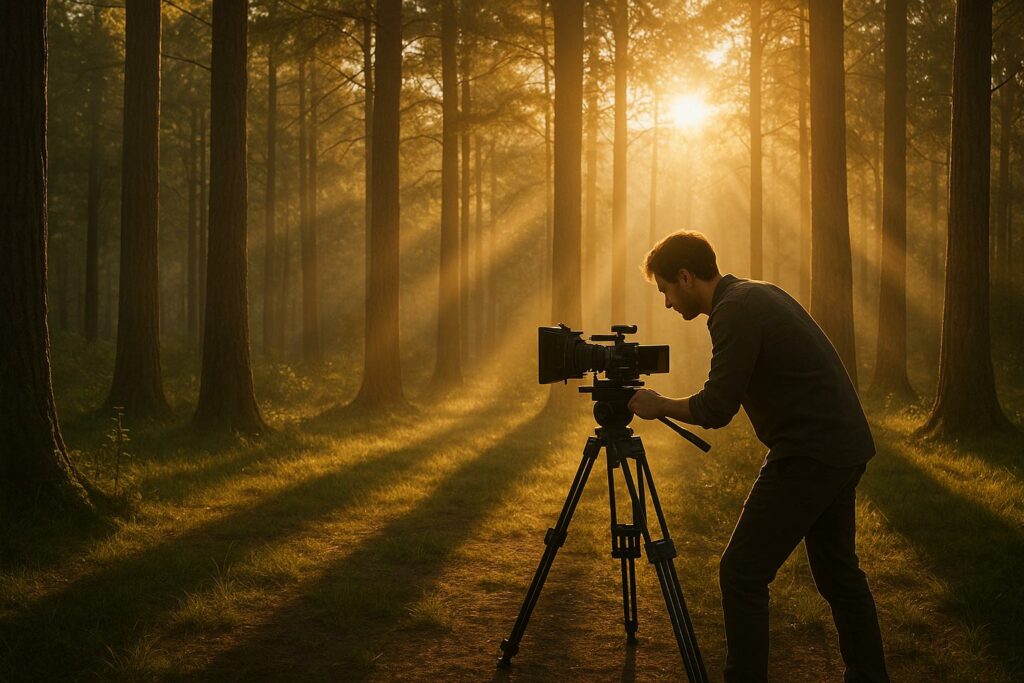
- Backlighting: Positioning the light source behind your subject creates a striking rim light or silhouette. This can evoke emotions like nostalgia or mystery. During golden hour, backlighting produces a soft halo effect, while shooting directly into the sun can add natural lens flares, boosting the scene’s atmosphere.
Your choice of lighting position should match the emotional tone of the scene. Front lighting feels neutral and safe, side lighting adds depth or tension, and backlighting creates drama and separation, making it ideal for emotional moments or cinematic reveals. Once you’ve positioned your subject, you can refine the light further using diffusion or reflection.
Using Diffusion and Reflection
Diffusion and reflection are powerful tools for controlling natural light and achieving the look you want.
- Diffusion: This softens harsh sunlight, reducing strong shadows and highlights. You can use sheer curtains, diffusion panels, large white sheets, or even natural elements like tree canopies to scatter and soften the light. For outdoor shoots, portable diffusion panels give you flexibility, while shooting under a tree canopy offers built-in, natural diffusion. Experiment with materials and distances to achieve the right softness for your scene.
- Reflection: Reflectors help fill in shadows and balance exposure by bouncing light onto your subject. Professional reflectors work great, but you can also improvise with white foam boards, walls, mirrors, or natural surfaces like sand or snow. For backlit scenes, using a white reflector to bounce sunlight onto your subject’s face can prevent underexposure and add captivating catchlights to their eyes.
Natural reflective surfaces are everywhere – light-colored walls, sidewalks, or calm water can all bounce flattering light onto your subject. The key is to position your subject and camera to make the most of these natural sources while avoiding unwanted glare or hot spots.
| Lighting Position | Visual Effect | Emotional Tone | Best Use Cases |
|---|---|---|---|
| Front Lighting | Even, minimal shadows | Neutral, approachable | Interviews, dialogue scenes |
| Side Lighting | Depth, texture, contrast | Dramatic, tense | Character studies, portraits |
| Backlighting | Rim light, separation | Nostalgic, mysterious | Emotional moments, cinematic shots |
Once you’ve shaped the light physically, fine-tuning your camera settings ensures you capture it perfectly.
Adjusting Camera Settings
To make the most of natural light, adjust your camera settings for consistent exposure.
- ISO: Keep it as low as possible to avoid noise and maintain clean images. For bright conditions, start with ISO 100 or 200 and only increase it when necessary.
- Aperture: Use a wide aperture, such as f/2.8, to create a shallow depth of field. This helps isolate your subject by blurring the background and drawing attention to key details.
- Shutter speed: Follow the 180-degree shutter rule for natural motion blur. For example, if shooting at 24fps, set your shutter speed to 1/50 second.
- ND filters: These are essential for controlling brightness in well-lit environments. ND filters reduce the light entering your lens without affecting aperture or shutter speed, allowing you to maintain creative control over depth of field and motion blur. A variable ND filter is especially useful for adapting to changing light conditions throughout the day.
Regularly monitor your exposure using tools like the histogram or zebra patterns. Natural light can change quickly – clouds may shift, or the sun’s angle might alter during golden hour. Be ready to adjust your ISO, aperture, or add ND filters on the fly to keep your exposure consistent. Keeping these controls easily accessible ensures you won’t miss critical moments.
sbb-itb-376fc17
Tools for Natural Light Cinematography
The right tools can elevate your natural light cinematography, making your work look polished and professional. The good news? Many of these tools are affordable or can be creatively improvised using everyday items.
Key Gear for Shaping Light
Reflectors
A 5-in-1 collapsible reflector ($15–$40) is a must-have for bouncing and shaping light. It offers multiple surfaces: white for a soft fill, silver for a brighter bounce, and gold for warm tones. On a tighter budget, white foam boards from a hardware store (around $5 each) are a fantastic alternative. They’re lightweight, easy to maneuver, and can be cut to custom sizes.
Diffusers
Harsh midday sun can create unflattering shadows, but a diffuser can soften the light beautifully. Professional diffusion panels range from $20–$50, but a sheer shower curtain (about $10–$15) works just as well. Simply place it between the sun and your subject to scatter the light evenly without affecting color.
Flags
Flags are perfect for blocking or controlling light. A professional flag kit costs $25–$60, but black cardboard (just $3–$5) can do the job in a pinch. Use flags to darken part of your subject or to reduce overexposure in the background.
Neutral Density (ND) Filters
Shooting in bright conditions? ND filters are essential for maintaining creative control, especially when working with wide apertures. A variable ND filter costs $30–$150, but if you’re in a bind, a pair of sunglasses can act as a quick fix.
| Tool | Price Range | Professional Option | DIY Option |
|---|---|---|---|
| Reflector | $15–$40 | 5-in-1 collapsible reflector | White foam board ($5) |
| Diffuser | $20–$50 | Translucent diffusion panel | Sheer curtain ($10–$15) |
| Flag | $25–$60 | Professional flag kit | Black cardboard ($3–$5) |
| ND Filter | $30–$150 | Variable ND filter | Sunglasses |
Once you’ve shaped the light, the next step is choosing the right lens for low-light scenarios.
Lens Recommendations for Low-Light Scenarios
When the natural light dims, a wide-aperture lens becomes your best friend. Lenses like the 50mm f/1.8, which typically cost $125–$200, allow more light to reach the sensor compared to standard kit lenses. This makes them ideal for capturing scenes in low-light conditions.
Prime lenses are especially popular for their sharpness and wide apertures. Affordable options include the Canon EF 50mm f/1.8 and the Sony FE 85mm f/1.8, both of which deliver excellent performance. For more versatility, the Sigma 35mm f/1.4 strikes a great balance between a wide aperture and a flexible focal length.
If zooming is essential, opt for lenses with a constant f/2.8 aperture. These lenses maintain consistent light-gathering ability throughout the zoom range, which is invaluable during golden hour or blue hour when lighting changes rapidly.
For budget-conscious filmmakers, vintage manual lenses can be a treasure trove. Many older lenses feature wide apertures like f/1.4 or even f/1.2 and can be adapted to modern cameras for under $100. These lenses often add a unique character and creamy bokeh to your footage.
Finally, pairing the right lens with a camera designed for natural light cinematography can take your work to the next level.
Camera Features to Consider
A camera equipped to handle natural light effectively is just as important as the tools and lenses you use. Look for these key features:
- High Dynamic Range (HDR): This helps capture details in both bright skies and deep shadows, giving you more flexibility in post-production.
- Manual Controls: Having full control over ISO, aperture, and shutter speed is essential for adapting to changing light. Cameras with dedicated dials or easy menu access make on-the-fly adjustments much smoother.
- High ISO Performance: For shooting during blue hour or in shaded areas, cameras that perform well at ISO 1600–3200 are ideal. Some professional models can push even higher while keeping noise levels low.
- Color Science and White Balance: Cameras with strong color rendering and customizable white balance help you manage the shifting color temperatures of natural light throughout the day.
- Exposure Tools: Features like zebra patterns and histogram displays provide real-time feedback, ensuring accurate exposure of highlights and shadows.
- In-Body Image Stabilization (IBIS): For handheld shooting in low light, IBIS allows you to use slower shutter speeds without worrying about camera shake, effectively letting in more light.
With the right combination of tools, lenses, and camera features, you can create stunning visuals using nothing but natural light.
Troubleshooting and Post-Production Tips
Even seasoned filmmakers encounter challenges when working with natural light, making on-set adjustments and post-production refinements essential for achieving the desired results.
Common Lighting Issues and Solutions
Shooting outdoors often leads to overexposure, especially under bright sunlight. This can result in blown-out highlights and unusable footage. To counter this, use ND filters, lower your ISO, or close down your aperture. If possible, move your subject into open shade to reduce the intensity of direct sunlight.
Harsh shadows are another common issue, creating unflattering contrast. While professional diffusers are ideal, a sheer curtain can work in a pinch. You can also bounce light into shadowy areas using a white foam board or a nearby reflective surface, like a white wall, to create a more balanced look.
Cloudy skies bring their own complications, as shifting cloud cover can constantly alter your exposure. Keep an eye on your settings and make adjustments as needed. Weather apps with real-time updates can help you plan your shoot around stable lighting conditions. These small, on-set fixes pave the way for smoother color grading during post-production.
Color Grading for Natural Light Footage
Once you’ve addressed lighting issues during the shoot, post-production becomes the next critical step to ensure consistency. Natural light shifts in color temperature throughout the day, which can make it tricky to maintain a uniform look across your footage. For instance, golden hour shots tend to be warm and inviting, while overcast conditions often result in cooler, blue-tinted visuals.
Start by neutralizing any extreme color casts using the white balance tools in your editing software. Programs like DaVinci Resolve offer color wheels that allow you to fine-tune shadows, midtones, and highlights. For golden hour footage, aim to retain its natural warmth without oversaturating skin tones. On the other hand, overcast footage may benefit from a slight touch of warmth to counteract its inherent cool tones.
LUTs (Look-Up Tables) designed for daylight settings can serve as a helpful starting point. Many filmmakers create custom LUTs tailored to specific times of day, but these should always be adjusted to suit the unique characteristics of your footage. For example, you might use masking techniques to warm up skin tones while maintaining cooler backgrounds, ensuring a cohesive and emotionally consistent look.
For projects like documentaries, where authenticity is key, subtle adjustments often work best. While dramatic color grading can elevate narrative films, natural light footage usually shines brightest when its original qualities are preserved and gently enhanced.
Comparing Different Times of Day
Understanding how light changes throughout the day can help you plan your shoots more effectively and anticipate post-production needs. Here’s a quick breakdown of what to expect:
| Time of Day | Post-Production Requirements | Common Corrections Needed |
|---|---|---|
| Golden Hour | Minimal adjustments | Recover highlights in bright skies occasionally |
| Midday | Extensive corrections | Soften harsh shadows, reduce contrast, fix blue tones |
| Overcast | Moderate tweaks | Add contrast and warmth to avoid a flat look |
Golden hour provides naturally flattering light, requiring only minor corrections, such as recovering highlight details in bright skies. Its warm, soft glow is ideal for creating visually appealing shots.
Midday light, while plentiful, often demands the most work in post-production. Harsh shadows and high contrast may need softening, and blue tones caused by clear skies often require correction. While this light is clean and noise-free, achieving a polished final look can take extra effort.
Overcast conditions, with their soft and even light, are forgiving but can sometimes appear flat on camera. Adding subtle contrast and warmth during editing can bring depth and vibrancy to your footage while preserving its gentle, natural quality.
For further learning, resources like Indie Shorts Mag provide tutorials and case studies that explore these techniques in depth, offering valuable insights for filmmakers at any skill level.
Mastering natural light cinematography is all about preparation, flexibility, and enhancing the light’s natural beauty. With time and practice, you’ll develop the skills to read light conditions intuitively and refine your footage to align perfectly with your story’s vision.
Conclusion
Natural light cinematography offers a budget-friendly way to tell stories with a genuine, heartfelt touch. As we’ve explored in this guide, working with natural light takes awareness, preparation, and plenty of hands-on practice.
The advantages are undeniable: natural light adds flexibility, a sense of realism, and emotional depth to your scenes – all without the need for costly gear. Whether you’re shooting during the golden hour, under an overcast sky, or in any lighting condition in between, each moment presents its own creative possibilities.
Leaning into the unpredictable nature of natural light challenges you to stay attentive and adaptable. This often results in capturing moments that feel more genuine and impactful than those created in tightly controlled, artificial environments.
Natural light also forges a stronger connection between your subjects and their surroundings, amplifying the emotional resonance of your story. This is particularly powerful in documentaries and indie films, where authenticity is key. As seen in the work of filmmakers celebrated by Indie Shorts Mag, this raw, unfiltered quality can deeply engage audiences and inspire continued creative growth.
Now, it’s time to put these ideas into action. Practice shooting at different times of the day, experiment with various techniques, and review your footage to see how light shapes your story. Whether you’re battling the harsh midday sun or basking in the soft glow of an overcast day, every experience adds to your understanding.
Mastering natural light is an ongoing journey, one that rewards patience and curiosity. So, take what you’ve learned here, step outside, and let nature’s ever-changing light elevate your storytelling to new heights.
FAQs
What are the best strategies for planning a film shoot when natural light is unpredictable?
When working with unpredictable natural light, being prepared can make all the difference. Start by visiting your location at various times of the day to observe how the light shifts and interacts with the environment. While weather apps can give you a sense of what to expect, always have a backup plan ready in case conditions take an unexpected turn.
Pack essential gear like reflectors, diffusers, and bounce boards to help you manage and shape the light you have. Whenever possible, plan key shots during the golden hour – shortly after sunrise or just before sunset – when the light is soft and naturally flattering. And don’t forget, post-production tools can be invaluable for smoothing out lighting inconsistencies and creating a polished, unified look for your project.
What are some budget-friendly ways to control and shape natural light when filming?
Controlling and shaping natural light doesn’t have to cost a fortune. Simple tools like reflectors – even homemade ones such as white foam boards or aluminum foil – can work wonders to bounce light onto your subject. Want to soften harsh sunlight? Try using diffusion materials like shower curtains or translucent fabric. To block or shape light, budget-friendly options like blackout cloth, cardboard, or inexpensive flags can do the trick.
Where you position your subject also plays a big role. Use nearby walls, windows, or even natural elements like trees to adjust the light’s direction and intensity. And don’t underestimate the power of timing – shooting during the golden hours (early morning or late afternoon) naturally provides softer, more flattering light.
How can I set my camera to keep exposure consistent when filming with natural light?
To keep your exposure consistent when working with natural light, start by switching to your camera’s manual mode. This lets you set and lock crucial settings like shutter speed, aperture, and ISO, ensuring the camera doesn’t make automatic adjustments that could lead to uneven results.
Natural light shifts throughout the day, so tools like a light meter or your camera’s histogram can be invaluable for keeping an eye on exposure levels. If you’re dealing with fluctuating brightness, neutral density (ND) filters are a great way to manage light intensity without changing your core settings.
Lastly, make it a habit to review your footage regularly during the shoot. This is especially important when clouds roll in or sunlight shifts, as these changes can subtly but significantly impact your scene.
Related Blog Posts

About the Author

Related Posts
No comments yet.
Got Something to add to this article?
Your email address will not be published. Required fields are marked *